
A logistics firm with 60 sites on private carrier links needs isolated routing for voice, inventory, and guest, wants the carrier to manage VPN membership and QoS, and lacks staff to run overlay tunnels. Which enterprise VPN design best matches private transport and outsourcing?
Select an answer to reveal the explanation.
Short Explanation
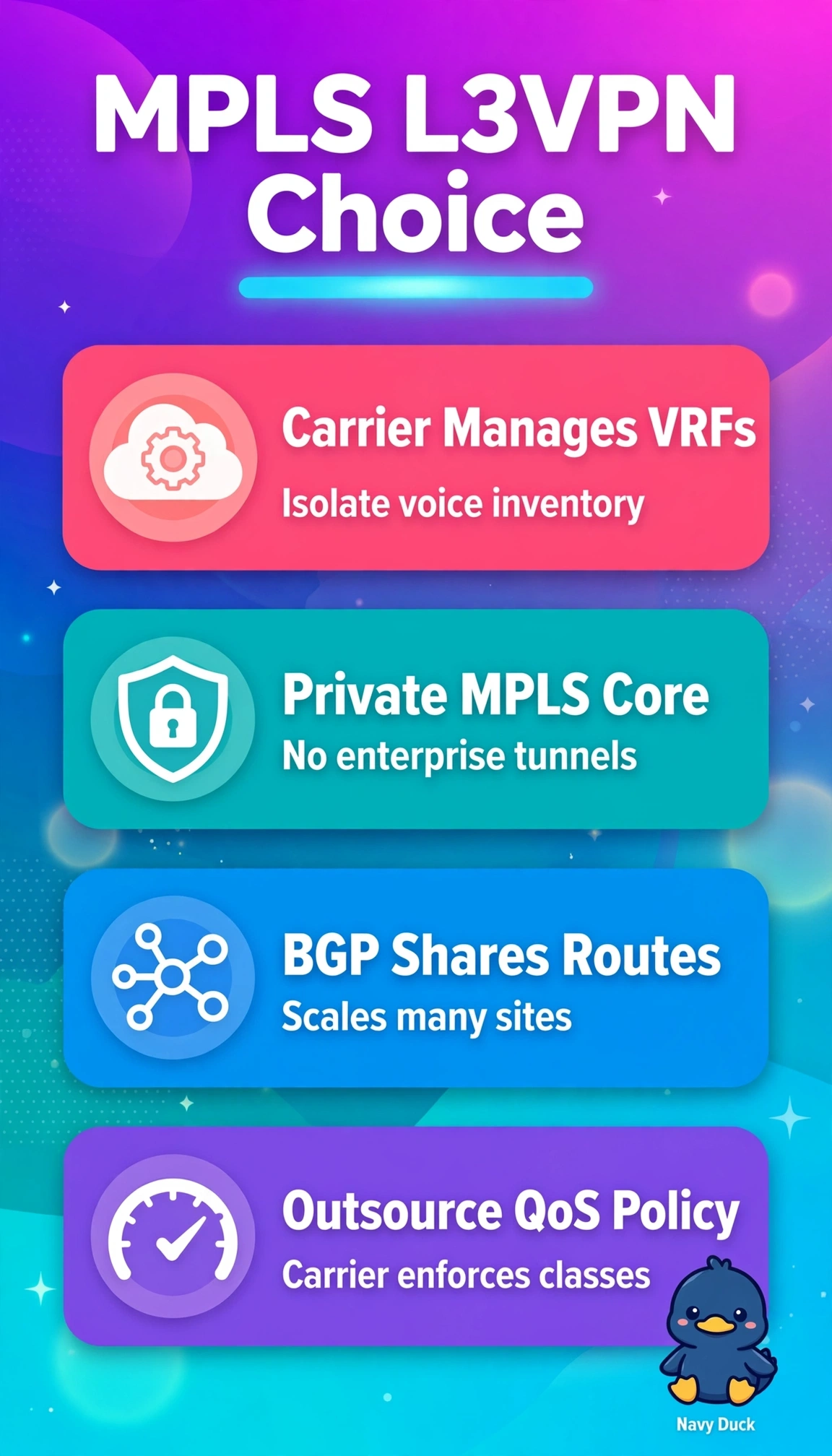
Sometimes you'd rather rent the plumbing than fix pipes yourself. MPLS L3VPN lets the carrier juggle VRFs and QoS on private links while you just hand off routes.
Full Explanation
MPLS Layer 3 VPN keeps customer routes in provider-maintained Virtual Routing and Forwarding instances and distributes them with multiprotocol BGP across private provider transport, delivering Layer 3 isolation and traffic separation with carrier-managed membership, QoS, and scalability and no enterprise tunnel overlay to operate. DMVPN overlay fails by concept because although it provides dynamic enterprise-controlled tunnels, it requires the enterprise to manage tunnel endpoints, NHRP, routing, and IPsec rather than outsourcing VPN membership. SD-WAN overlay fails by concept because it is enterprise-managed with centralized control and IPsec overlays typically over Internet, which contradicts private transport and carrier-managed requirements. Pseudowire emulation fails by concept because it delivers point-to-point Layer 2 transport rather than Layer 3 VPN routing separation for multiple VRFs. For the exam, tie MPLS L3VPN to provider-managed VRF isolation versus overlay VPN to enterprise-managed tunnels; in practice confirm VRF route targets, PE-CE peering, and QoS classes with the carrier.