
A cloud provider with 800 routers needs second-level interface counters and BGP state streaming without overloading managers during peak congestion events. Which telemetry design leverages model-driven telemetry subscriptions and collectors versus SNMP polling for this provider?
Select an answer to reveal the explanation.
Short Explanation
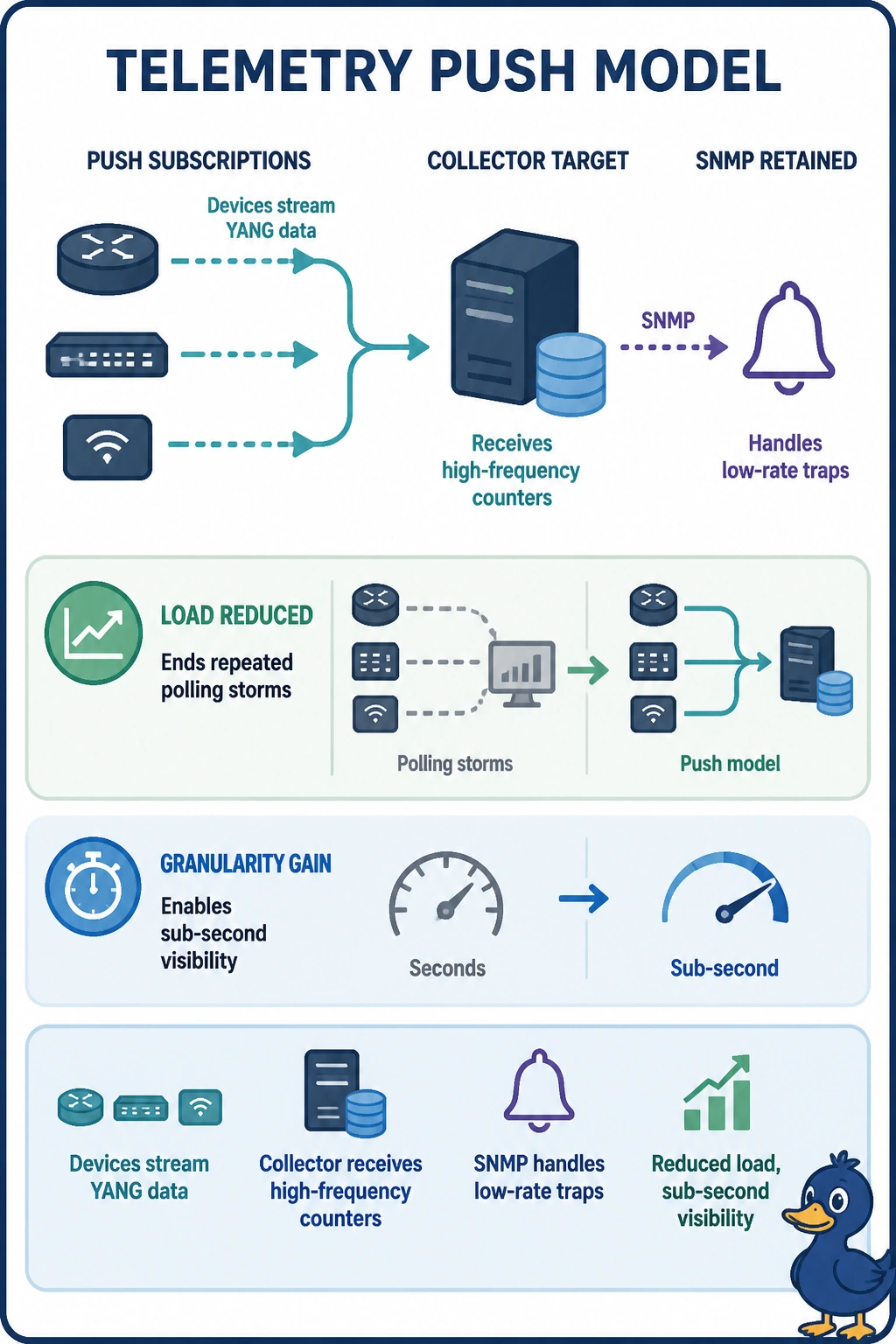
You're swapping constant check-ins for live updates that push when it matters. Push streaming delivers fresher data with less chatter, like live scores instead of refreshing a page.
Full Explanation
The correct design succeeds because model-driven telemetry pushes YANG-structured dial-out streams to horizontally scalable collectors at second-level cadence, which decouples high-volume interface counters and continuous BGP state from request-response polling and preserves manager capacity during congestion while retaining SNMP only for infrequent fault traps where it remains efficient. The optimized SNMPv3 polling design fails on cadence and scaling because even well-tuned 30-second MIB polling cannot deliver second-level granularity for bursty interfaces and it reimposes manager-driven request load across 800 routers exactly when control plane and links are most stressed. The streaming-to-managers design fails on architecture because directing high-frequency streams into traditional managers rather than dedicated collectors retains the centralized bottleneck the scenario requires avoiding, since collectors provide buffering, filtering, and fan-out designed for sustained streams. The on-change with polled counters design fails on subscription type because on-change suits BGP adjacency transitions but polled periodic counters cannot reconstruct microbursts or sub-second rates, so interface visibility remains inadequate despite correct collector placement. As an exam caveat, distinguish push-based streaming subscriptions (dial-out from the router, or dial-in such as gNMI where the collector opens the session) from request-response SNMP polling, and collector buffering from manager correlation, as stems often test cadence and receiver role together. As a practical check, validate supported YANG models, protocol, cadence, and collector capacity in the lab and confirm during induced congestion that granularity persists while manager load stays flat.