
A retailer connects three regional campuses to a core over Layer 3, sees full /24 churn from stores leaking everywhere, and needs smaller tables plus loop-free regional isolation. Which route summarization and filtering design at campus boundaries best stabilizes the core?
Select an answer to reveal the explanation.
Short Explanation
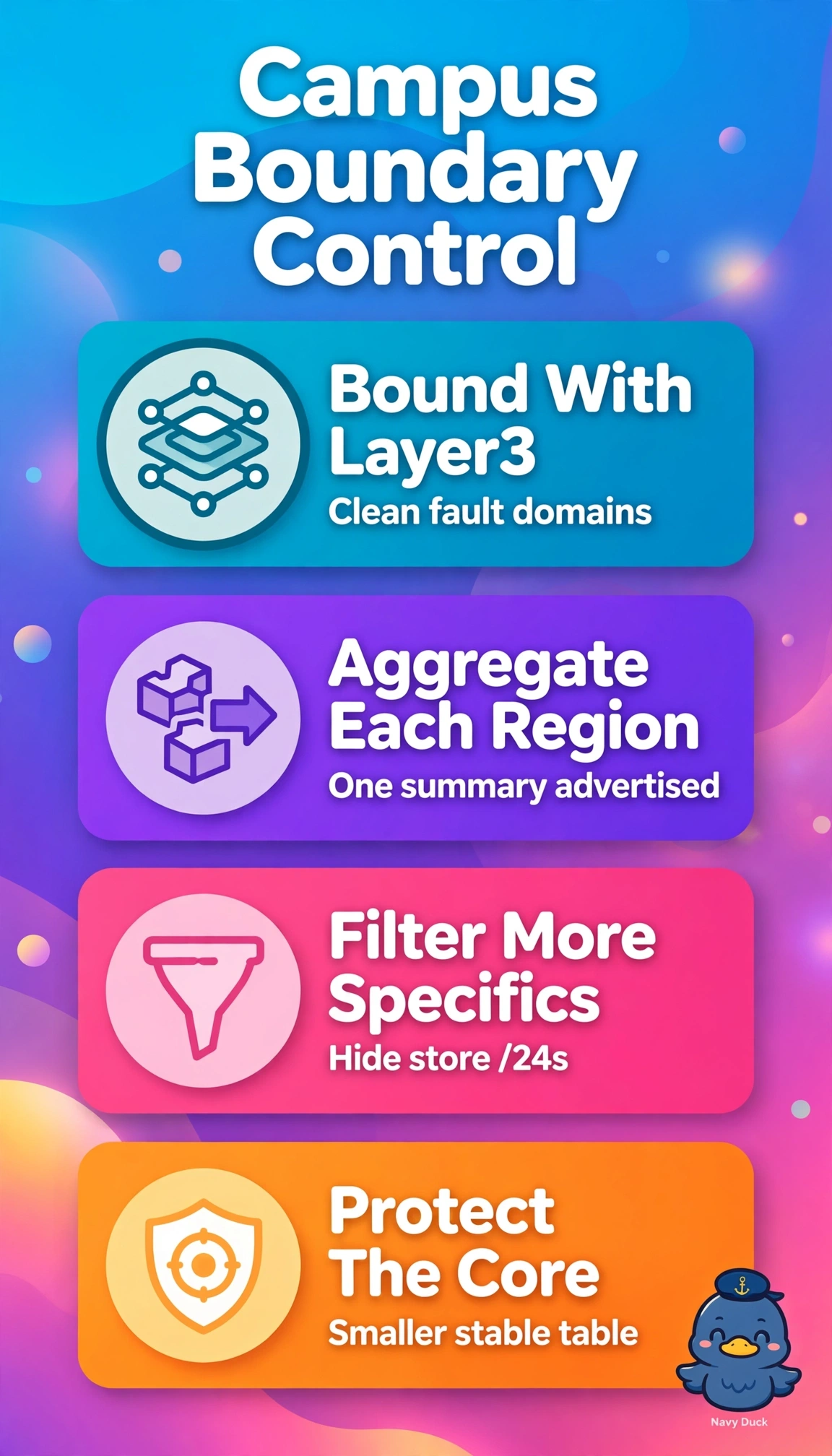
You want regions to whisper summaries, not shout every store prefix. Boundary aggregation bundles /24s into one ad and filters the noise, so the core stays lean and calm.
Full Explanation
Placing manual aggregation and prefix filtering on Layer 3 campus boundaries lets each region advertise only its summary aggregate while suppressing longer-match store specifics, which minimizes core routing table size, dampens flap propagation, and enforces clean fault domains with backdoor and loop checks. Redistributing all /24s into the core fails by concept because it maximizes state and churn and filtering defaults toward regions breaks regional reachability policy. Extending Layer 2 VLANs and summarizing spanning-tree priorities fails by concept because VLAN extension stretches failure domains and spanning-tree tuning does not aggregate IP prefixes or isolate routing. Summarizing only toward regions while allowing all specifics toward the core fails by concept because it protects regions but leaves the core exposed to the exact instability stated. For the exam, associate campus stability with Layer 3 boundaries plus summarize-and-filter outbound; in practice verify aggregate coverage, discard routes, and prefix-list discipline on both sides.