
A NetOps team reads a YANG module advertising interface config with containers, lists, leafs, and a namespace showing a vendor-specific path for a new Cisco feature. They must automate consistently across Cisco and Juniper. Which YANG-based data model interpretation should guide their design choice?
Select an answer to reveal the explanation.
Short Explanation
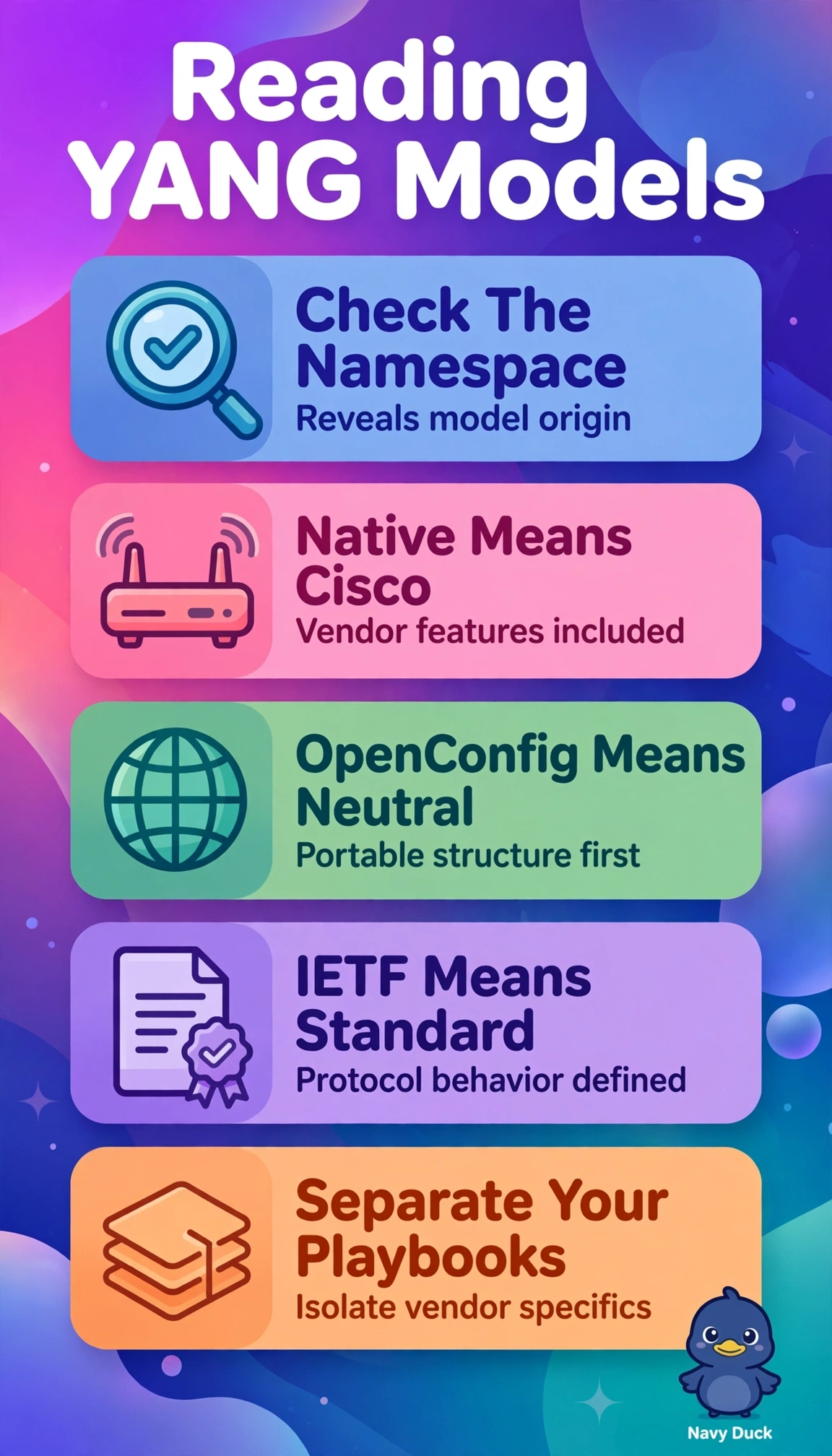
Namespaces are like accents telling you where a model belongs. A native model nails vendor extras but won't translate, so you lean on OpenConfig or IETF when you need cross-vendor calm.
Full Explanation
The vendor-specific namespace identifies the module as a Cisco native model that precisely describes the new feature with its containers, lists, and leafs, so it should be scoped to Cisco while portable interface automation is built on OpenConfig or IETF models that both Cisco and Juniper support through their own mappings, preserving full function without sacrificing consistency. Standardizing solely on OpenConfig and postponing the new feature fails on completeness because it achieves uniformity by deferring a stated business need that currently exists only in native form. Mirroring the Cisco hierarchy to Juniper through translation fails on capability parity because automation cannot create operating-system support where none exists, and identical YANG shapes do not guarantee identical behavior across implementations. Assuming IETF baselines will transport Cisco extensions fails on schema authority because vendor-specific nodes fall outside the standard and will be rejected or ignored by Juniper without a native equivalent or explicit handling. For exam purposes, remember that containers, lists, and leafs describe YANG syntax only, while namespace and model provenance determine whether reuse across vendors is valid. In practice, inspect the namespace with pyang, compare native leaves against OpenConfig and IETF coverage, and validate the portable payload on both Cisco and Juniper lab devices to confirm which leaves require native augmentation.