
A regional retail chain connects 45 stores with Cisco SD-WAN over broadband and LTE using centralized control and IPsec overlay tunnels. Stores need prioritized voice for POS support, fair sharing for inventory and guest Wi-Fi, and weekly training video that headquarters sources as IP multicast. Underlay loss and latency vary by site. Which SD-WAN QoS and multicast design consideration best fits this fabric?
Select an answer to reveal the explanation.
Short Explanation
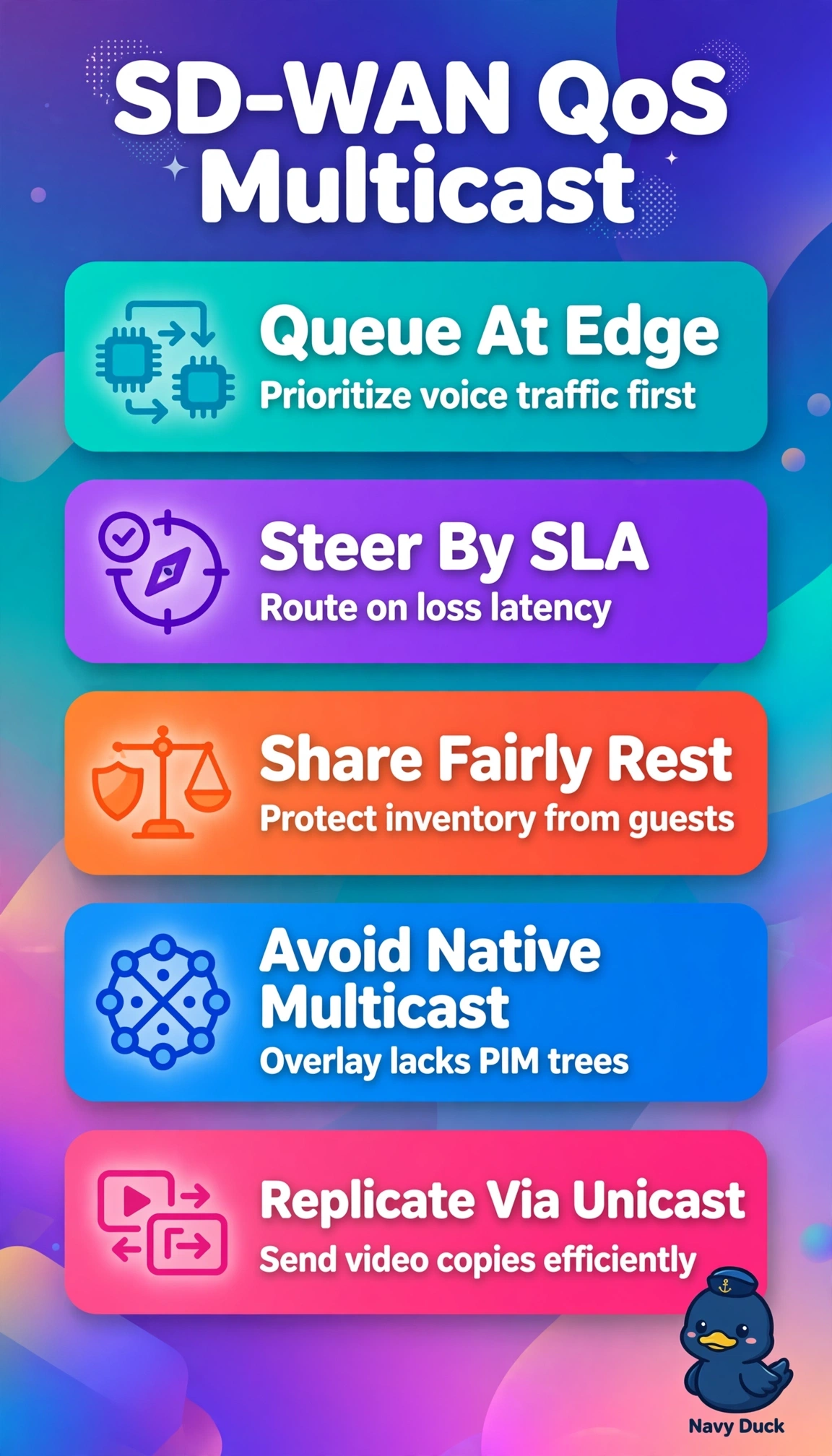
You protect voice on variable links by queuing at each store and steering traffic based on current path conditions. Pairing edge priority queuing with application-aware routing helps voice, while unicast replication delivers the training video without relying on native multicast across the overlay.
Full Explanation
The design fits centralized SD-WAN control with distributed enforcement: broadband and LTE conditions vary by site, so QoS must be applied at each branch egress where congestion occurs. Strict priority queuing protects POS voice from jitter and loss, while application-aware routing uses live probe measurements to steer voice onto the best-performing path. Inventory and guest Wi-Fi can share remaining bandwidth without starving one another, and headquarters training video should use unicast replication because encrypted IPsec tunnels do not carry native PIM multicast state across this SD-WAN fabric. Native PIM multicast across the overlay fails because it assumes multicast transport that the unicast overlay does not provide. Centralized headquarters QoS with priority queuing and application-aware routing, paired with unicast video, fails because headquarters cannot shape per-site uplink congestion that only the local edge observes. Localized edge QoS and unicast replication with weighted fair sharing for voice, inventory, and guest Wi-Fi fails because delay-sensitive voice needs strict priority rather than equal fairness. Exam caveat: centralized SD-WAN control does not mean centralized QoS enforcement, and overlay tunnels should not be assumed to forward native multicast like a private MPLS core. Practical check: validate branch egress policy maps, application SLA forwarding decisions, replication load, and voice jitter and loss counters during a pilot video event across broadband and LTE stores.