
A regional retailer received 10.20.16.0/22 and must address 12 WAN point-to-point links plus four stores each needing a 120-host server VLAN while preserving space for growth. Which VLSM allocation prevents address waste on point-to-point and server links for this IPv4 plan?
Select an answer to reveal the explanation.
Short Explanation
You're slicing a small block without crumbs left over. Right-sizing masks matches each link to its hosts, much like cutting fabric to pattern instead of one-size squares.
Full Explanation
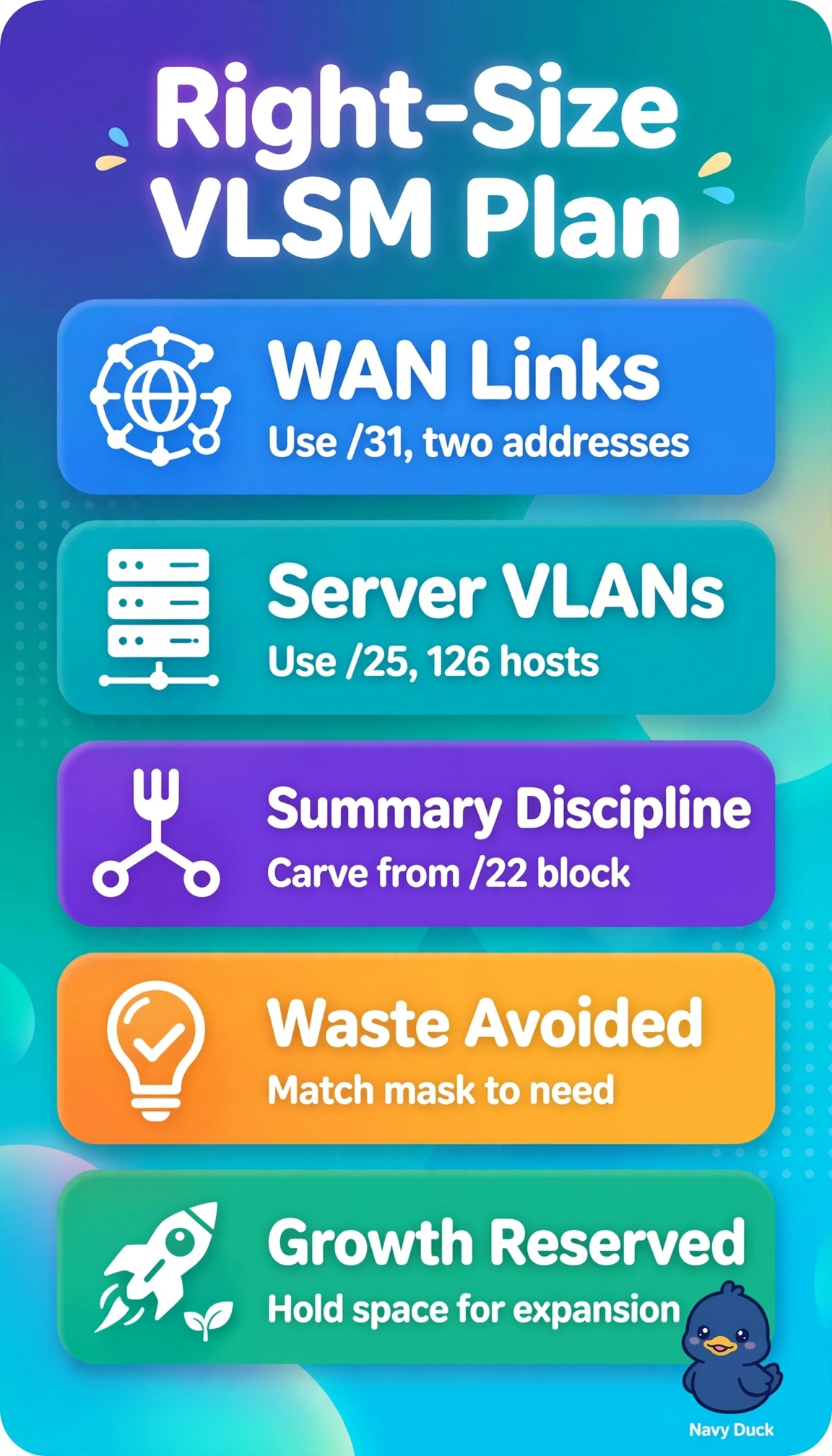
VLSM matches prefix length to host count so a /22 can serve mixed link types without waste, where point-to-point links need only two addresses and 120-host VLANs need at least 126 usable hosts. Assigning /31 subnets standardized for point-to-point links and /25 blocks providing 126 usable hosts for server VLANs minimizes waste while leaving room for growth within the summary. Assigning /30 and /24 blocks fails because four /24 server VLANs already consume the entire /22, leaving no space for the 12 WAN links, and each /24 wastes over 130 addresses. Assigning /29 and /23 blocks fails even more clearly because four /23 blocks need twice the whole /22 and oversize each VLAN to 510 hosts. Assigning /27 blocks to point-to-point links wastes 30 addresses per link and demonstrates nibble alignment at the expense of conservation. Exam caveat is that /31 links lack network and broadcast addresses and require supporting implementations. Practical check is to calculate usable hosts and reserve one growth block per store before carving subnets.