
A large university runs IPv4 everywhere with modern switches, routers and Windows clients and wants to add IPv6 for research labs without tunneling or translation. The team can upgrade routing, DHCP, DNS and monitoring, but worries about doubling troubleshooting and security workload. Which native dual-stack design addresses its operational considerations?
Select an answer to reveal the explanation.
Short Explanation
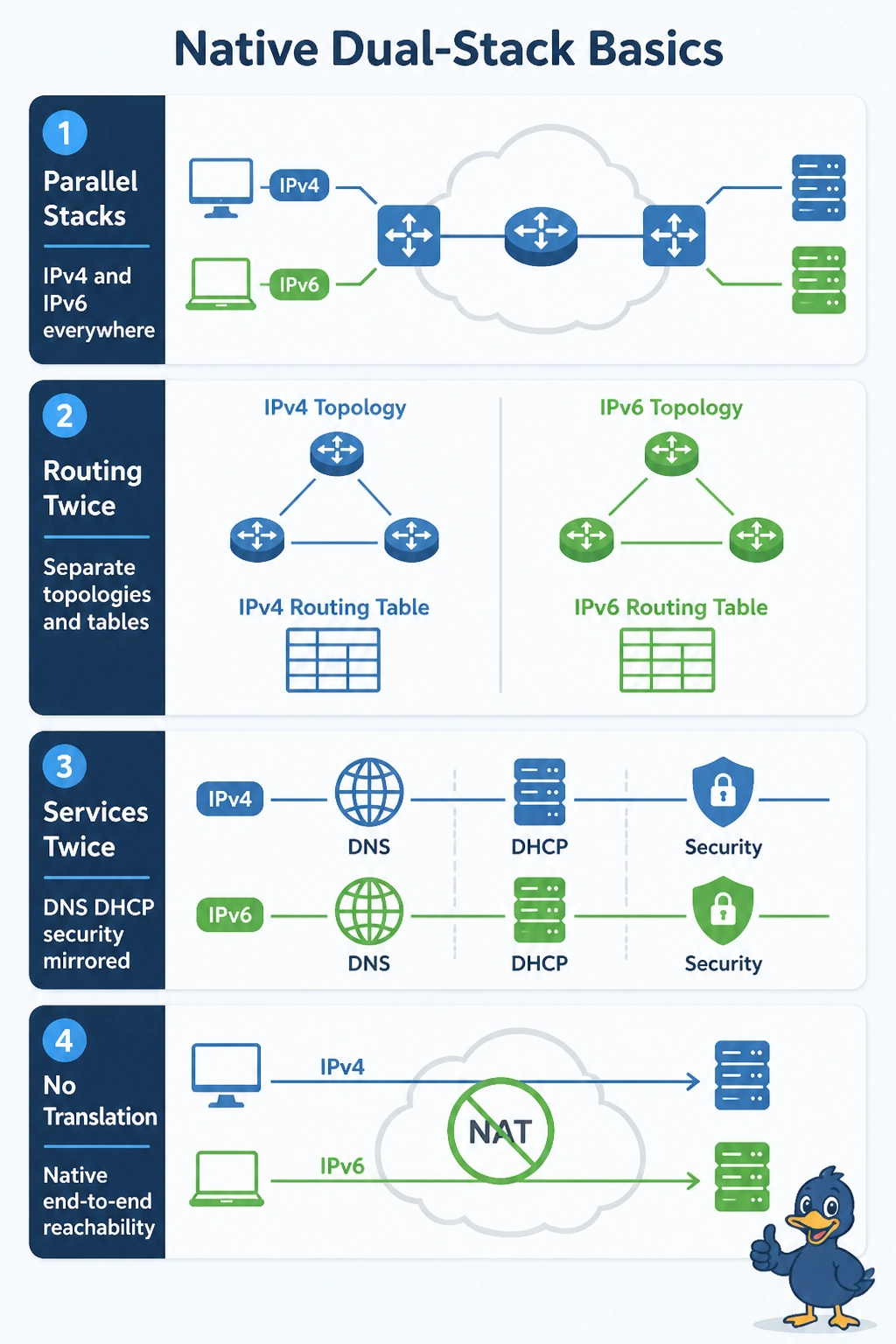
You’re running IPv4 and IPv6 side by side, without an interpreter between them. Dual-stack means both protocols work end to end, with parallel routing, security policies and monitoring for you to manage.
Full Explanation
Native dual-stack runs IPv4 and IPv6 as independent, parallel stacks on lab clients, access networks, core routing and servers. That meets the requirement for end-to-end IPv6 without tunneling or translation, but it means you must upgrade routing, DHCP, DNS and monitoring and manage parallel addressing, troubleshooting and security policies. A single IPv4-based security policy cannot simply protect both protocols: IPv6 has distinct headers and extension headers, uses ICMPv6 for functions such as neighbor discovery, and has different autoconfiguration behavior, so it requires appropriate IPv6 filtering and inspection. Using SLAAC while deferring DHCPv6, DNS and global routing upgrades leaves the labs without the complete services needed for dependable global reachability and name resolution; link-local connectivity alone is not enough. Enabling IPv6 on core routers and research servers while keeping lab clients and access networks IPv4-only is not end-to-end dual-stack, because the clients cannot use IPv6. An exam caveat is that native dual-stack avoids encapsulation and translation, not the operational work of securing and monitoring two protocols. As a practical check, verify that a lab PC has IPv4 and global IPv6 addresses, both routing tables work, DNS resolves A and AAAA records, and monitoring and firewall counters cover both protocols.