
An enterprise runs IPv4 internally, is adding IPv6 for new buildings, and connects to a provider MPLS VPN that carries customer routes as VPNv4. Route policies must stay separate per protocol. Which BGP address-family design best supports this IPv4, IPv6, and VPN requirement?
Select an answer to reveal the explanation.
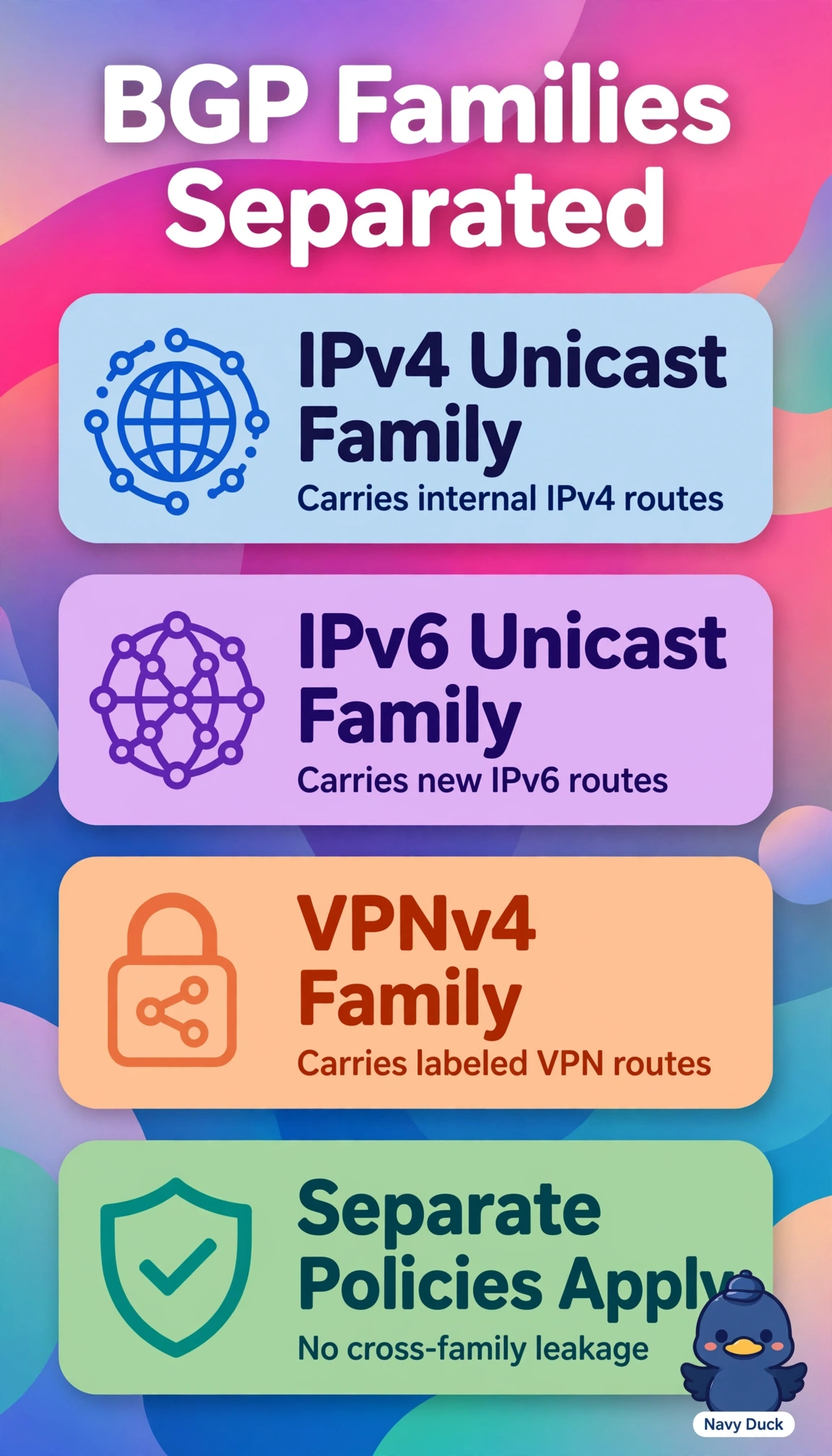
Short Explanation
You need labeled drawers, not one junk drawer for everything. MP-BGP keeps IPv4, IPv6, and VPNv4 NLRI isolated so each policy applies cleanly.
Full Explanation
The correct design is right because MP-BGP separates NLRI by address family over shared sessions, so IPv4 unicast supports the existing core, IPv6 unicast gives native reachability and scalable control for new buildings, and VPNv4 preserves the provider MPLS labels and RD and RT semantics already in use, while separate policies per family allow distinct filtering, aggregation and preference without cross-protocol impact. The unified-policy design fails on isolation because one converged route-map cannot express different prefix-lists, communities, local-preference and RT handling for IPv4, IPv6 and VPNv4, so a change for one protocol risks leaking into or destabilizing customer VPN routes and complicates auditing. The VPNv6-based design fails on completeness because the stem says the provider carries customer routes as VPNv4, and dropping the VPNv4 family removes the existing IPv4 VPN routes; VPNv6 (6VPE) is a separate family for IPv6 VPN routes and would be added alongside VPNv4, not substitute for it. The OSPFv3-only design for IPv6 fails on boundary and scale because OSPFv3 is excellent within a building but lacks inter-domain policy, path selection and VPN interaction, forcing redistribution that loses BGP attributes and hinders consistent end-to-end control. Exam caveat is to follow the stated provider VPN type and per-protocol separation rather than choosing the newest technology, since the VPN family in use (VPNv4) must stay enabled, and IPv6 VPN routes would use the separate VPNv6 family. Practical check is to verify distinct address-family ipv4, address-family ipv6 and address-family vpnv4 sections each with its own neighbor activate and route-map, plus show bgp vpnv4 unicast and show bgp ipv6 unicast both populated.