
A financial campus uses PIM sparse mode for market data, but engineers see duplicate packets and intermittent loops after a unicast routing change altered path costs. Multicast now arrives on an unexpected router interface. Which RPF check behavior should the designer verify to restore loop-free forwarding?
Select an answer to reveal the explanation.
Short Explanation
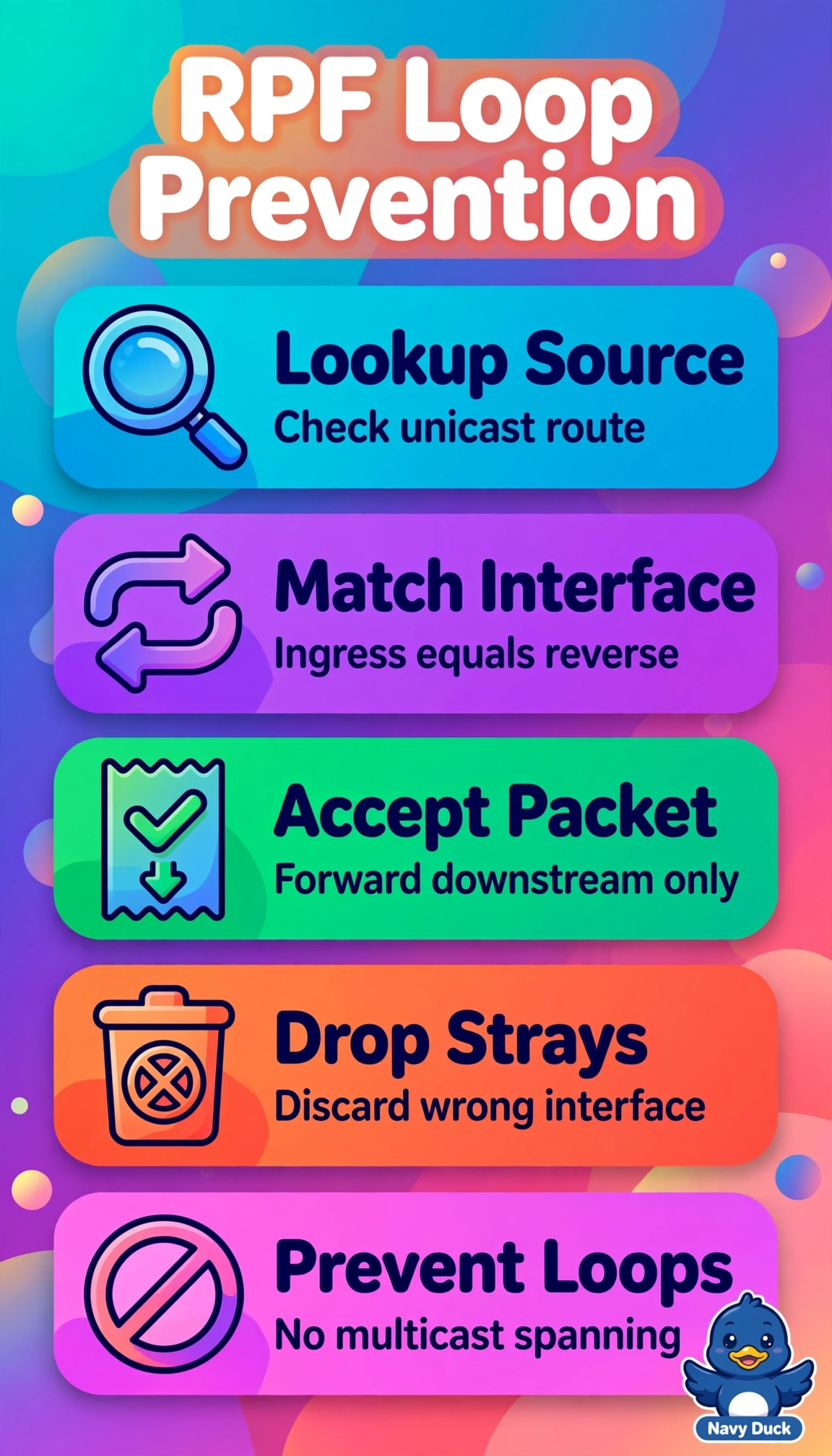
You're seeing copies looping after routing shifted, so check your compass. Enforcing the reverse-path check drops strays that didn't arrive by the best way home, like refusing mail delivered from the wrong post office.
Full Explanation
Reverse-path forwarding prevents multicast loops without a spanning tree by consulting the unicast table for the source or RP, accepting multicast only on the interface that is the best reverse path toward that address and discarding packets arriving elsewhere, which automatically adapts when unicast costs change. Flooding out all interfaces except one based on group address ignores reverse-path logic and would replicate loops, forwarding purely on multicast destination lookup describes dense replication without loop prevention, and TTL comparison against RP path cost confuses looped-packet expiry with interface validation. For the exam, link RPF failure after unicast changes to stale or asymmetric routes and verify with unicast route to source, and in practice check that the incoming interface equals the unicast outgoing interface toward the source, investigate asymmetric routing, and ensure PIM neighbors are established on the expected RPF interface.