
A regional healthcare system runs dual-stack IPv6 in its two data centers but leases an IPv4-only private WAN that the carrier will not upgrade this year. Radiology imaging must flow over IPv6 between the data centers with fixed endpoints, predictable routing, and simple packet captures for compliance audits. Which overlay tunneling approach for IPv6 across IPv4 infrastructure best meets these needs?
Select an answer to reveal the explanation.
Short Explanation
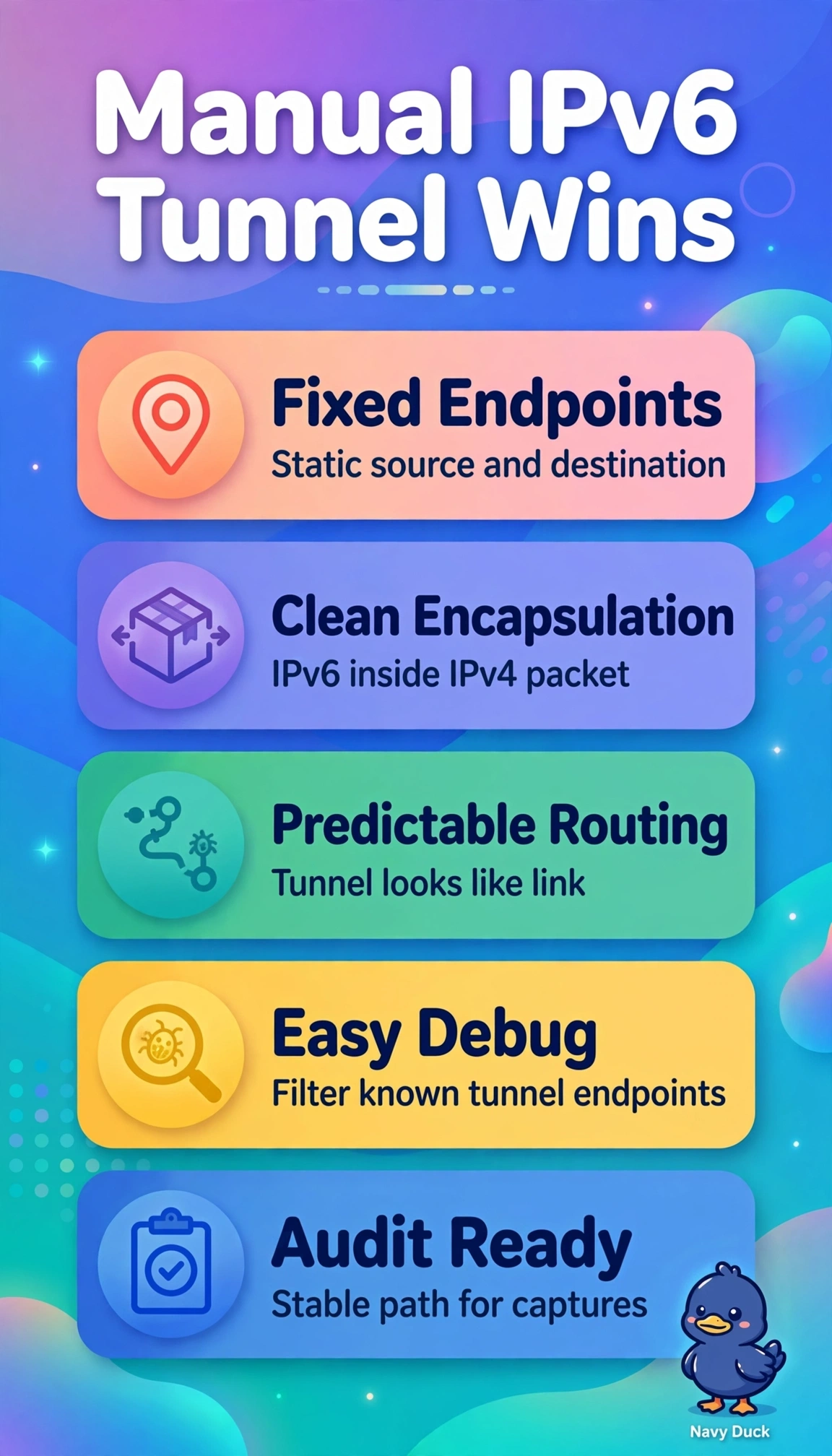
You've got fixed sites and auditors watching, so you'll love boring predictability here. Manually set tunnels nail up the same endpoints every time for clean captures and routing. That's determinism winning over magic automation, like reserving a private lane instead of hitchhiking.
Full Explanation
Manually configured IPv6-in-IPv4 tunnels encapsulate IPv6 packets inside IPv4 with explicitly defined source and destination addresses on the data center edge routers, which creates a stable point-to-point logical link that appears as a directly connected IPv6 interface for routing, policy, and monitoring. That determinism directly satisfies the need for fixed endpoints, predictable routing, and simple packet captures because troubleshooters know exactly where encapsulation occurs and can filter on known tunnel endpoints. Automatic 6to4 tunneling fails by concept because it derives dynamic endpoints from embedded IPv4 addresses and typically relies on relays, which introduces unpredictability and operational complexity unsuitable for audited enterprise site-to-site traffic. ISATAP fails by concept because it is designed as an intra-site host-to-router mechanism for dual-stack hosts inside an IPv4 campus, not as a controlled edge-to-edge WAN overlay between data centers. NAT64 fails by concept because it is translation rather than tunneling, breaking end-to-end IPv6 transparency needed for consistent addressing and compliance visibility. For the exam, remember to match automatic tunnels to transient or Internet use and manual tunnels to stable enterprise overlays, and in practice verify tunnel source and destination reachability over IPv4 plus IPv6 routing and MTU before turning up imaging flows.