
A regional enterprise has two eBGP links from one border router to the same neighbor AS, one 1 Gbps and one 10 Gbps, and wants both links to carry traffic proportionally without manual route tuning. CPU and memory headroom is sufficient for extra paths. Which BGP load-sharing design should the designer select to achieve proportional use of these links?
Select an answer to reveal the explanation.
Short Explanation
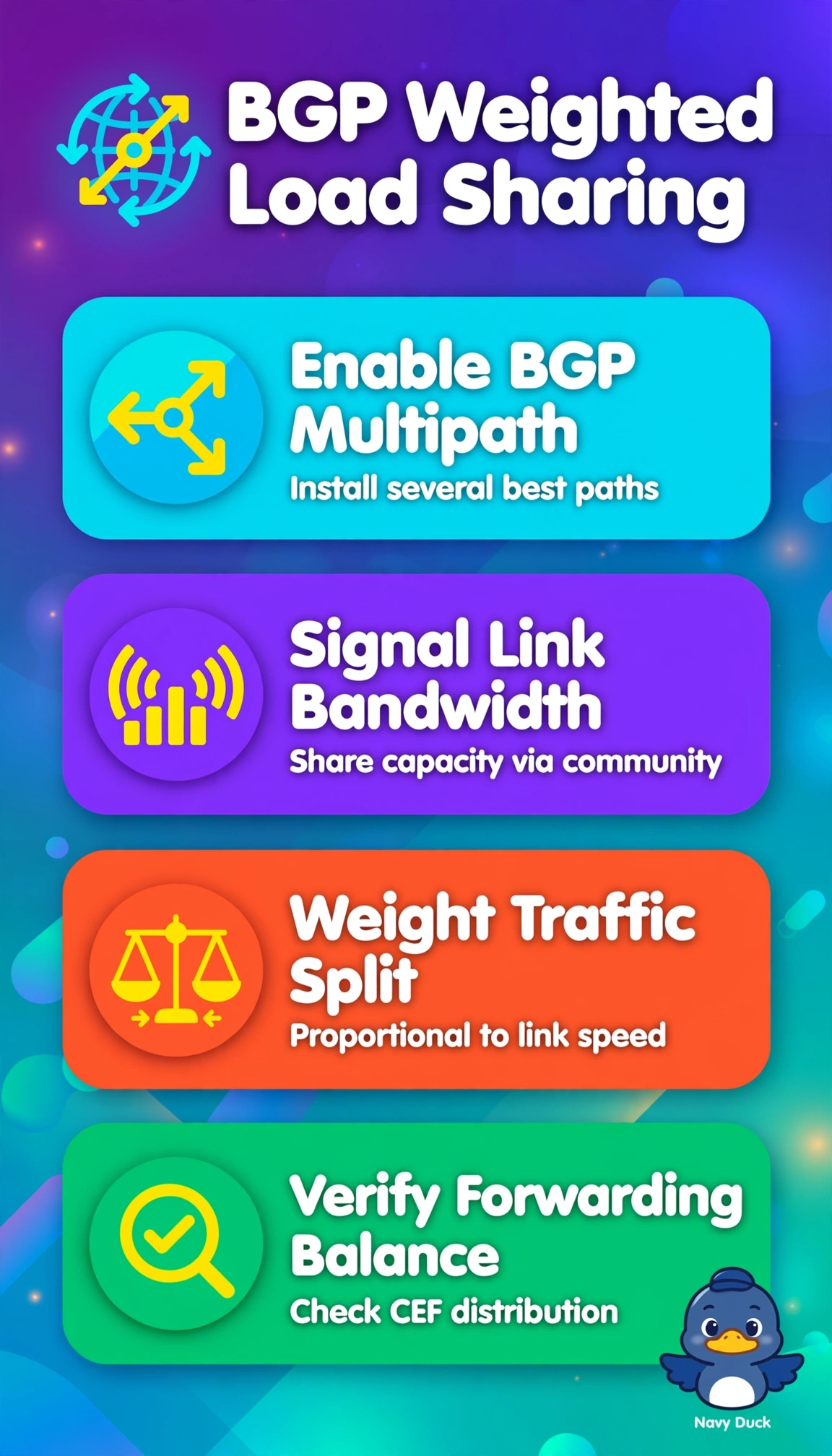
Equal splitting would flood your small pipe fast. DMZ link bandwidth tells BGP each link's muscle so traffic spreads in fair proportion.
Full Explanation
The correct design is right because on a single border router with two eBGP sessions to the same neighboring autonomous system BGP normally selects one best path, while multipath allows both external paths to be installed for concurrent forwarding and DMZ link-bandwidth supplies locally configured interface bandwidth to the BGP decision so forwarding is weighted proportionally to 1 Gbps versus 10 Gbps without per-prefix manual policy, meeting automatic proportional use using available CPU and memory for extra paths. Plain multipath for equal-cost sharing fails by uniformity because without bandwidth awareness it hashes flows evenly rather than 1-to-10, congesting the small link while underutilizing the large link despite adding resiliency and capacity. Local Preference steering by application priority fails by manual effort because it needs continuous classification and policy maintenance to approximate balance and cannot dynamically enforce capacity-proportional sharing. Neighbor-sent Link Bandwidth communities for weighted selection fails by external dependence because it requires the peer to attach accurate extended communities with correct propagation, while the scenario demands locally determined sharing. As an exam caveat, distinguish locally derived DMZ bandwidth for eBGP multipath weighting from the Link Bandwidth extended community, which is non-transitive by default and so is not carried across autonomous systems unless the peer is explicitly configured to send and accept it. As a practical check, verify both paths are installed as multipath candidates, confirm bandwidth values match interface capacities, and monitor per-link throughput to validate an approximate 1:10 distribution.