
A media company streams one-to-many 4K video to 500 branch receivers with bursty joins, needs shortest-path forwarding after discovery, and must limit initial flood. Which source-tree versus shared-tree PIM sparse-mode design best satisfies this multicast distribution requirement?
Select an answer to reveal the explanation.
Short Explanation
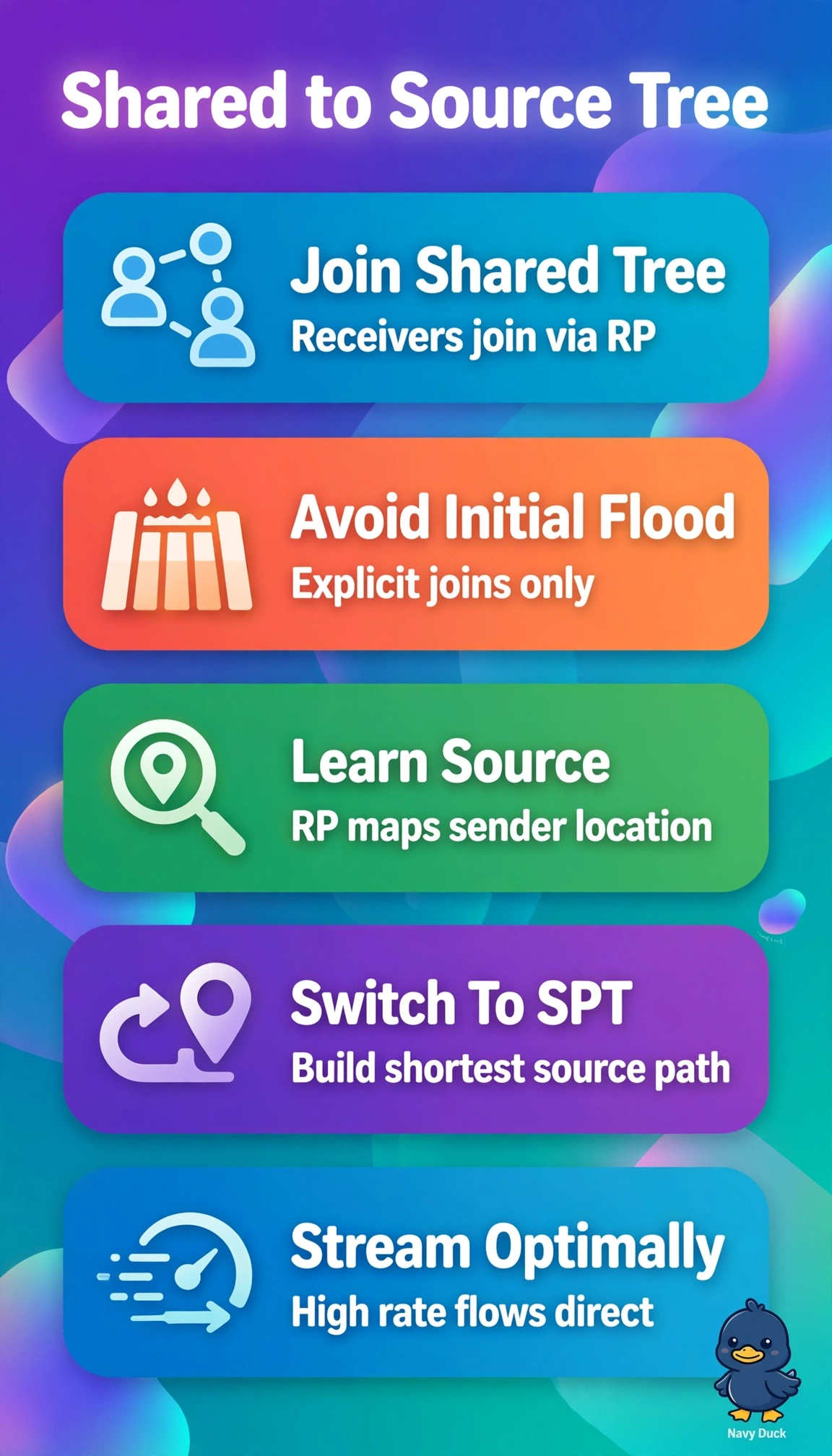
You've got hundreds of bursty viewers and one heavy stream to tame. Shared-to-source starts lean on the rendezvous point then cuts over to the shortest path, like meeting in the lobby then walking straight.
Full Explanation
PIM sparse mode initially joins receivers to a shared (,G) tree rooted at the rendezvous point using explicit joins, which avoids flooding, then the last-hop router can trigger (S,G) shortest-path-tree switchover toward the source for optimal latency and load distribution for high-rate flows. Pinning all flows on the shared tree keeps suboptimal routing through the rendezvous point and concentrates load, failing the shortest-path requirement for 4K. Dense-mode flood-and-prune periodically floods the entire network and prunes unwanted branches, which wastes bandwidth for bursty groups and scales poorly to 500 receivers. Building permanent source trees from every receiver without shared-tree discovery maintains excessive state and control overhead when joins are bursty and transient. For the exam, remember (,G) is shared via RP and (S,G) is source-specific shortest path with SPT switchover; in practice monitor SPT threshold and RP load to tune when switchover occurs.