
A university runs PIM-SM in two campuses with separate RPs and needs RP redundancy inside each campus plus discovery of active multicast sources between campuses for inter-domain streaming. Failover must be automatic without static RP reconfiguration. Which RP redundancy and inter-domain design should the designer choose for this multicast requirement?
Select an answer to reveal the explanation.
Short Explanation
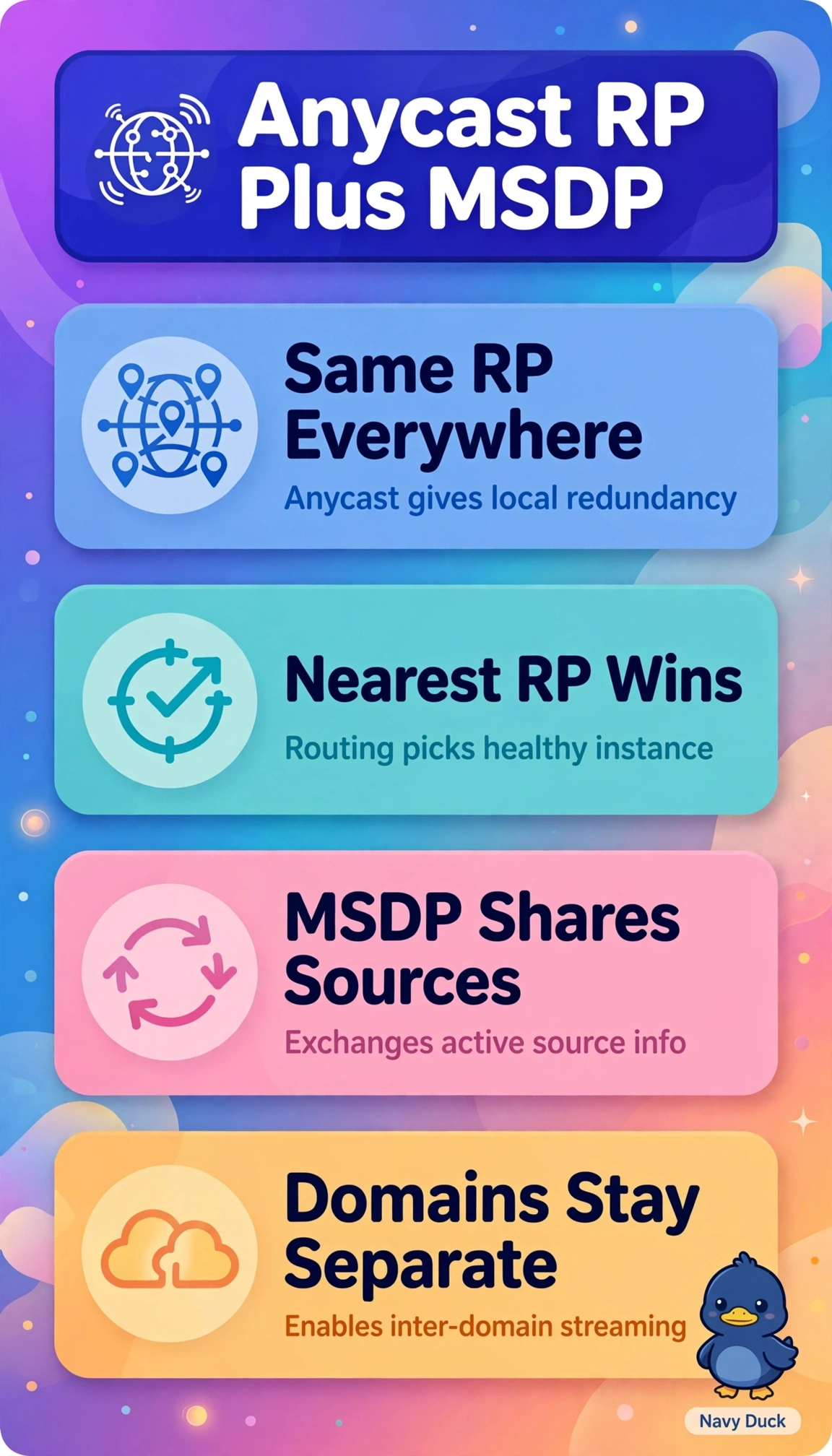
You've got two campuses that need their own backup helper, plus a way to hear about live shows next door. With anycast RP you'll have local failover covered, while MSDP acts like friendly campus gossip sharing who's streaming now.
Full Explanation
The correct design pairs anycast RP for intra-domain resilience with MSDP for inter-domain awareness because each PIM-SM campus needs a highly available rendezvous point plus a control mechanism to learn remote active sources. Inside each campus advertising the same RP address from multiple routers lets unicast routing select the closest instance and reroute automatically on failure without reconfiguration, while MSDP Source-Active messages between RPs advertise live sources across domains so remote receivers can join and transition to shortest-path trees for streaming. The anycast with BSR but no inter-domain peering design delivers automatic failover and local redundancy yet leaves each domain isolated, so receivers never learn remote sources and inter-campus streaming cannot establish. The MSDP with static RP mappings design enables source discovery but violates the automatic failover condition because a failed RP requires manual remapping rather than routing-driven convergence. The anycast with MBGP design provides local redundancy and inter-domain routing information, but MBGP only supports RPF checks through prefix exchange and cannot signal active sources, leaving the core discovery gap unfilled. As an exam caveat, distinguish topology exchange from source discovery since BSR, Auto-RP and MBGP are often presented beside MSDP yet only MSDP carries Source-Active data between PIM-SM domains. As a practical check, verify shared RP reachability, established MSDP peering with received Source-Active entries, then isolate one RP to confirm uninterrupted joins.