
A 300-user branch uses two Cisco SD-WAN routers sharing one LAN switch block, with voice, data, and guest VLANs, dual Internet transports, and a need for seamless gateway failover without host reconfiguration. Routing must stay simple and loop-free toward the overlay. Which LAN-side design with VRRP and routing should the designer select?
Select an answer to reveal the explanation.
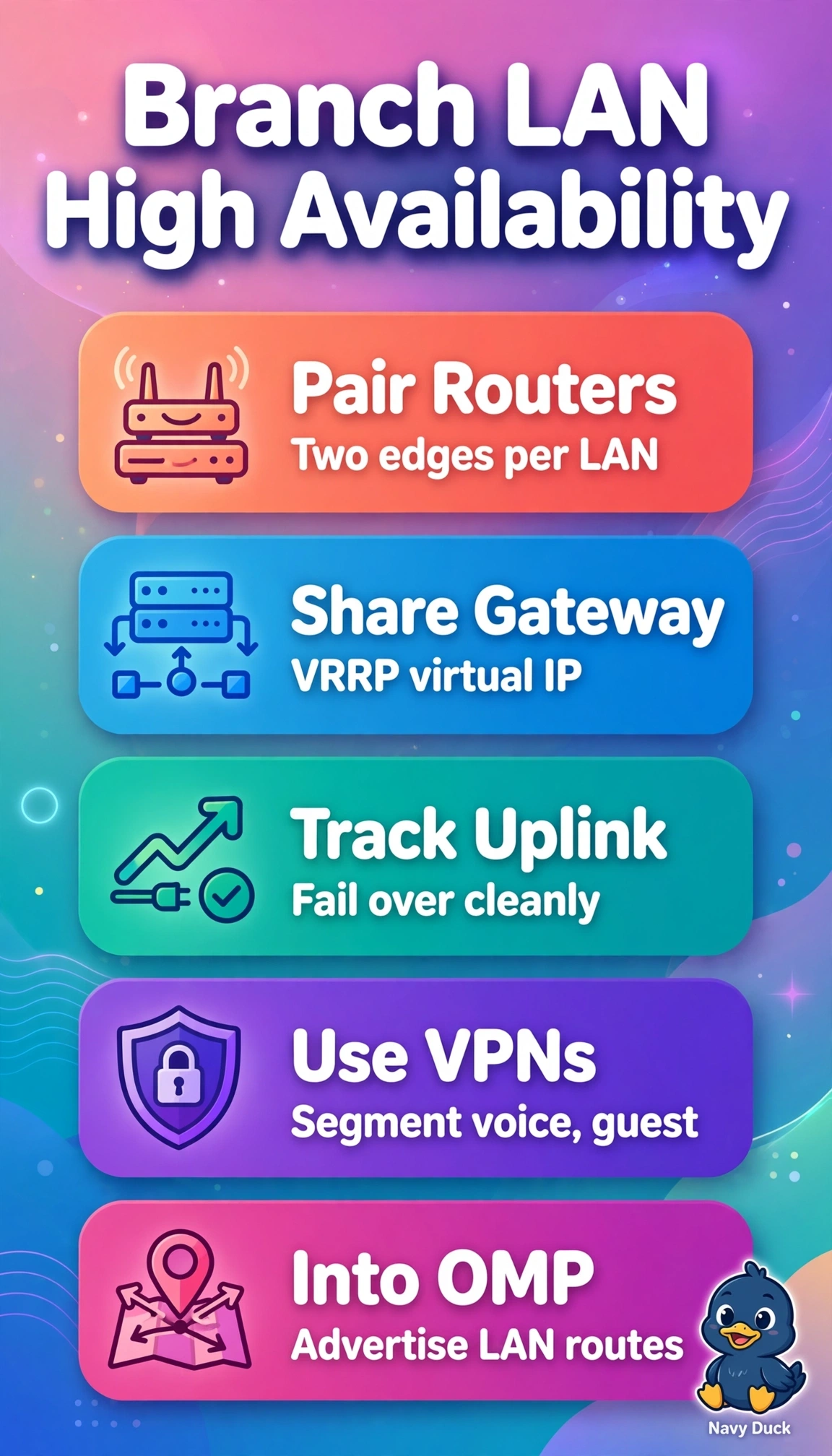
Short Explanation
You've got two doors to the same hallway, so you need one shared address. VRRP plus OMP gives you invisible failover with clean redundancy, like co-pilots sharing one intercom so passengers notice nothing.
Full Explanation
The correct design works because VRRP provides one virtual gateway for voice, data, and guest VLANs across the shared switch block so hosts retain their configuration while master-backup failover preserves sessions, and originating those LAN prefixes into OMP advertises the branch to the overlay where loop avoidance and policy are centralized, keeping edge routing minimal. Redistributing OMP routes into the LAN IGP fails by direction because it burdens branch routers and switches with overlay state and redistribution complexity without actually making local voice, data, and guest subnets reachable from remote sites. Relying on VRRP without redistributing LAN prefixes into OMP fails by reachability because local gateway redundancy succeeds yet the overlay never learns the branch subnets, so inbound traffic from other sites has no OMP path to return. Enabling mutual OSPF and OMP redistribution on both routers fails by simplicity because dual-point two-way leaking creates feedback, suboptimal routing, and filter management overhead that contradicts the requirement for simple loop-free overlay integration. For the exam, focus on redistribution direction wording, as originate versus import choices look similar but have opposite effects. In practice, verify VRRP priority and tracking plus show OMP routes for the LAN on a remote router while testing failover.