
A hospital campus suffers STP reconvergence outages where a single distribution link failure isolates VLANs, and dual-homed servers flap during upgrades. Cabling cannot be fully recabled to routed links everywhere. Which loop-free campus design minimizes STP scope while keeping dual-homing resilience?
Select an answer to reveal the explanation.
Short Explanation
You'll love how this cleans up your uplinks, like tying two shoelaces into one knot that won't come undone. With multichassis EtherChannel, both links stay active so you don't get STP blocking or flaps during upgrades.
Full Explanation
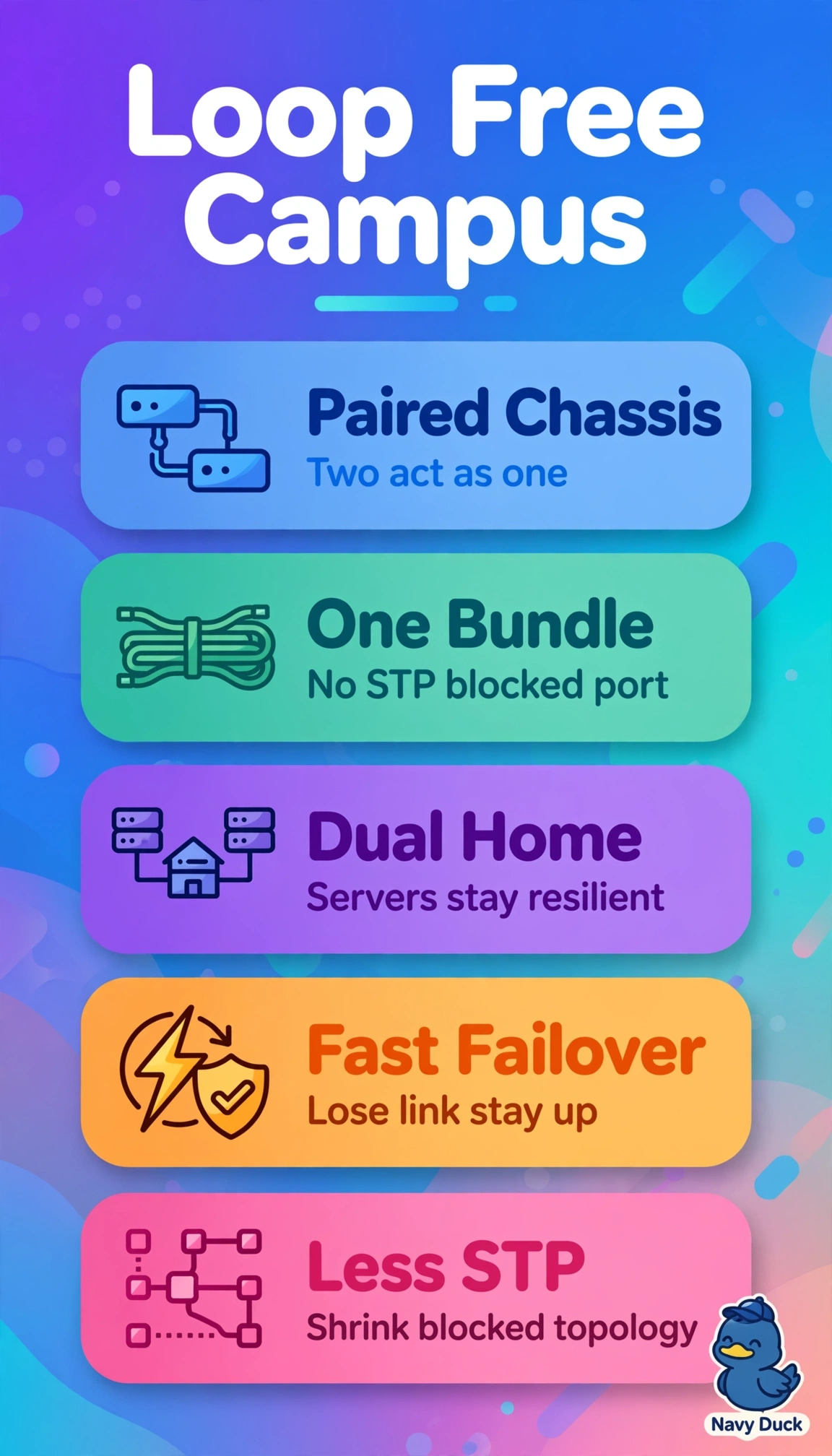
Paired distribution with multichassis EtherChannel lets access switches and dual-homed servers bundle uplinks across two distribution switches as one logical active-active link, whether the pair is a vPC-style design with independent control planes or a Catalyst VSS or StackWise Virtual pair, leaving no uplink STP-blocked, preventing single-link VLAN isolation, preserving L2 adjacency without campus-wide recabling to routed links, and allowing one distribution node to be upgraded while the peer carries traffic. Rapid PVST+ with optimized timers improves convergence but retains per-VLAN blocking and reconvergence, so the same isolation and outage can recur and STP scope is not minimized. Routed Layer 3 uplinks with ECMP give loop-free fast recovery but require recabling every access uplink as point-to-point routed and remove same-VLAN L2 continuity needed by existing dual-homed servers. Merging distant distribution switches into one cross-building virtual chassis removes blocked ports locally but creates one fate-sharing control plane and larger failure domain, so upgrades, control-plane faults, or inter-building link issues risk wider impact and flapping. For exams distinguish a paired distribution layer with multichassis bundles from stretching one virtual chassis across distant buildings, which enlarges the blast radius, and check if the stem forbids full L3 recabling or mandates L2 attachment. Practically verify zero STP-blocked uplinks, members split across both peers, and one peer upgrades non-disruptively while VLANs and hosts stay reachable.