
An enterprise has a central data-center core and six regional campuses that must limit link-state flooding, keep campus failures from destabilizing the core, and allow controlled route leaking for shared services. Which IS-IS level 1 versus level 2 design best creates a stable hierarchy?
Select an answer to reveal the explanation.
Short Explanation
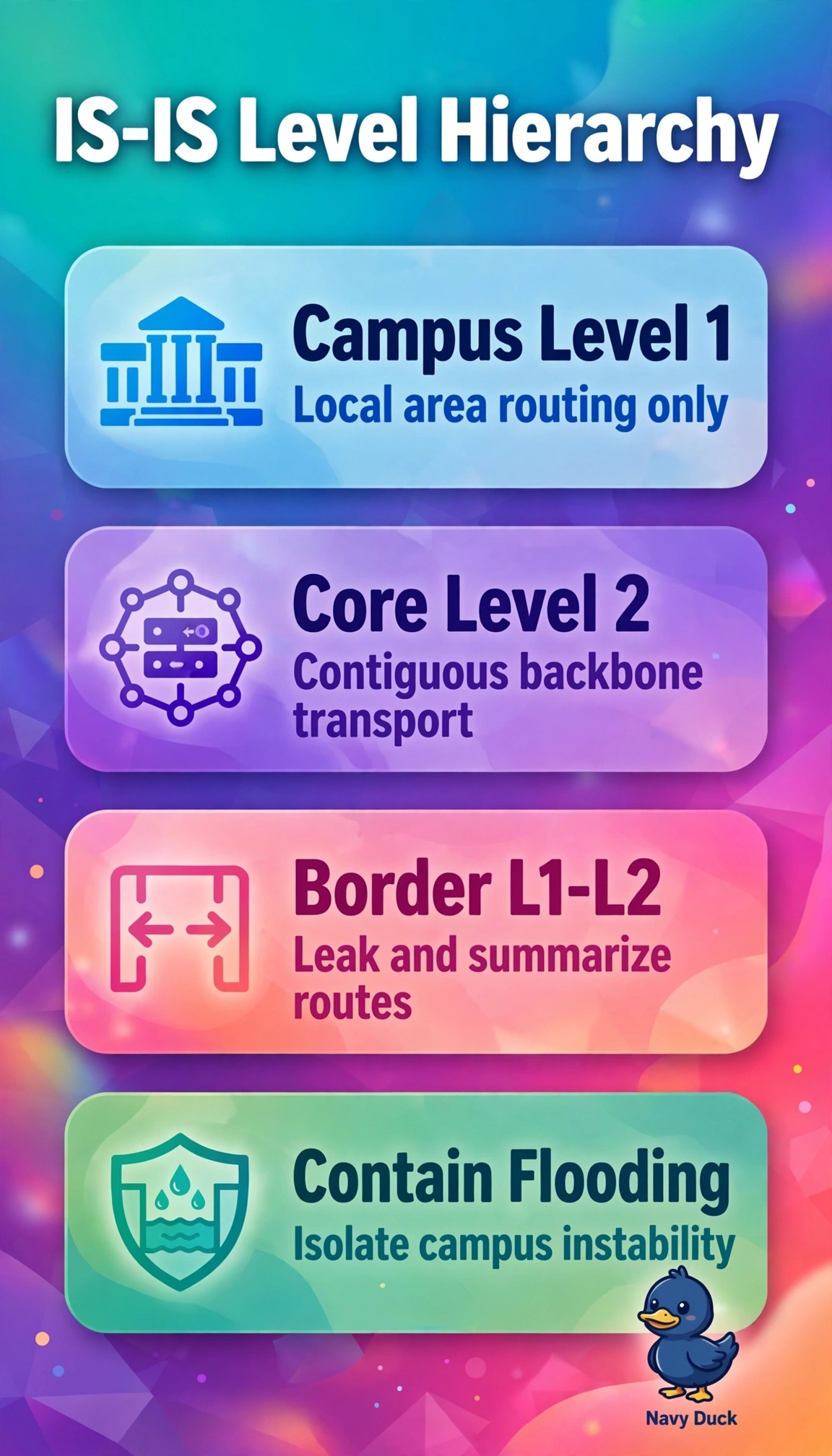
You want quiet neighborhoods tied by a strong downtown. Level 1 campuses with a Level 2 backbone contain floods, like local streets feeding a highway without clogging it.
Full Explanation
IS-IS hierarchy uses Level 1 for intra-area routing within each campus and Level 2 for the contiguous backbone across the core, with Level 1-2 border routers controlling leaking, which contains flooding, limits blast radius, and enables summarization for stability. A single Level 1 area fails by concept because all routers share one flooding domain, so campus flaps destabilize the core despite simpler adjacency. A single Level 2 domain fails by concept because flat flooding still propagates everywhere and removes area summarization benefits, even though it avoids leaking configuration. Level 2-only islands linked by Level 1 fails by concept because it inverts the architecture, since Level 2 must be contiguous backbone and Level 1 cannot transit between Level 2 areas. For the exam remember IS-IS levels mirror OSPF areas but with Level 1-2 borders and NET addressing; in practice verify NETs, area IDs, adjacency levels, and leak policies.