
A university campus has 180 VLANs across five distribution blocks, slow convergence after uplink flaps, and heavy BPDU processing with PVST running a spanning tree per VLAN. CPU is high and root placement is inconsistent. Which STP scalability and root placement design using RSTP versus MST best stabilizes the campus?
Select an answer to reveal the explanation.
Short Explanation
You are juggling too many timers at once. MST with defined instances trims overhead while pinned roots steady convergence, like consolidating committees with clear chairs.
Full Explanation
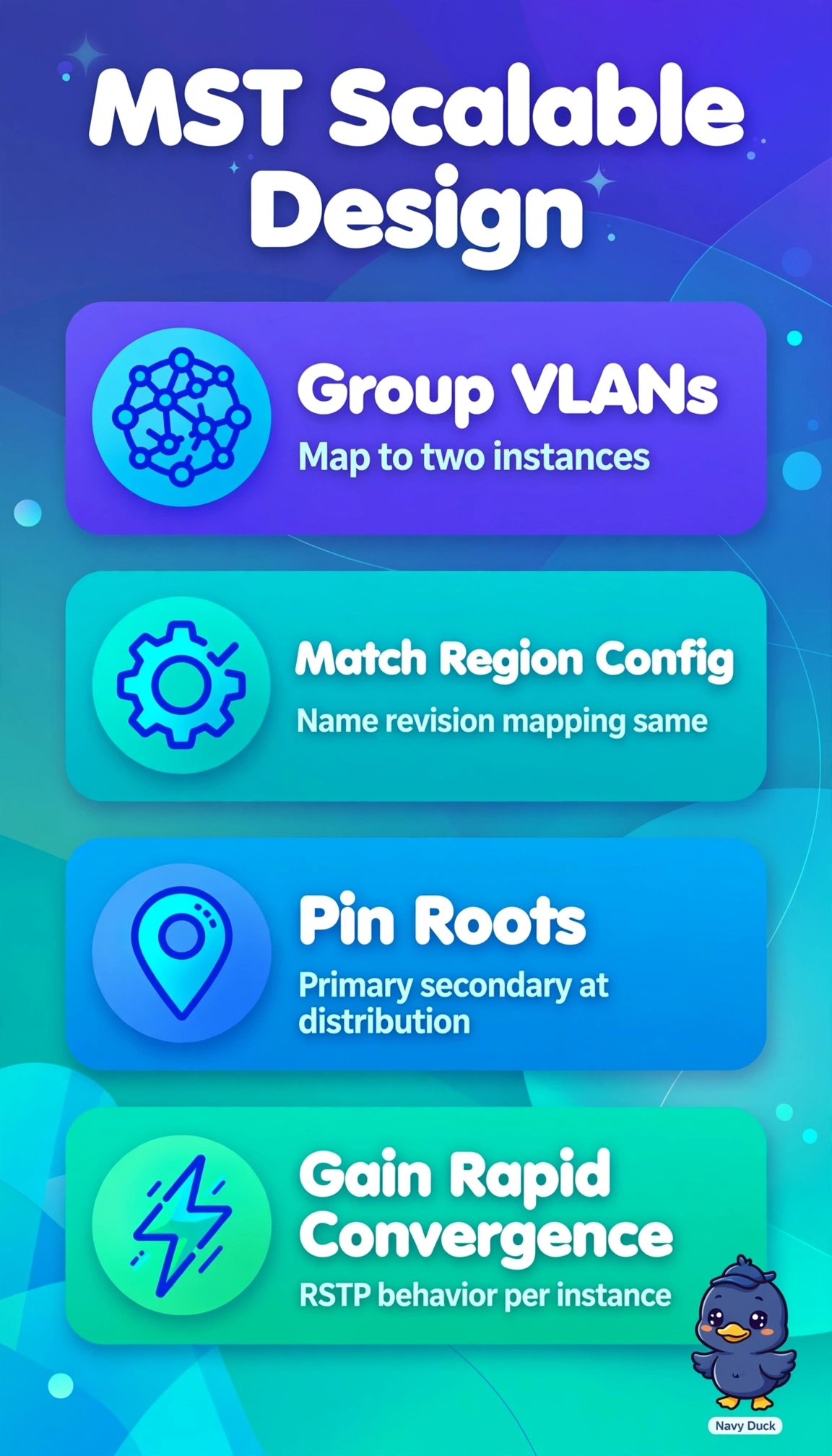
MST reduces control-plane load by mapping many VLANs to a few instances with RSTP-like rapid convergence, and deterministic primary and secondary root placement at distribution ensures predictable forwarding and load sharing across blocks. Remaining on PVST with core root for all VLANs fails by concept because per-VLAN instances scale poorly and centralized roots create suboptimal paths, even though PVST offers per-VLAN tuning. Single-instance RSTP with access roots fails by concept because one topology cannot balance VLAN load and access-layer roots pull traffic inefficiently, even though convergence is fast. Disabling spanning tree fails by concept because routing cannot prevent Layer 2 loops on switched links, risking broadcast storms despite correct Layer 3 metrics. For the exam remember MST regions, instances, and distribution-layer roots are the campus scalability baseline; in practice verify region name, revision, VLAN-to-instance mapping consistency, and root priorities.