
A university wants to deploy interactive virtual classrooms with hundreds of senders and receivers exchanging video across all campuses without heavy source-specific state. The design must minimize multicast state, avoid per-source trees, and use a shared root for all flows. Which PIM design best supports many-to-many communication?
Select an answer to reveal the explanation.
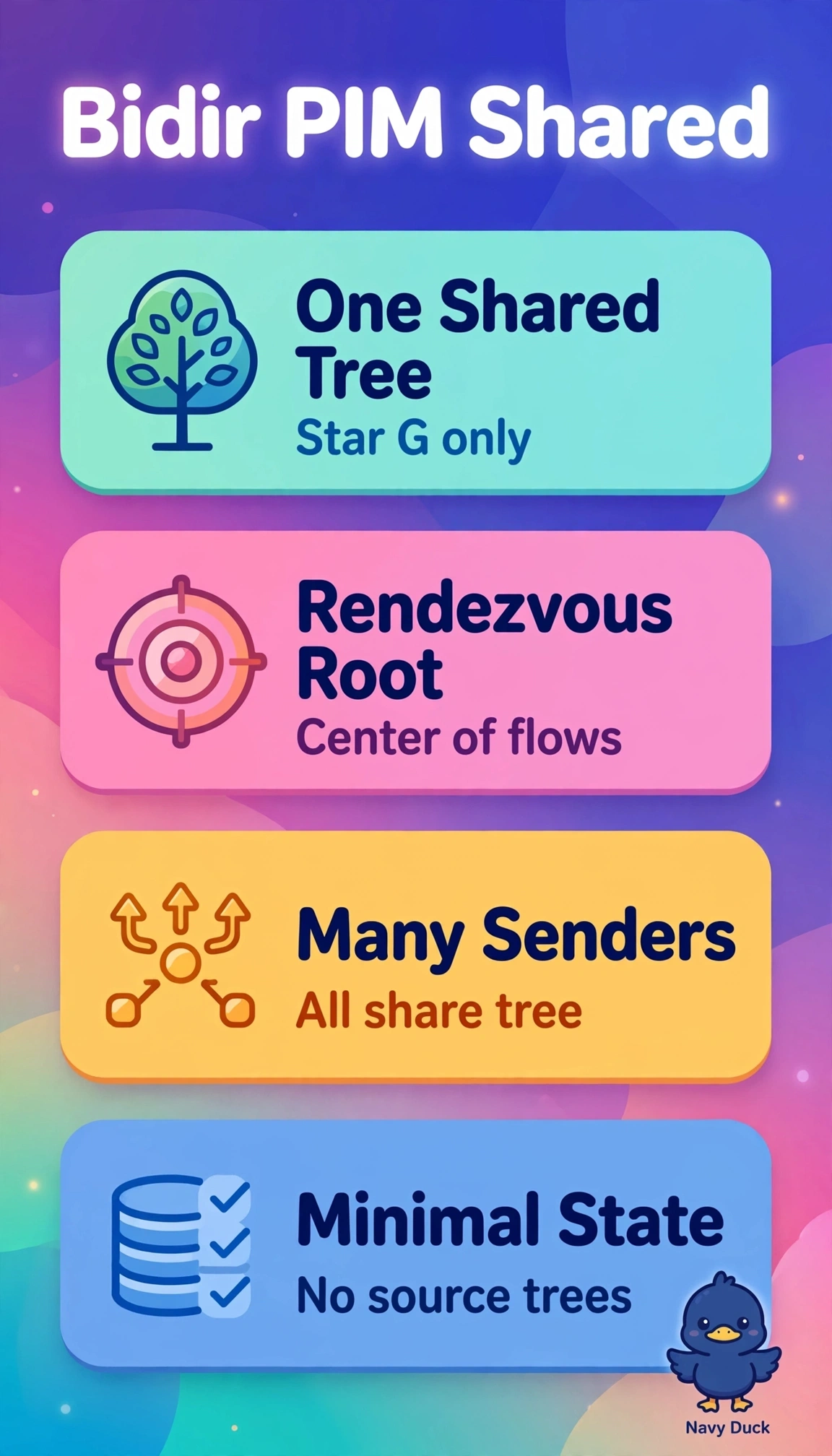
Short Explanation
You've got a giant study group where everyone talks and listens at once. Shared bidirectional trees act like a central hallway where all voices travel without building a private road for each speaker.
Full Explanation
Bidirectional PIM builds a single shared bidirectional tree rooted at the rendezvous point with *,G state only, allowing sources to send toward the root and receivers to receive from the same tree without source-specific S,G state or data-driven shortest-path switchover, ideal for many-to-many applications. Source-specific with rendezvous point fails by concept because SSM explicitly avoids a rendezvous point and creates per-source S,G state, opposite of state minimization. Dense-mode with rendezvous point fails because dense-mode floods and prunes without a shared tree concept and does not scale for sparse many-to-many groups. Sparse-mode with shortest-path trees fails because it maintains per-source state after switchover and optimizes one-to-many rather than minimizing state for many senders. Exam caveat is to link many-to-many plus minimal state directly to bidirectional PIM and rendezvous point. Practical check is to confirm application supports bidirectional operation and rendezvous point placement minimizes latency.