
A retail chain with 120 small stores needs connectivity where wired broadband takes 60 days to install, POS traffic is low bandwidth but critical, and outages must fail over automatically with centralized policy. Which 4G/5G transport design as primary or backup best meets the retail requirement?
Select an answer to reveal the explanation.
Short Explanation
You need a spare tire that swaps itself in. Managed cellular backup with VPN and failover keeps POS alive, like an automatic generator kicking on when power drops.
Full Explanation
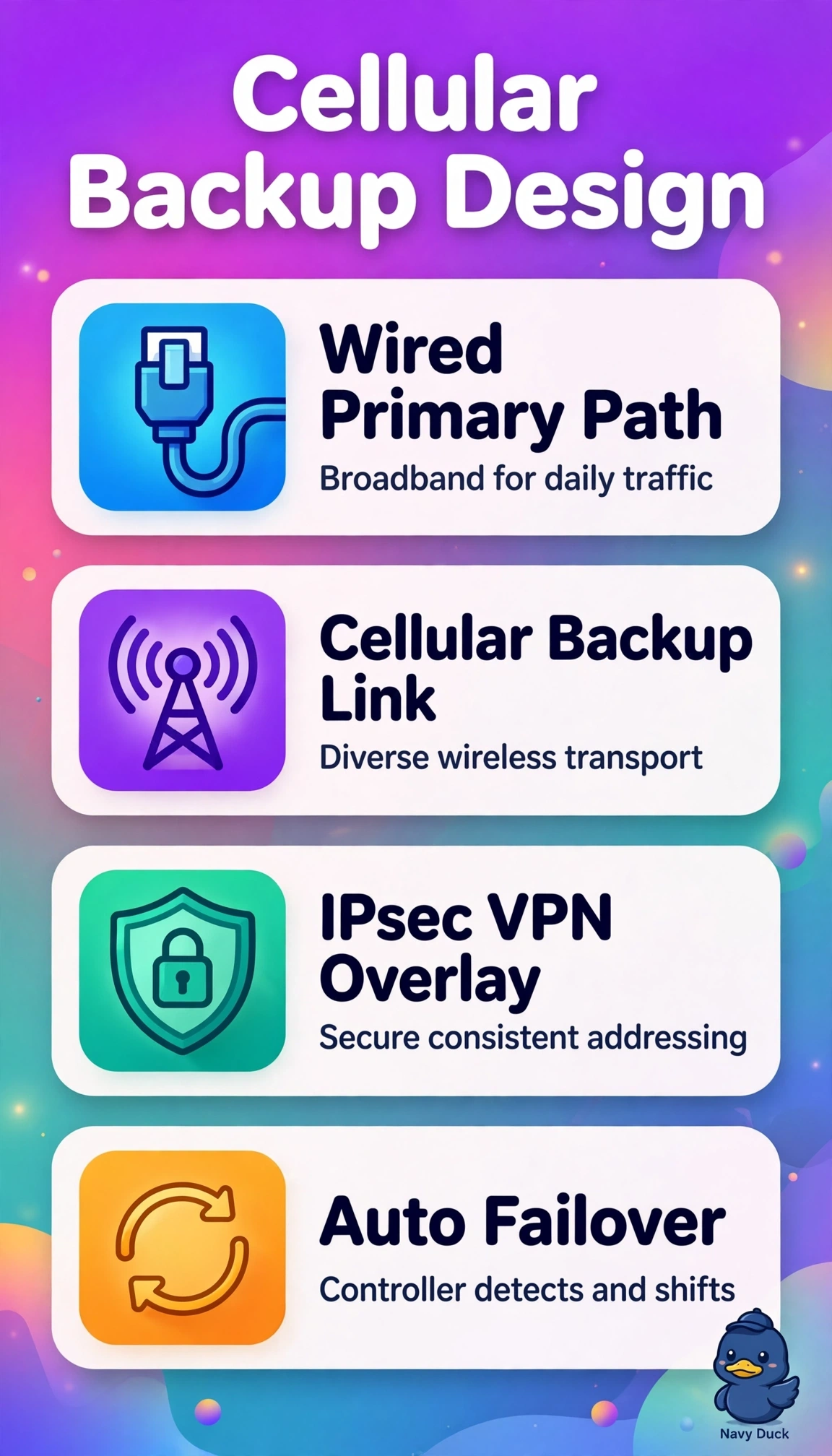
The correct design succeeds because it matches transport capabilities to business constraints: 60-day wired lead times require rapidly deployable cellular, low-bandwidth POS transactions fit well within LTE/5G capacity when protected by IPsec for security and QoS, and operating 120 sites demands template-driven central controller policy with probe-triggered automatic failover to preserve critical uptime without per-site intervention. The locally configured backup design provides VPN security and automation but violates the centralized policy requirement, forcing maintenance of 120 independent routing and failover policies that drift, complicate audits, and slow mass changes. The instant Day-0 design addresses rapid opening with VPN and central control but violates the automatic failover requirement by depending on manual activation, which introduces detection delay and staffing dependency incompatible with critical POS continuity. The guest-video-tuned backup design offers central control and automation but violates the traffic-priority fact by sizing data plans, bearers, and QoS queues for high-throughput entertainment rather than protecting small latency-sensitive POS flows, risking congestion and transaction failure. Exam caveat: distinguish managed controller-based cellular from merely having cellular present, as stems award credit only when central policy and automatic path selection are both explicit. Practical check: verify controller health-probe timers, IPsec throughput over cellular, POS DSCP marking survival across the tunnel, and pooled data-plan overage protection during extended wired outages.