
A financial firm streams market data from two well-known sources to 500 trading desks. Requirements are one-to-many delivery without shared-tree complexity, receivers specify the exact source they want, and bandwidth is saved by dropping unwanted sources. Which multicast design supports explicit source selection by receivers?
Select an answer to reveal the explanation.
Short Explanation
Your traders want only their chosen feed, not every noisy channel at once. Source-specific channels work like a direct subscription where you name the show and the network delivers just that stream.
Full Explanation
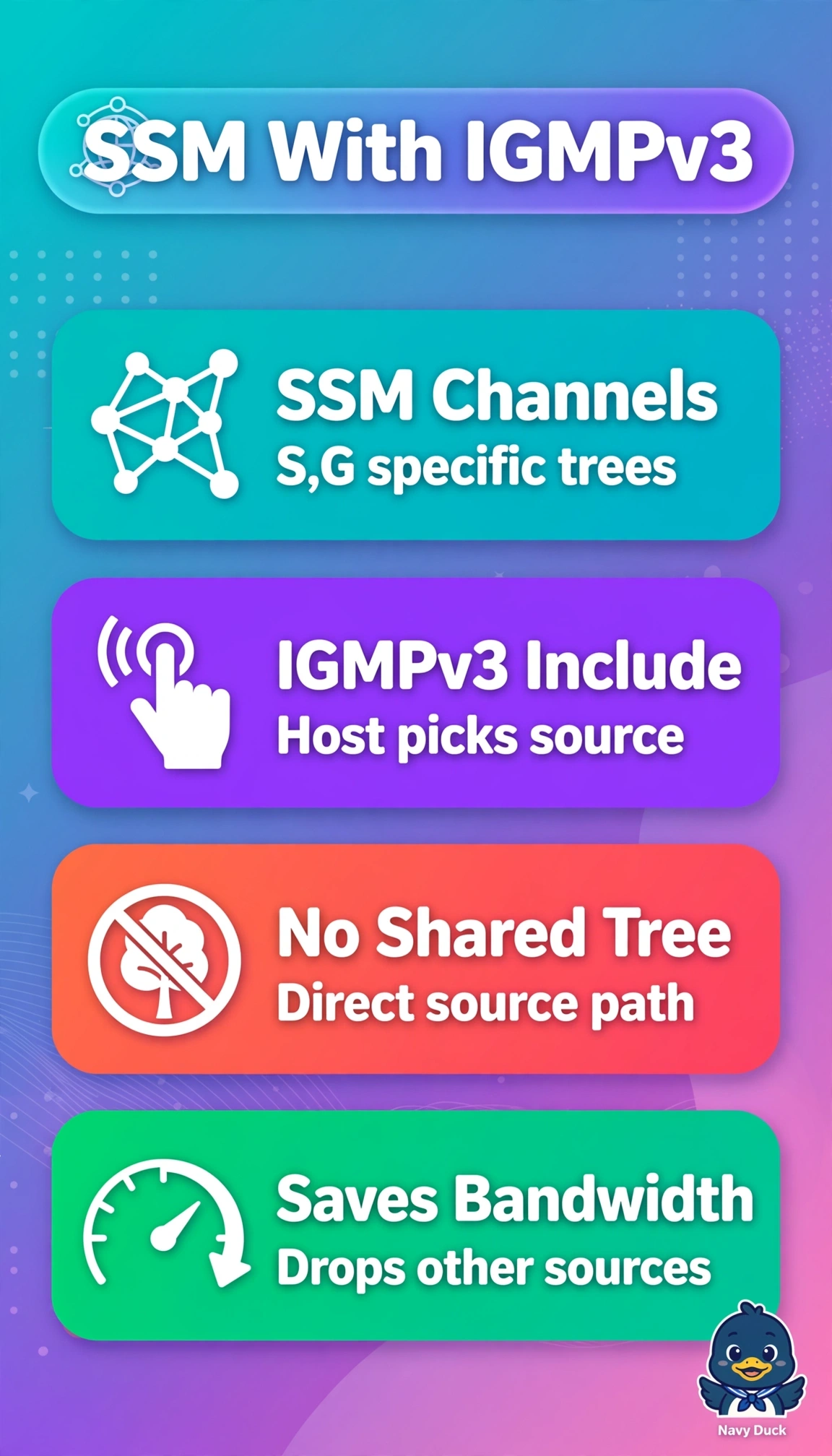
Source-specific multicast uses shortest-path trees built directly to the requested source with state expressed as S,G channels, and IGMPv3 allows hosts to send INCLUDE messages listing desired sources so the last-hop router joins only those sources and prunes others at the source edge. Dense-mode with IGMPv2 fails because it floods then prunes without source selection and IGMPv2 can only join groups, wasting bandwidth and lacking INCLUDE semantics. Bidirectional PIM with IGMPv2 fails because it uses a shared bidirectional tree optimized for many-to-many traffic and still relies on group-only joins without per-source choice. Sparse-mode with Auto-RP and IGMPv2 fails because it supports any-source multicast via rendezvous point and IGMPv2 cannot signal source preference, requiring extra source discovery. Exam caveat is to link IGMPv3 INCLUDE capability strictly to SSM channel subscription questions. Practical check is to confirm receivers and last-hop routers support IGMPv3 and applications reference S,G channels in the SSM range.