
A retailer must bring up 80 new branch SD-WAN routers with limited on-site skill, centralized templates, and secure identity verification before they join the overlay. Which SD-WAN onboarding and provisioning approach meets zero-touch deployment with authentication requirements?
Select an answer to reveal the explanation.
Short Explanation
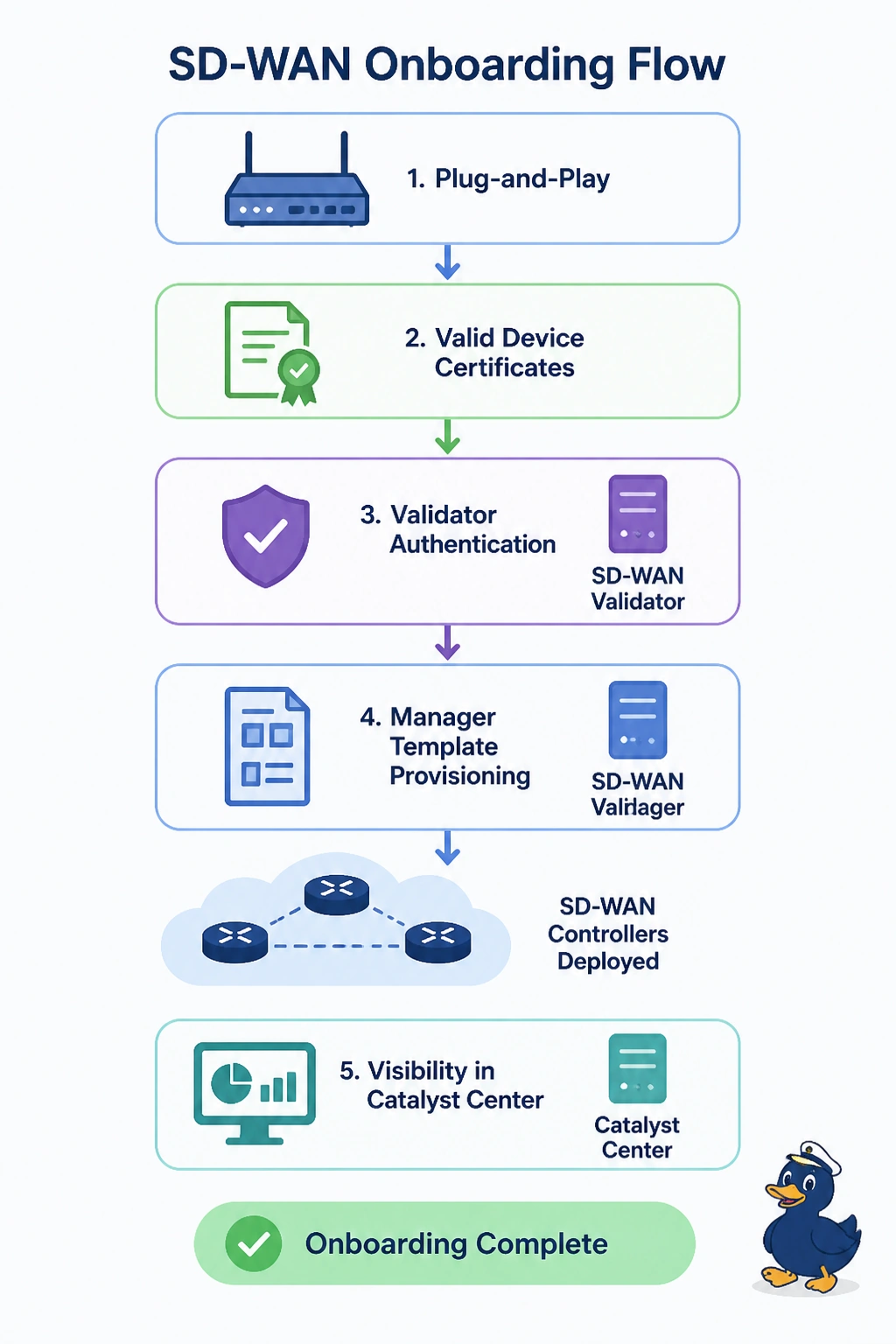
You can bring up dozens of stores without sending skilled engineers to each one. Plug-and-Play, certificate-based Validator authentication, and Manager templates give you secure provisioning with centralized control.
Full Explanation
Plug-and-Play enables true zero-touch onboarding: each unconfigured router contacts the Validator, presents its factory device certificate for identity verification, and, after authentication, joins the overlay and receives centralized configuration from Manager templates. This meets the limited on-site skill, central control, and secure admission requirements for 80 branches. Serial-number authorization with templates still allows discovery and configuration delivery, but an allowlist does not cryptographically prove device identity; without certificate checks, a device could be spoofed, so secure verification before overlay admission is missing. Certificate-based Validator authentication and Manager templates preserve security and centralization, but manually bootstrapping every router requires skilled on-site technicians, defeating zero-touch deployment and adding travel and inconsistency. Plug-and-Play with certificate authentication but site-specific CLI tuning retains automation and security, yet omits centralized templates; dispersed configurations make version control, auditing, and rapid policy rollout harder. Exam caveat: Validator authentication and Manager provisioning are separate functions, and one does not replace the other. Practical check: before shipping, verify certificate validity, Validator reachability, and template attachment in Manager.