
An enterprise has a headquarters campus, three large hybrid branches needing voice and ERP, plus small sales offices and bursty cloud analytics. Budget is tight and MPLS renewals are expensive. Which WAN connectivity selection balances performance, cost, and cloud agility across on-premises, hybrid, and cloud sites?
Select an answer to reveal the explanation.
Short Explanation
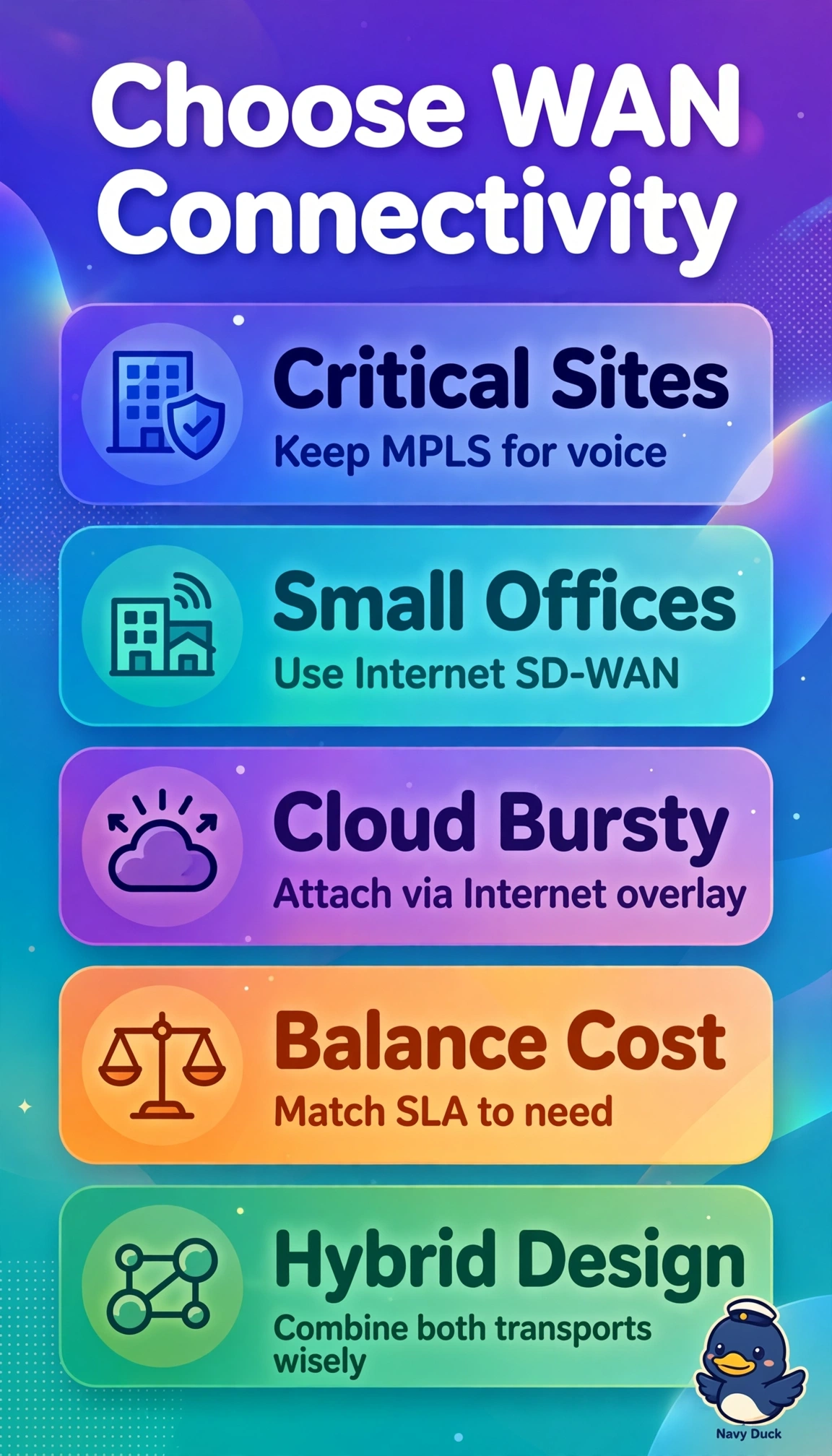
Not every site deserves premium transport, so segmentation of WAN types fits best. You keep SLA-grade MPLS where voice and ERP live and shift the rest to Internet SD-WAN.
Full Explanation
The hybrid design is correct because it aligns transport characteristics with application profiles, preserving MPLS with its low loss, jitter and SLA guarantees for headquarters and large hybrid branches where real-time voice and transactional ERP cannot tolerate best-effort variability, while shifting small sales offices and bursty cloud analytics to SD-WAN over Internet to cut expensive MPLS renewals, enable local Internet breakout, dynamic path selection and zero-touch provisioning for rapid cloud scaling. The all-site dual-Internet SD-WAN design fails by transport suitability because although it maximizes cost savings and cloud agility and is widely deployed for retail and cloud-first estates, it removes deterministic QoS for voice and ERP at large sites where packet loss directly degrades calls and transactions. The MPLS plus static IPsec design fails by orchestration agility because although it preserves core performance and is a traditional cost-control method, manual tunnels lack centralized policy, application-aware routing and elastic scaling needed for bursty analytics and frequent small-site changes. The MPLS plus SD-WAN for small sites plus fixed private circuits for cloud design fails by economic elasticity because although dedicated interconnects offer consistent performance and are standard for stable high-volume cloud peering, fixed-capacity billing overprovisions bursty workloads and reintroduces the tight-budget pressure the scenario requires avoiding. For exams, distinguish steady high-volume traffic that justifies private interconnect from bursty variable traffic that favors elastic Internet with SD-WAN policy, and in practice validate by measuring voice MOS, ERP transaction times, per-megabit transport spend and time to onboard a cloud VPC before committing to renewal decisions.