
A network automation engineer opens a YANG model for interface configuration and sees a container interfaces, a list interface keyed by name, and leaves for description, enabled, and mtu. The team uses Cisco, Juniper, and Arista devices. Which interpretation of the YANG-based data model best guides correct vendor-neutral automation design?
Select an answer to reveal the explanation.
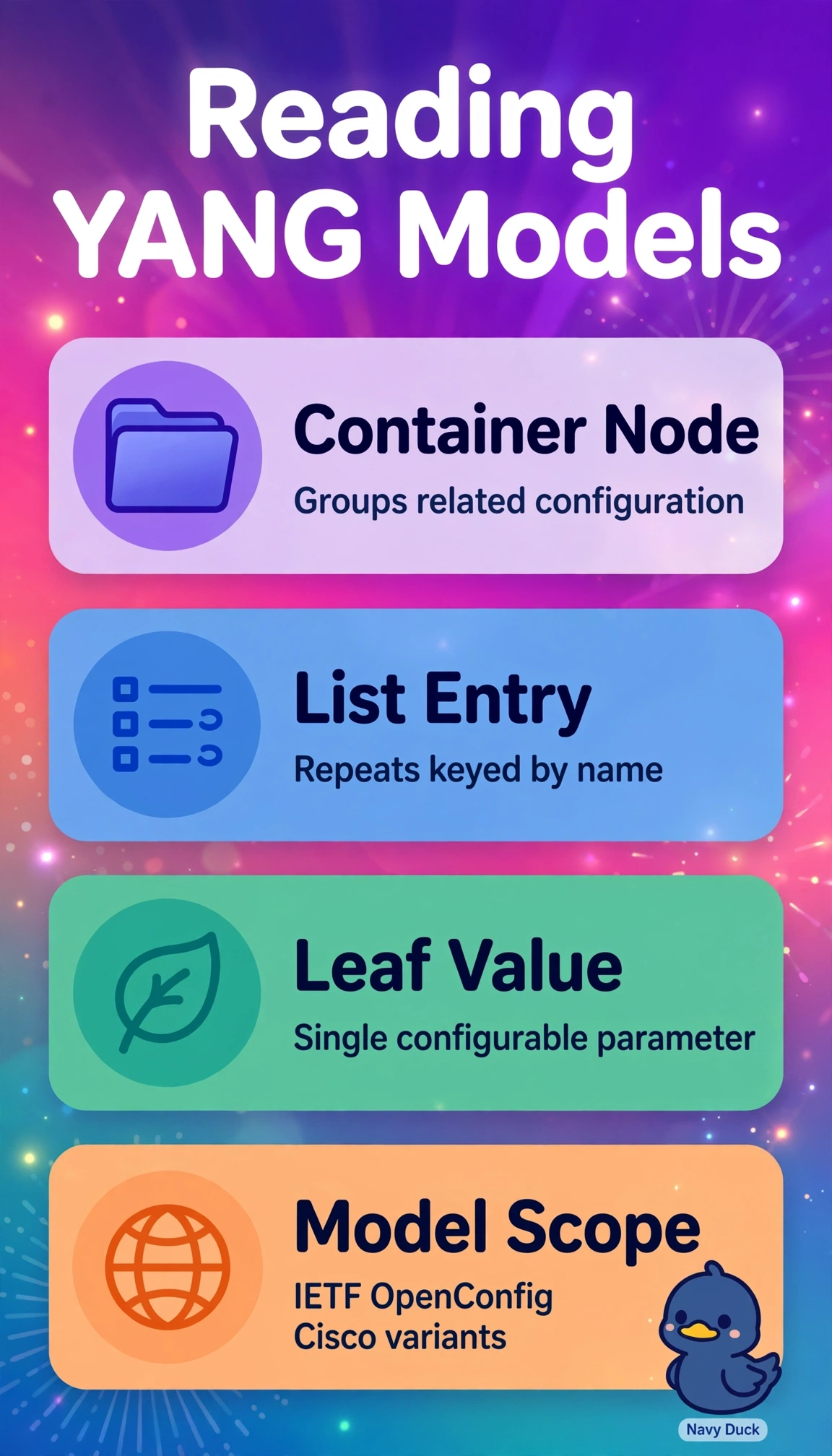
Short Explanation
You are reading a blueprint, not giving construction orders yet. Focus on hierarchy where containers organize lists and leaves hold values, like folders holding labeled forms you will fill.
Full Explanation
YANG models data structure through containers that group related nodes, lists that instantiate multiple entries keyed by identifiers such as interface name, and leaves that hold single configurable values, so reading hierarchy correctly lets automation map intent to NETCONF or RESTCONF payloads across vendors, especially with IETF or OpenConfig models. Treating the model as CLI command order fails by concept because YANG abstracts state and structure rather than prescribing keystroke sequence, even though leaves may resemble CLI keywords. Interpreting lists as SNMP OIDs fails by concept because YANG targets structured configuration and operational datastores, not legacy polling identifiers, even though both describe management data. Assuming the model defines forwarding behavior fails by concept because the model describes configuration and state schema, not internal forwarding algorithms, even though values influence device behavior. For the exam remember to distinguish IETF standard, OpenConfig vendor-neutral, and Cisco native models by scope and naming while reading structure the same way; in practice validate the model tree with a browser and test payloads in a lab.