
A university is moving residence halls to SD-Access, students roam between APs, IT wants wireless clients in the same fabric virtual networks as wired users, and operations must stay centralized. Which fabric wireless design role for Cisco Catalyst Center meets these mobility requirements?
Select an answer to reveal the explanation.
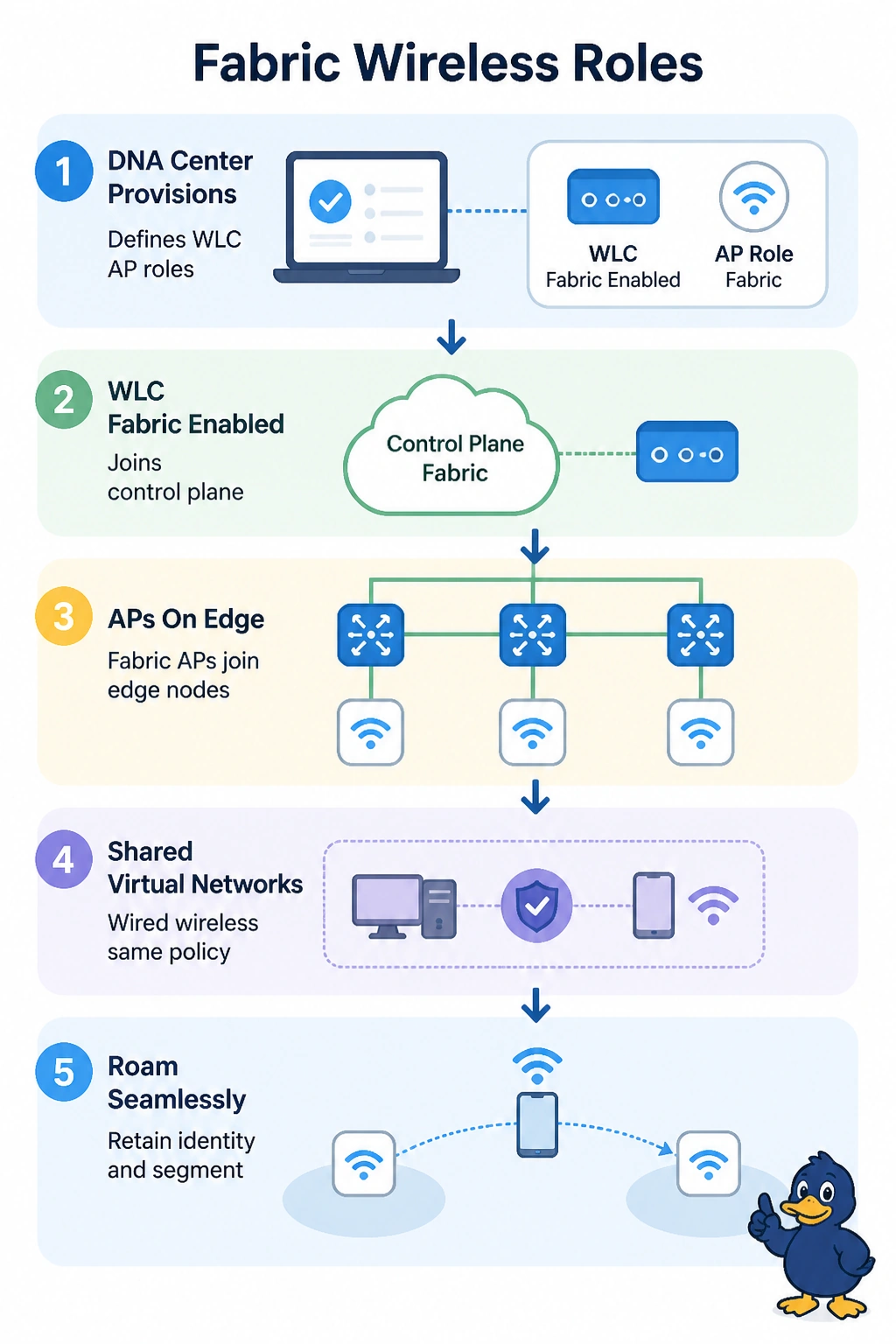
Short Explanation
You want Wi-Fi users to feel wired into the fabric wherever they wander. Fabric-enabled wireless lets Catalyst Center (formerly DNA Center) join APs and WLCs to the fabric, like giving every hallway the same front door. Roaming stays smooth and policy follows.
Full Explanation
Fabric wireless basics place fabric-mode access points on fabric edge nodes, under control of a fabric-enabled wireless controller that is provisioned by Cisco DNA Center, so client traffic is encapsulated in VXLAN and mapped to virtual networks with consistent policy and Layer 2 roaming across APs. Autonomous APs with local VLANs fail by concept because standalone bridging breaks centralized fabric control, segmentation, and host-tracking benefits that DNA Center automation provides. Centrally switched FlexConnect through the data center fails by concept because hairpinning wireless traffic defeats distributed fabric forwarding and does not integrate wireless clients as fabric endpoints in virtual networks. Separate SSIDs on isolated subnets per building fails by concept because building-scoped segmentation prevents seamless mobility and unified wired-wireless policy. For the exam, remember DNA Center is the automation and assurance point that defines fabric roles, it does not forward client data itself. In practice verify WLC fabric mode support, AP image compatibility, and roaming with virtual network to SGT mapping.