
A university is building a new 6-building campus with identical fiber links and no legacy routing to preserve, and the team wants Cisco Catalyst Center to discover switches and bring up the routed foundation with minimal CLI. Which underlay choice achieves rapid automated LAN provisioning for the SD-Access fabric?
Select an answer to reveal the explanation.
Short Explanation
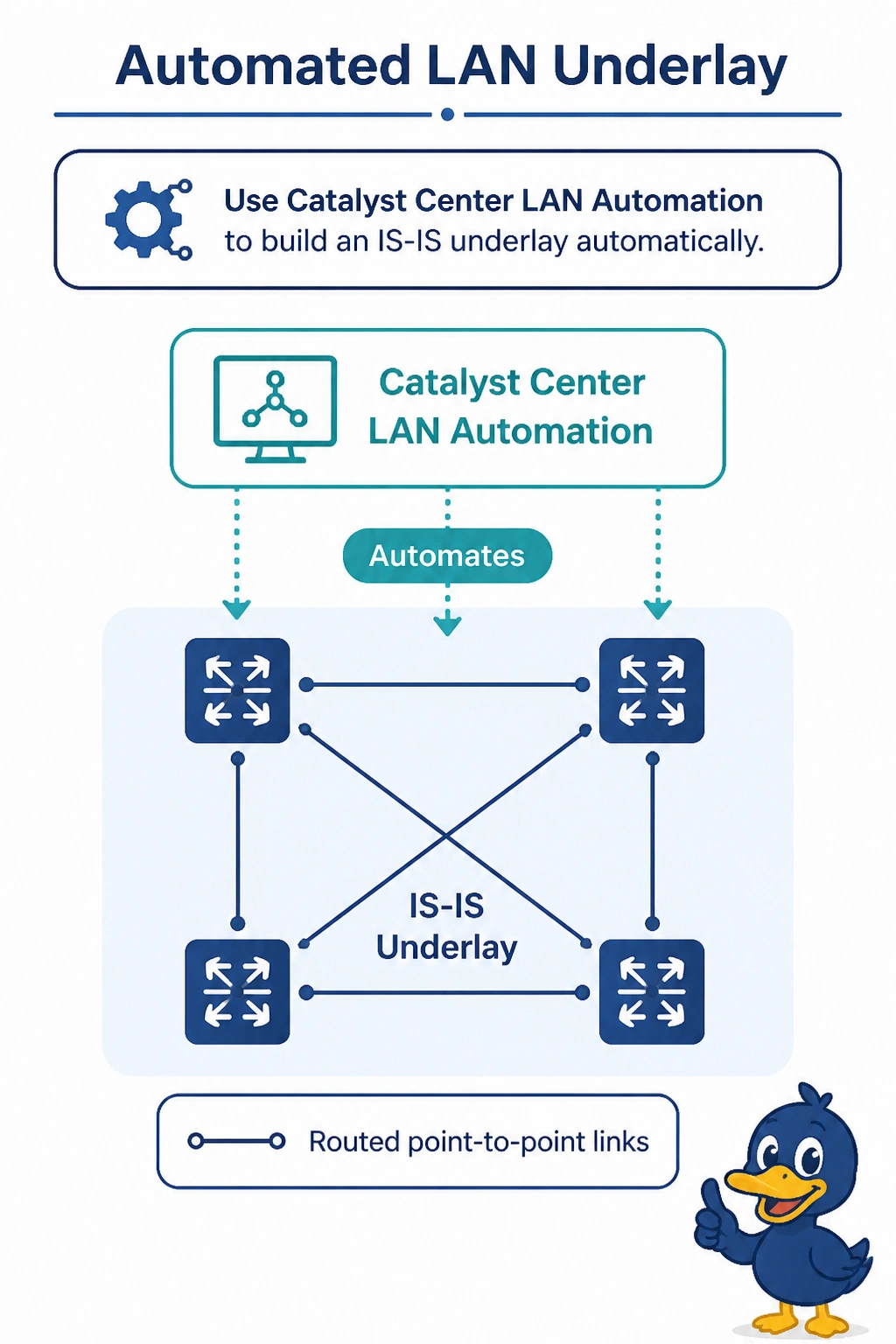
You've got a clean slate and want speed, so you'll love how automation handles the grunt work. LAN Automation spins up the IS-IS foundation for you, leaving underlay design to discovery and defaults rather than manual tuning.
Full Explanation
The correct approach works because LAN Automation in Cisco Catalyst Center (formerly Cisco DNA Center) is designed for greenfield SD-Access underlays, discovering devices via Plug and Play and automatically configuring routed point-to-point links, loopbacks, and IS-IS as the transport foundation for the VXLAN overlay, which removes manual routing, addressing, and neighbor errors. A manual OSPF underlay satisfies SD-Access transport requirements and fits brownfield networks with an existing routed core to preserve, but it misses the stated requirement for minimal CLI and rapid provisioning on new fiber. A manual IS-IS underlay provides the same protocol as automation with added control over metrics for traffic engineering, yet it likewise sacrifices automation benefit when no legacy constraints exist. Deploying LAN Automation with EIGRP fails by concept because LAN Automation builds an IS-IS underlay, not EIGRP, so the protocol choice is factually incorrect for the automation workflow. For the exam, remember automated means greenfield IS-IS by DNA Center and manual means brownfield reuse of existing IGP; in practice verify device support for LAN Automation and reserve manual design for networks where the underlay must remain unchanged.