
A freight operator runs IS-IS with Level-1 warehouse areas and Level-1-2 core routers connecting to two data centers. Area prefixes are flooding into the backbone unsummarized, narrow metrics cap path costs, and remote sites lack a return route to a shared services summary. Which IS-IS route leaking, summarization and metric style design meets all requirements?
Select an answer to reveal the explanation.
Short Explanation
You're building clean floors with one labeled elevator back down. Wide metrics give you room for bigger costs, summarization keeps areas quiet, and leaking just the services route fixes the return path.
Full Explanation
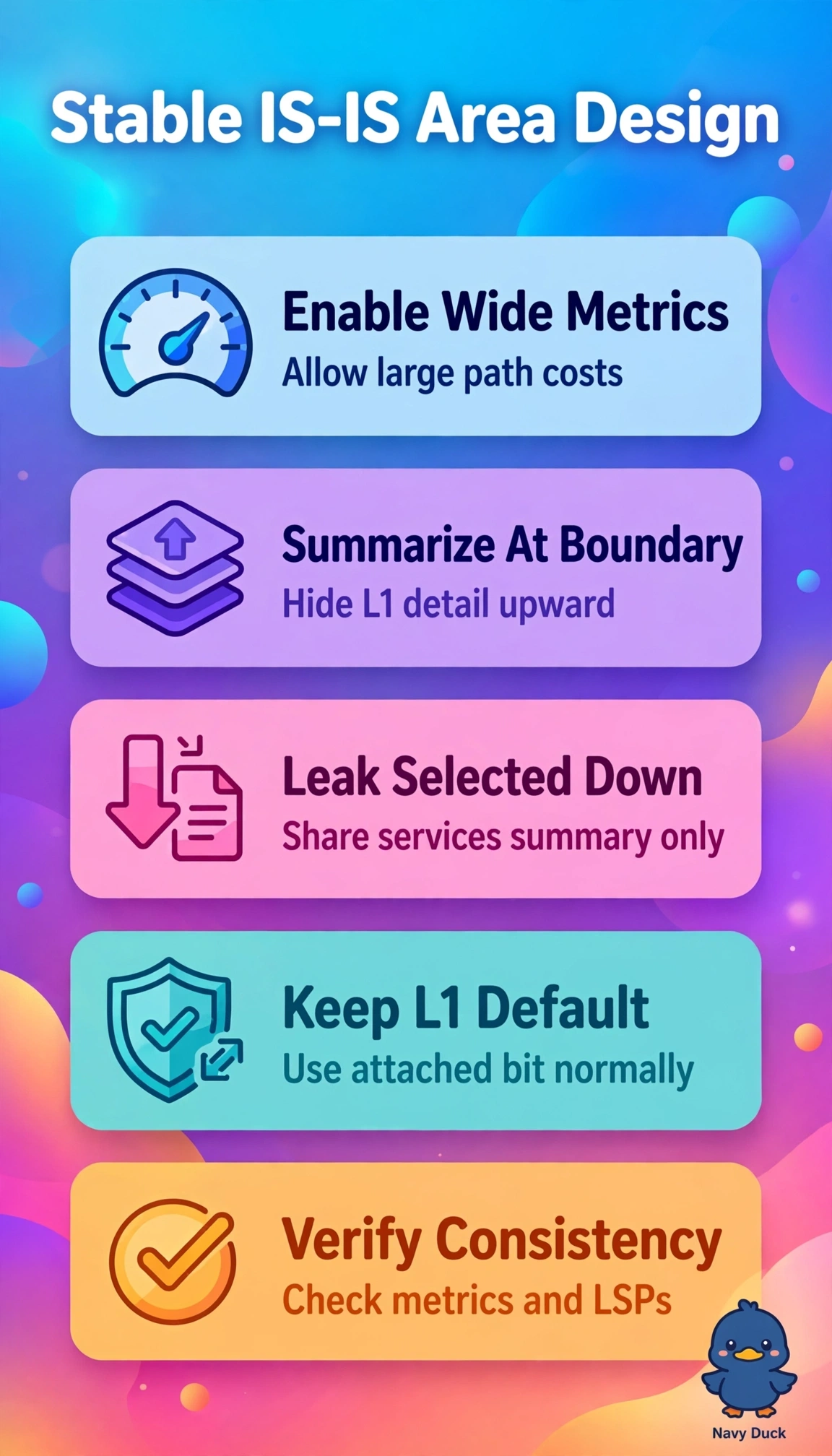
The correct design works because wide metrics remove the narrow-metric 6-bit cost ceiling and allow large, traffic-engineered costs and proper summarization, summarization of Level-1 prefixes at the Level-1-2 boundary hides warehouse detail and stabilizes the Level-2 LSPDB, and controlled Level-2 to Level-1 leaking of only the shared-services summary provides the exact return path Level-1 routers otherwise miss because Level-1 routers use the attached bit default toward the nearest Level-1-2 router. Keeping narrow metrics fails by concept because summarization and leaked routes cannot use high or fine-grained costs and will clamp or misroute traffic. Disabling summarization fails by concept because flooding every warehouse prefix into the backbone defeats scalability and increases LSP churn despite correct metrics and leaking. Relying only on the attached bit fails by concept because the default route attracts all inter-area traffic to the nearest Level-1-2 router and cannot provide an optimal or policy-specific return path for the services summary. For the exam, remember Level-1 to Level-2 propagation is automatic while Level-2 to Level-1 requires explicit leaking, and in practice verify metric-type consistency with show isis database and validate summaries and leaked prefixes before migrating areas.