
A regional retailer runs EIGRP named mode with dual hub links where the backup path has a higher feasible distance and stays idle, wasting capacity during peak sales. Design requires hierarchical address families, preserved metrics, and controlled use of the slower path. Which EIGRP metric design enables unequal-cost load sharing in named mode?
Select an answer to reveal the explanation.
Short Explanation
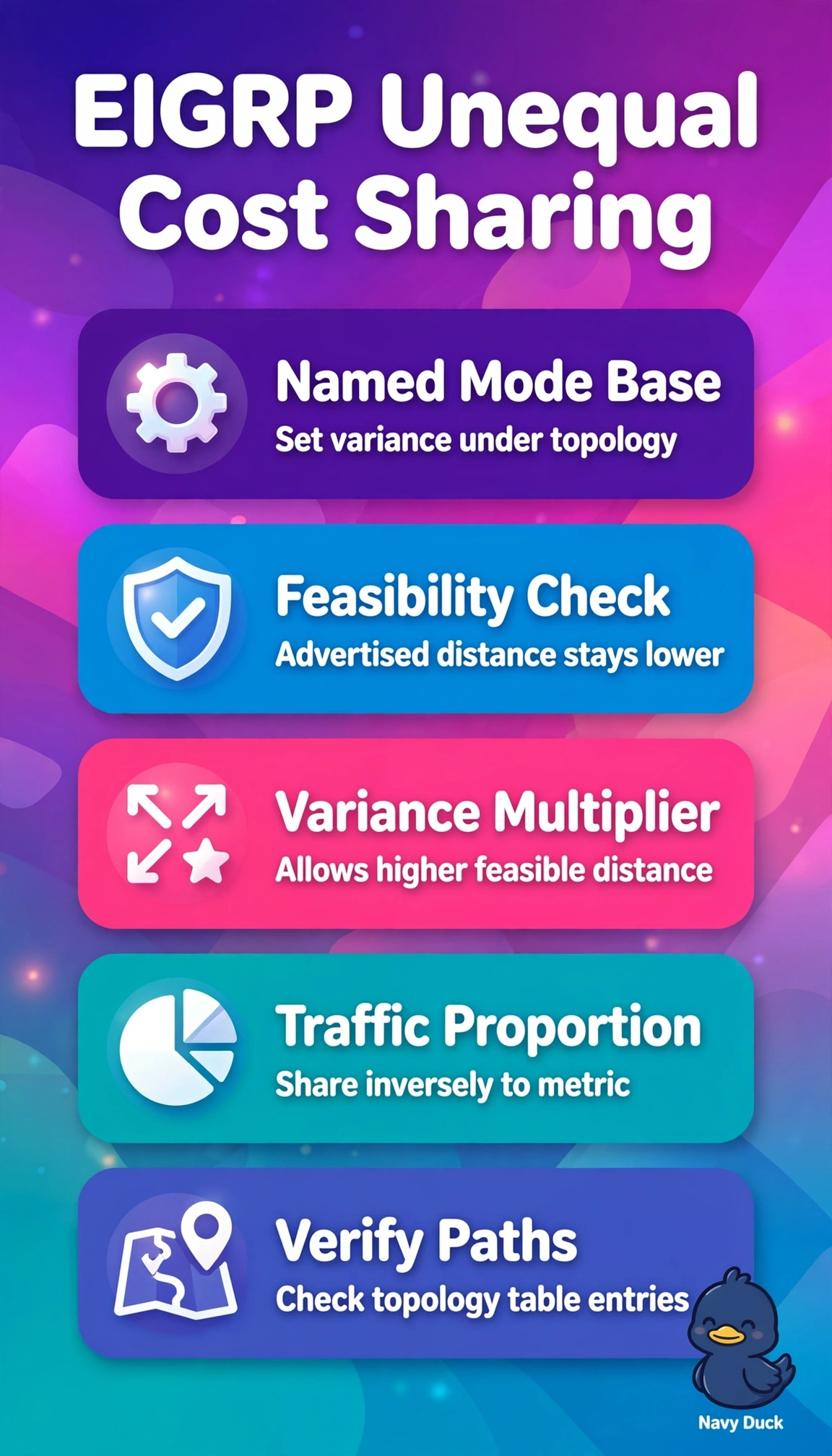
You've already got that backup path sitting idle, so variance is your release valve. It lets feasible successors carry traffic in proportion to cost while named mode keeps config tidy.
Full Explanation
EIGRP installs only successors by default, but variance allows feasible successors meeting the feasibility condition to enter the routing table for unequal-cost load sharing, with traffic proportionate to composite metric derived from bandwidth and delay; named mode centralizes this under the address-family topology base so IPv4 and IPv6 inherit consistent policy and hierarchy. Adjusting K-values changes metric calculation itself and must match on all neighbors or adjacencies fail, plus it does not authorize unequal-cost paths and risks instability. Enabling add-path advertisement confuses BGP path advertisement with EIGRP forwarding and has no effect on EIGRP variance behavior. Raising maximum-paths alone permits more equal-cost paths but EIGRP still rejects higher-metric feasible successors without variance, so the backup link remains unused. For the exam, remember variance multiplies the best metric as a threshold and only loop-free feasible successors qualify; in practice verify with show ip eigrp topology and confirm the backup path meets the feasibility condition before tuning.