
A regional bank connects two data centers 70 km apart and needs 40 Gbps of low-latency replication, full control of encryption keys, and capacity to add wavelengths later without ordering new carrier circuits. The carrier offers dark fiber between sites and managed MPLS VPN. Which DWDM connectivity approach best meets the low-latency scaling requirement?
Select an answer to reveal the explanation.
Short Explanation
You get your own lanes on your own highway with this one. Dark fiber plus DWDM gives you control over wavelengths for latency and growth, like adding lanes without rebuilding the road.
Full Explanation
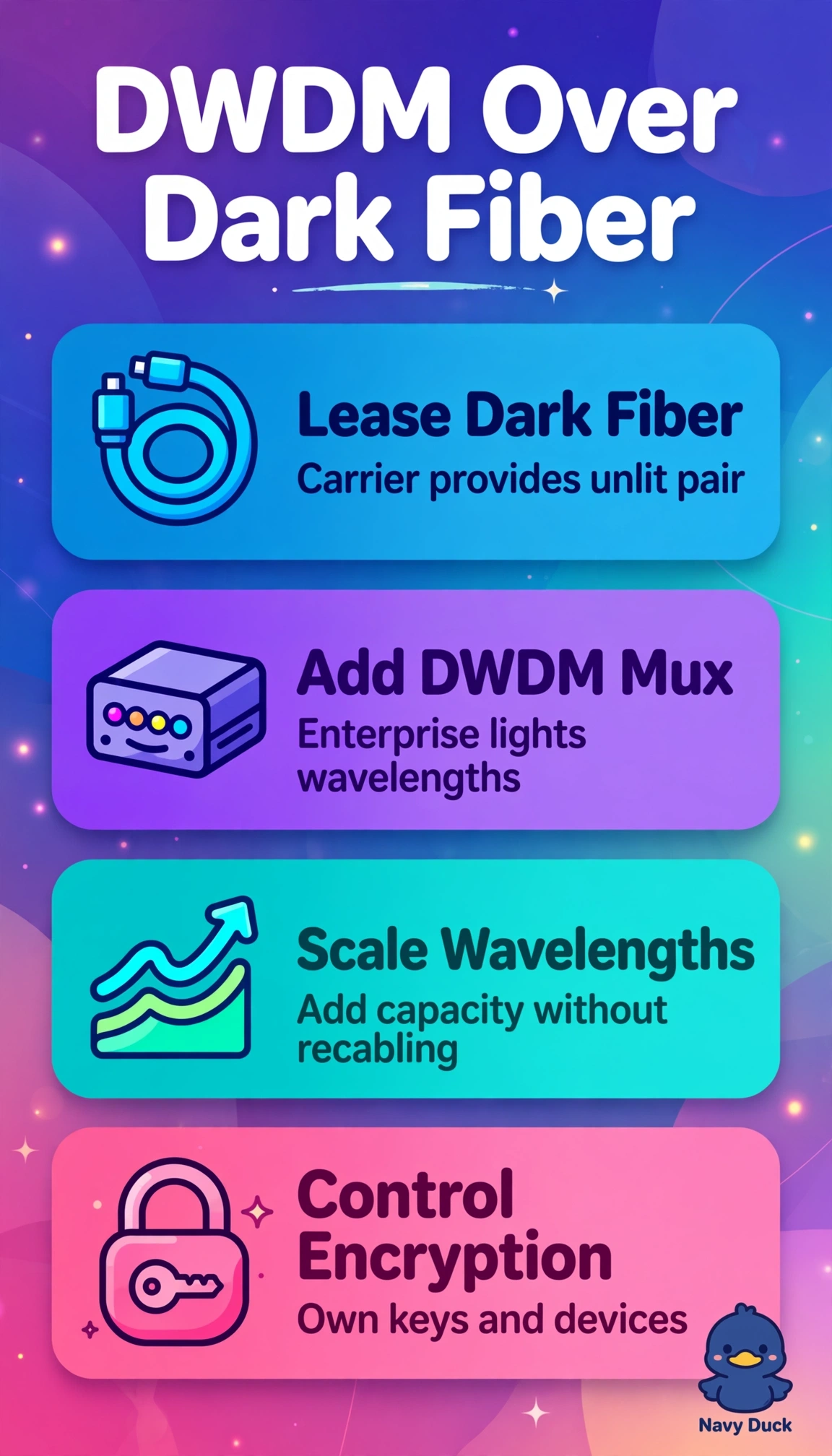
Owned DWDM over leased dark fiber places multiplexing and encryption under enterprise control, delivers very low latency by avoiding carrier packet processing, and scales by lighting additional wavelengths on the same fiber pair without new circuits, which directly satisfies control, latency, and growth needs. A managed MPLS VPN fails by concept because it shares provider infrastructure and adds lookup queuing that increases latency and removes direct wavelength control, even though it simplifies routing. Internet IPsec VPN fails by concept because best-effort transport and encryption overlay add jitter and unpredictability unsuitable for synchronous replication, even though it is low cost and diverse. A single carrier Ethernet private line fails by concept because capacity is capped by the ordered service rate and upgrades require carrier provisioning rather than lighting a new wavelength. For the exam remember DWDM is an optical multiplexing choice for high-capacity campus and metro interconnect, not a routing protocol; in practice verify fiber distance, loss budget, optics, and who manages amplifiers and dispersion compensation.