
A research university needs to transport 200 Gbps between two campuses 60 km apart for genomics replication, with strict loss and latency budgets, dedicated fiber control, and future growth to 400 Gbps. Carrier packet services cannot guarantee the optical performance and upgrade path required. Which optical connectivity approach best satisfies capacity and control needs?
Select an answer to reveal the explanation.
Short Explanation
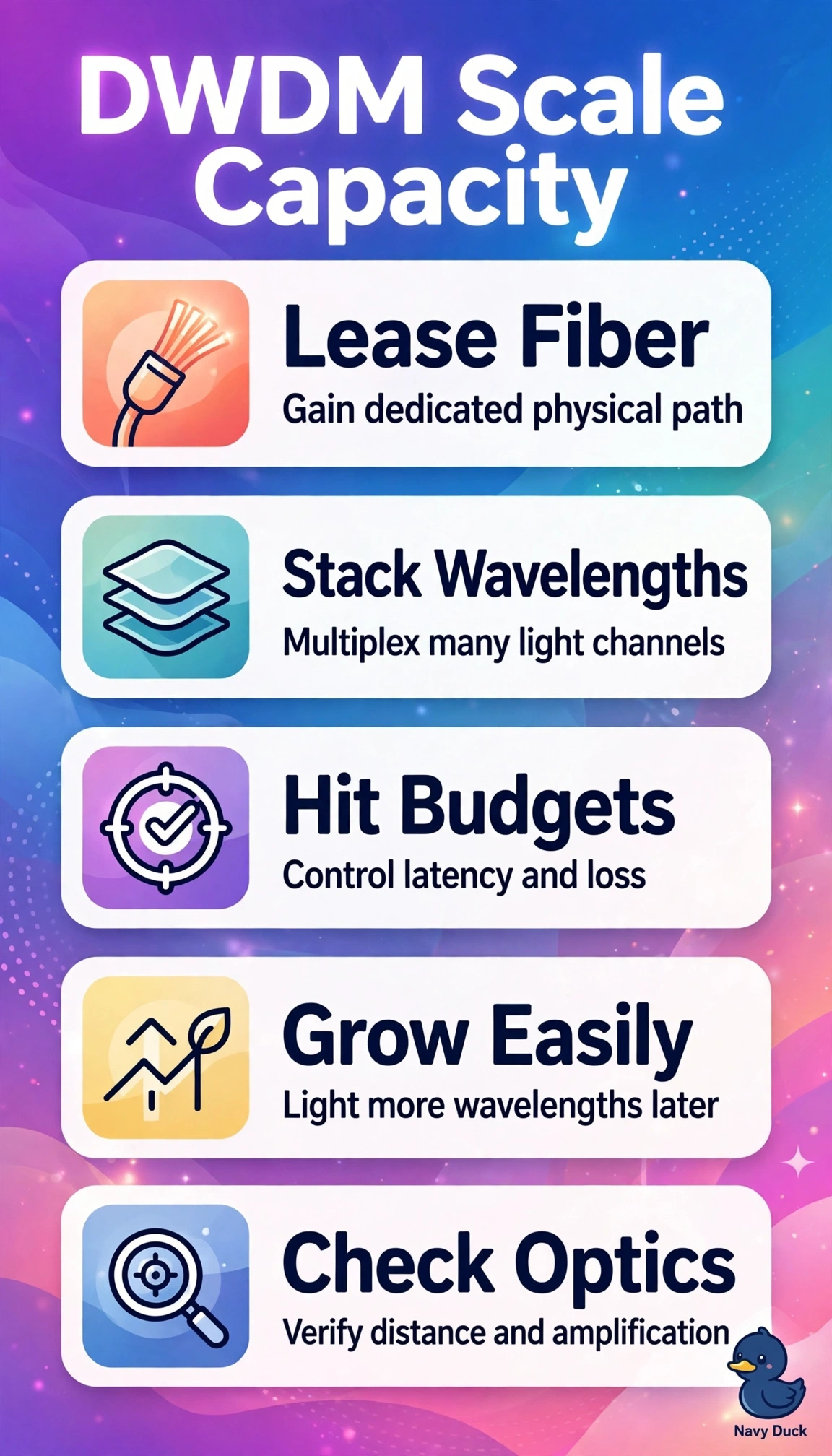
You're adding extra lanes of colored light on your own private highway. Using multiplexing lets you stack wavelengths now and light more later.
Full Explanation
Leased dark fiber with DWDM is correct because the university retains full control of the photonic layer over 60 km while multiplexing multiple 100G/200G wavelengths on one pair to meet 200 Gbps today and adding wavelengths or higher-rate coherents to reach 400 Gbps without recourse to carrier packet QoS, preserving low latency, loss budget, and deterministic upgrade. A carrier-managed lit 200 Gbps wavelength is operationally sound and widely used for DCI, but it cedes lambda provisioning, amplification, and upgrade timing to the carrier, violating the explicit dedicated control and guaranteed optical upgrade path. Lighting dark fiber with a single 200G coherent optic is also common for low-latency campus DCI and meets control and distance needs, but without multiplexing it consumes the fiber capacity in one channel and forces a disruptive forklift or second pair to reach 400 Gbps, failing the multiplexed scalability requirement. Passive CWDM over dark fiber is cost-effective for aggregating 10G/25G channels on campus spans, but its wide spacing, lack of amplification for coherent rates, and limited reach cannot reliably carry 200 Gbps coherent transport at 60 km nor evolve to 400 Gbps, failing the capacity and performance requirement. Exam caveat: lit versus dark matters more than headline rate because management determines who controls upgrades. Practical check: verify OTDR loss, dispersion, amplifier spacing, coherent reach, and DWDM slots before turn-up.