
A retail chain deploys SD-Access across stores and needs endpoint mobility without changing IP addresses, plus large Layer 2 extension across the campus without flooding everywhere. Which statement correctly describes the LISP control plane and VXLAN data plane roles in that fabric?
Select an answer to reveal the explanation.
Short Explanation
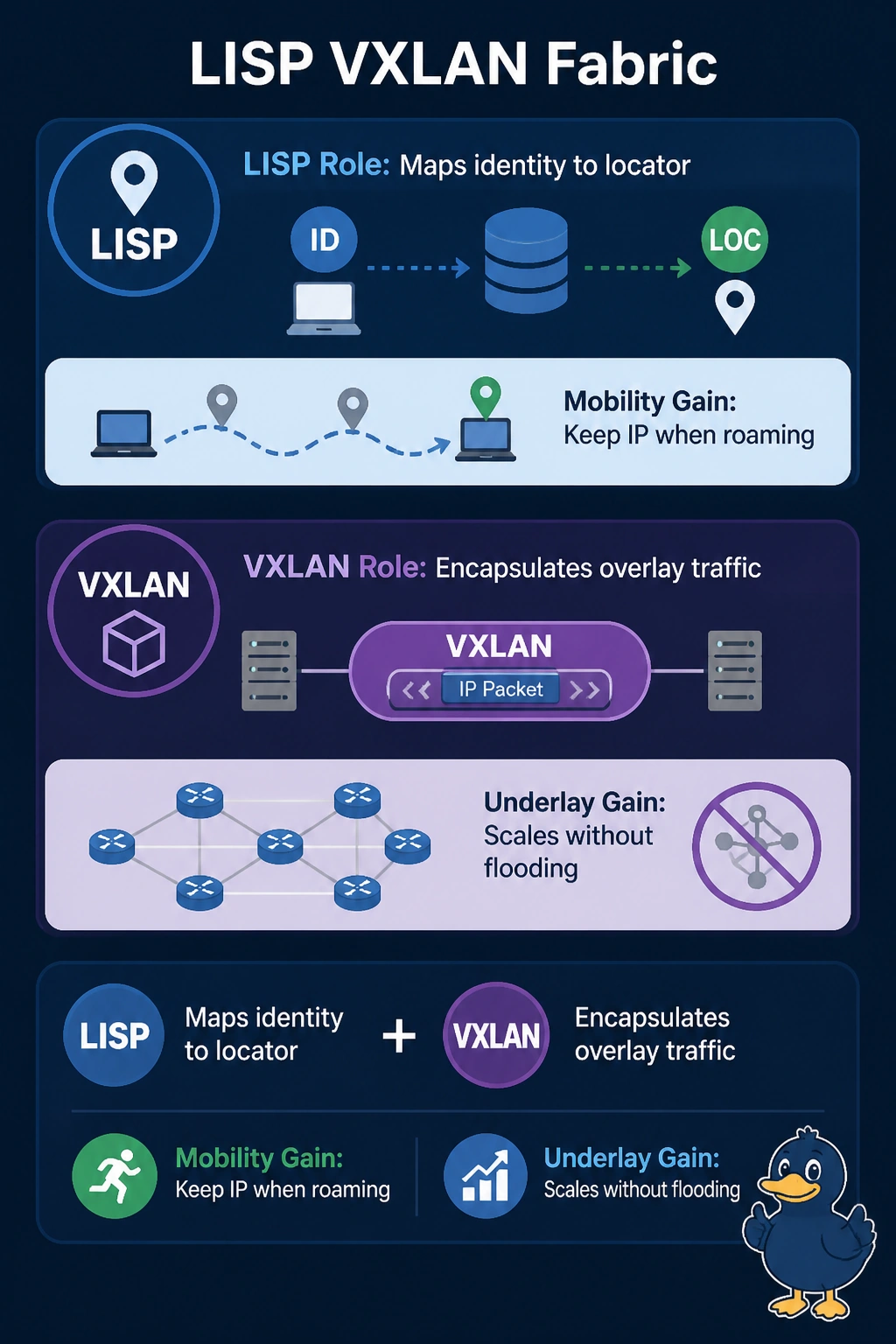
You're separating the address book from the delivery trucks, so moves don't break deliveries. LISP's map-and-encap split lets VXLAN forward while the map tracks where you roam.
Full Explanation
The correct description reflects fabric separation of control and data, because LISP provides the control plane mapping of endpoint identity to routing locator, enabling mobility with consistent addressing, while VXLAN provides data-plane encapsulation that carries Layer 2 and Layer 3 traffic over the underlay without traditional flooding. Reversing the roles fails by concept because VXLAN does not maintain identity-to-locator mappings and LISP itself is not the overlay header transporting user frames. Calling LISP encryption and VXLAN routing fails by concept because encryption and route advertisement are separate functions from mapping and encapsulation in this design. Calling LISP policy enforcement and VXLAN a database fails by concept because enforcement occurs at edge and border nodes while mapping state resides in the control plane node. Exam caveat: always tie LISP to mapping and VXLAN to encapsulation in SD-Access. Practical check: verify map registrations for roaming endpoints and VXLAN tunnel status across underlay paths.