
A network team automates Cisco IOS XE switches and must choose a management interface that uses standard HTTP operations on a hierarchical data model with JSON encoding. They need to retrieve and modify specific configuration resources by URL path. Which RESTCONF characteristic justifies selecting RESTCONF for this use case?
Select an answer to reveal the explanation.
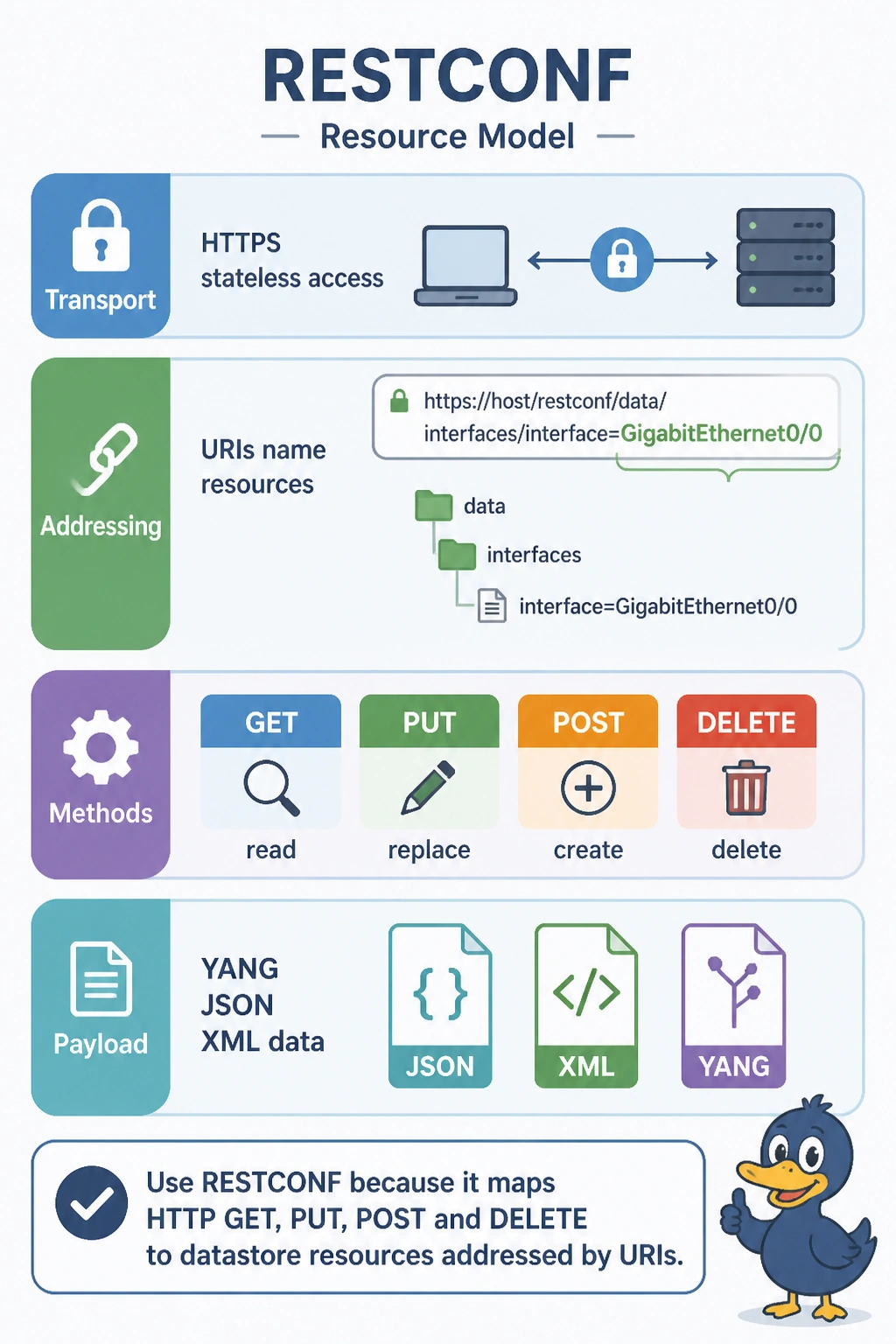
Short Explanation
You're browsing the network like web pages, where each URL is a setting you can fetch or change. That resource-oriented style is what makes RESTCONF simple over HTTPS.
Full Explanation
RESTCONF is the correct choice because it provides an HTTP-based interface to YANG-defined datastores where each configuration node is a resource identified by a URI path and manipulated with standard methods with GET for retrieval and PUT POST PATCH DELETE for modification, using structured encoding that includes JSON as required here, which directly satisfies hierarchical modeling plus URL-addressed access plus JSON. The polling-oriented description fails by writability because limiting interaction to GET for operational state supports valid monitoring but cannot fulfill the stated need to modify specific configuration resources, so read-only use remains insufficient despite correct transport and encoding. The XML-only description fails by representation because while RESTCONF can indeed carry XML payloads and many deployments do so, the scenario explicitly requires JSON encoding for automation parsing, so mandating XML alone violates a stated fact. The whole-datastore replacement description fails by granularity because overwriting the entire running datastore in one transaction is a supported bulk pattern but it does not provide retrieval and targeted modification of individual resources by URL path and it increases risk compared to resource-level addressing. For exam caveat, avoid equating any HTTPS transport or shared YANG models with RESTCONF semantics since generic APIs, telemetry subscriptions, and session-oriented management can share models and security yet differ critically on methods, addressing, encoding, and persistence. As a practical check, validate on IOS XE with authenticated curl calls using Accept and Content-Type application/yang-data+json against restconf/data paths for a specific interface, confirming GET returns that subtree and targeted PUT modifies only that URI before committing the choice to playbooks.