
A logistics firm must connect new IPv6-only sensors across regional sites, but the core remains IPv4-only with no upgrade window and limited MTU headroom. Routing changes must stay minimal at the core. Which overlay tunneling approach for IPv6 across IPv4 infrastructure best fits this migration?
Select an answer to reveal the explanation.
Short Explanation
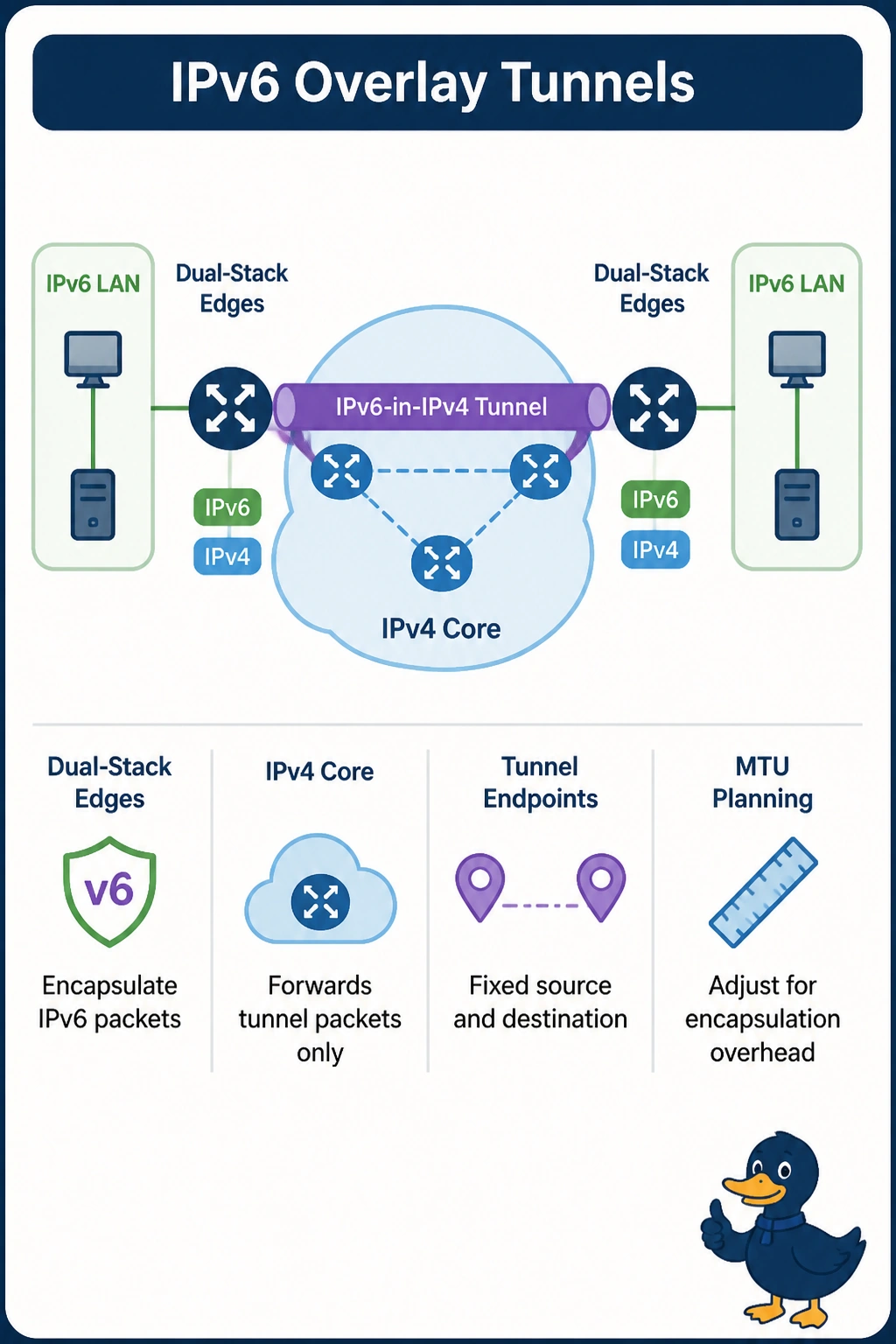
You've got new IPv6 islands to link without touching your IPv4 core. You'll set up a manual tunnel between your dual-stack edges — it's like a private express lane straight over the old road.
Full Explanation
The manually configured point-to-point design fits because only the regional edge routers need dual-stack and a defined tunnel source and destination, while the IPv4-only core forwards the encapsulated packets as ordinary IPv4 without any IGP change or upgrade, providing deterministic routing for stable site-to-site sensor traffic with only 20 bytes of IPv4 overhead, which best preserves limited MTU headroom. The dynamically addressed automatic fabric that embeds IPv4 addresses into the IPv6 prefix fails stability and control despite easing meshed deployment, because it ties addressing to public IPv4 endpoints and often depends on relays and frequent prefix changes that complicate enterprise routing and troubleshooting. The UDP-encapsulated host traversal mechanism fails scope and efficiency despite solving NAT traversal, because it is built for transient single hosts behind NATs rather than gateways aggregating IPv6-only sensors, and the extra UDP plus IPv4 headers worsen MTU pressure while adding relay dependence and jitter. The flexible multiprotocol encapsulation with extra headers fails MTU economy despite versatility for multiple protocols and tunnel modes, because the added GRE header on top of IPv4 increases overhead to 24 bytes or more and reduces effective payload size compared with a minimal IPv6-in-IPv4 tunnel. As an exam caveat, distinguish manual tunnels by keywords stable, deterministic, site-to-site, minimal core change and low overhead from automatic and host-based methods signaled by dynamic, NAT, temporary, or multiprotocol. As a practical check, verify IPv4 reachability between tunnel endpoints, explicitly set tunnel MTU and TCP MSS clamping, and confirm end-to-end IPv6 sensor reachability before scaling.