
A university has four regional hubs each serving dozens of closets, and the core routing table is growing with flapping access prefixes that destabilize the backbone. The goal is clean summarization at each hub and stable core updates. Which hierarchical IPv4 plan should the designer create to enable summarization at distribution boundaries?
Select an answer to reveal the explanation.
Short Explanation
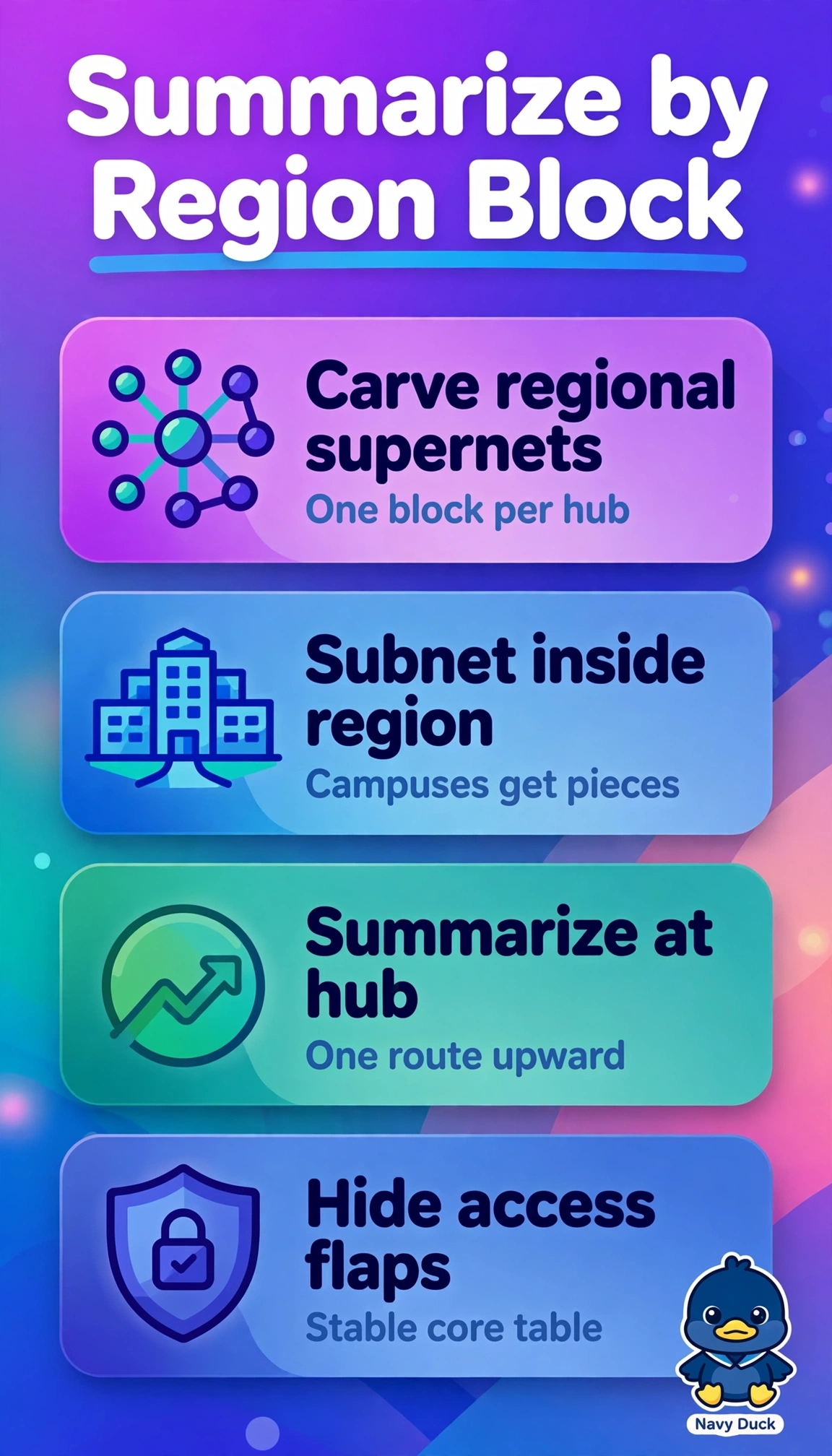
You get stable core updates when each hub has a clean boundary to summarize. Give each region one contiguous block and subdivide it for campuses, making contiguity your design anchor.
Full Explanation
The right plan aligns addressing with routing topology: give each hub one large contiguous regional block and carve campus, building, and closet subnets from it. The hub can then advertise a single summary to the core, hiding access flaps, minimizing core routing state, and creating clean distribution boundaries. Giving every campus a separate block from the central pool can support campus autonomy and tidy campus-edge advertisements, but unrelated prefixes behind one hub do not form a common regional aggregate; the hub may have to propagate many routes instead of summarizing. Giving each region a contiguous block but leaking campus more-specifics to the core preserves visibility or supports optimal path control, yet exposes access flaps to the backbone, allowing the core table to grow and destabilize. Organizing blocks by device function across regions can simplify ACLs, QoS, and device moves, but it spreads functional prefixes across hubs rather than aligning them with regional boundaries, preventing clean hub summarization. Exam caveat: distinguish logical neatness from topological summarizability; only alignment with the chosen boundary reduces routing state there. Practical check: list the routes a hub would advertise upstream and verify that one regional prefix covers them; if exceptions are needed, the plan misses the stability goal.