
A manufacturing firm uses six campus QoS classes for voice, interactive video, plant control, transactional data, bulk transfer, and scavenger traffic. Its new MPLS provider supports only a three-class model with fixed DSCP for real-time, business-critical, and default, and re-marks nonconforming values. The firm must keep voice latency low and protect control transactions without starving default. Which enterprise-to-SP DSCP aggregation strategy best preserves the end-to-end QoS policy intent?
Select an answer to reveal the explanation.
Short Explanation
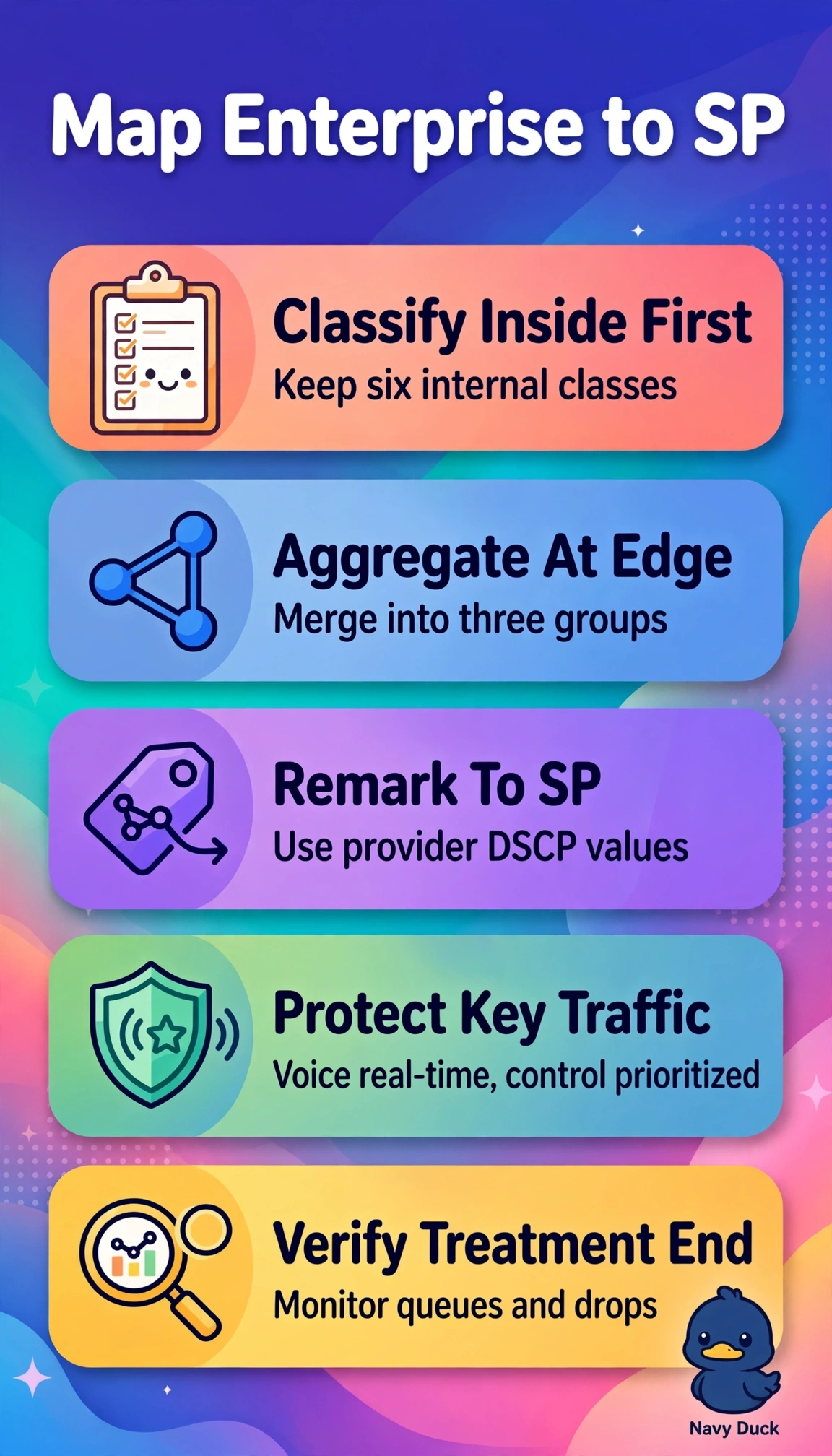
You keep control by translating at the border, not by fighting the provider. Aggregating into their three classes with remarking lets voice stay fast while control and bulk share sensibly, like consolidating mail into priority, standard, and bulk bins.
Full Explanation
End-to-end QoS intent is preserved only when the enterprise maps its six-class policy to the provider fixed three-class model at the handoff and rewrites DSCP to the values the provider honors, which keeps real-time traffic in the low-latency queue, groups transactional data with plant control into business-critical for assured forwarding, and leaves bulk and scavenger in default so default is not starved. Preserving DSCP values while grouping at the WAN edge fails on trust and remarking behavior because the provider re-marks any nonconforming code point, so voice and control would unpredictably fall to default despite correct local grouping. Reserving business-critical for transactional data while placing plant control with bulk in default fails on control-plane protection because control transactions then compete with loss-tolerant bulk and scavenger traffic and lose assured bandwidth and drop preference during congestion. Consolidating voice, video and control into business-critical while leaving real-time unused fails on latency engineering because business-critical is provisioned for assured forwarding rather than strict priority with policed low jitter, so voice delay and variation increase even though classification is simplified. For exams, remember that provider remarking forces enterprise-edge aggregation and setting rather than transparency, and that voice must use real-time to meet latency targets; in practice verify the provider contract for DSCP-to-class mapping, configure the WAN edge policy to aggregate and set conforming values, then monitor per-class drops, queuing and one-way latency to confirm voice stays in real-time and control stays protected.