
A hospital is deploying SD-Access with wireless infusion pumps roaming between floors, a fusion router to the data center, and a need for a central host database. The design must keep endpoints on the fabric while handling external connectivity and endpoint location. Which SD-Access fabric role assignment satisfies those needs?
Select an answer to reveal the explanation.
Short Explanation
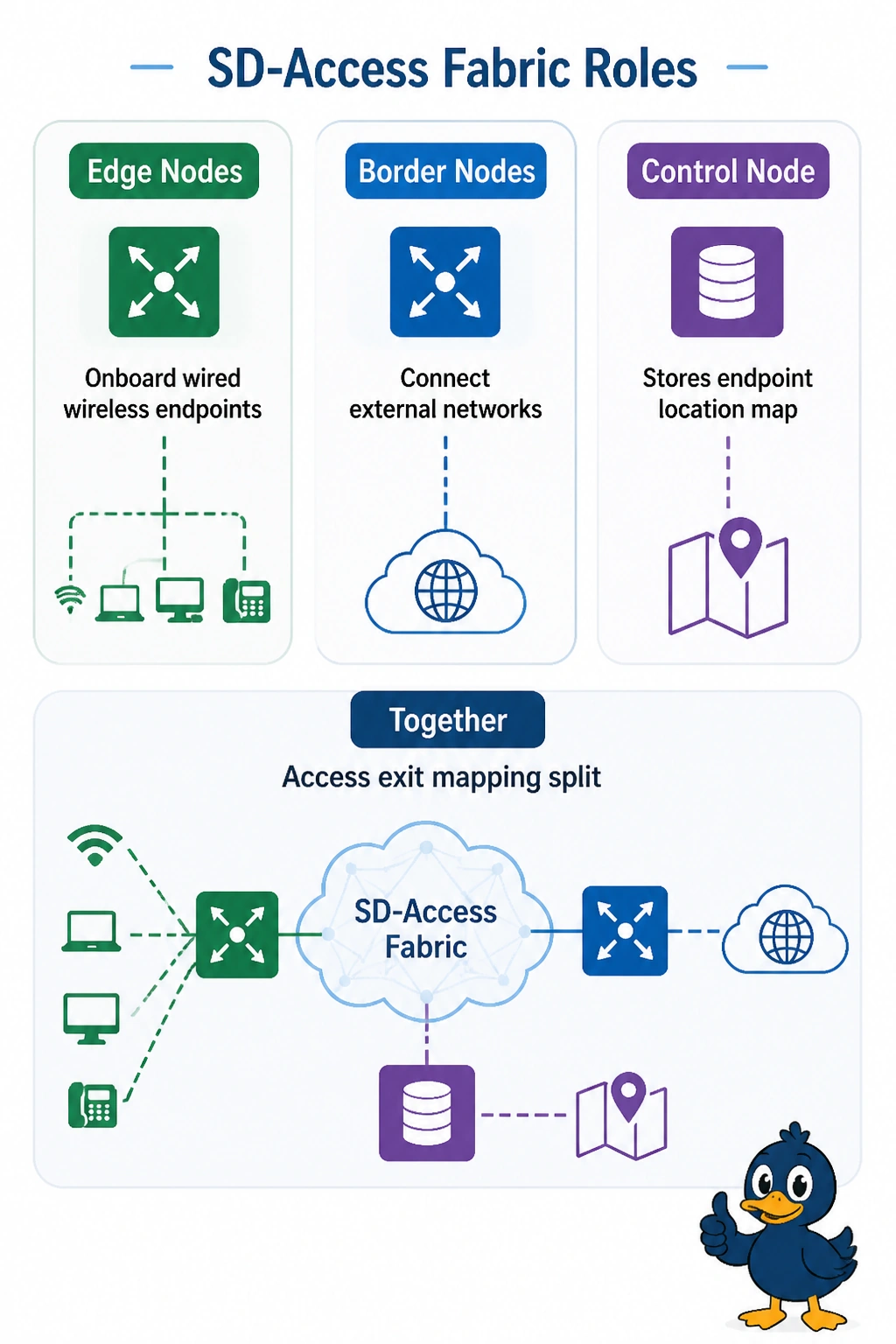
You'll nail the roles if you match each job to its place at the table. Remember the division-of-labor with edge handling users, border handling exits, and control plane handling maps.
Full Explanation
The correct assignment aligns with SD-Access architecture where fabric edge nodes connect and onboard endpoints including roaming clients, fabric border nodes provide handoff to external networks such as data centers and Internet, and control plane nodes maintain the host tracking database of endpoint-to-location mappings. Swapping border and edge duties fails by concept because border nodes are exit points with fusion and policy handoff, not access onboarding for large endpoint counts. Placing onboarding on control plane nodes fails by concept because control plane nodes are a centralized mapping system, not access switches for wired and wireless attachment. Assigning mapping to edge and routing to control plane fails by concept because edge nodes enforce policy for attached hosts while mapping and external route advertisement belong to control plane and border functions. Exam caveat: do not confuse control plane mapping with policy enforcement, which is distributed to edge and border. Practical check: validate that roaming endpoints retain identity while the control plane updates their locator and borders advertise external routes.