
A retail chain with 40 stores needs any-to-any inventory traffic between stores and two data centers, plus a separate low-latency point-to-point link for payment processing between the primary data center and a bank cage. The carrier offers Metro Ethernet services with different forwarding and isolation options. Which Metro Ethernet design best fits these connectivity requirements?
Select an answer to reveal the explanation.
Short Explanation
You're choosing between a group chat and a private call for different conversations. Pairing multipoint E-LAN for stores with private E-Line for payments gives each traffic type the right shape.
Full Explanation
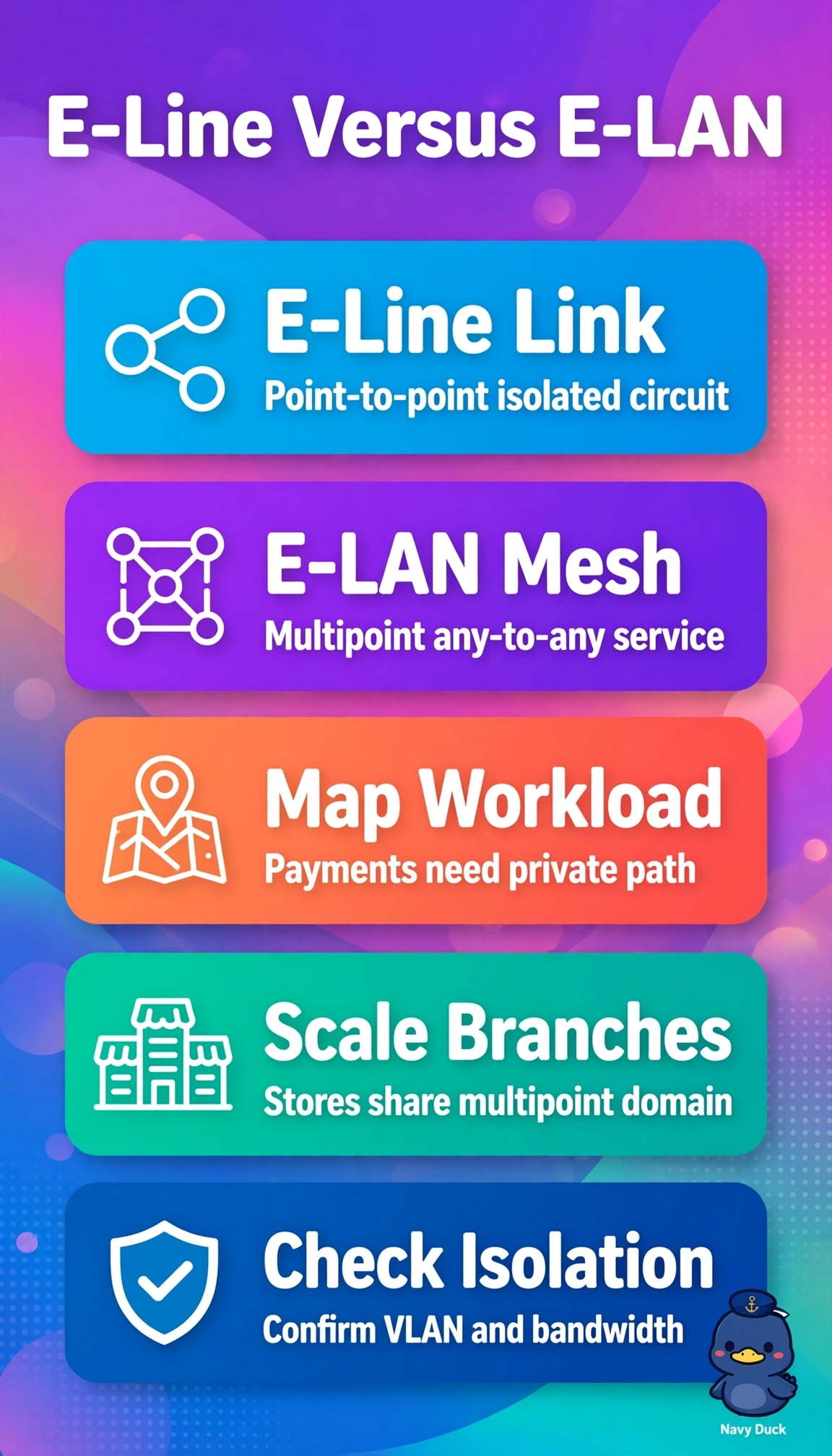
The correct design matches service attributes to traffic patterns: E-LAN provides multipoint-to-multipoint Ethernet connectivity ideal for 40 stores plus two data centers needing any-to-any inventory exchange without hub-spoke tromboning, while E-Line provides an isolated point-to-point EVC with predictable low latency ideal for payment processing between the primary data center and bank cage. The E-Tree alternative fails by forwarding concept because rooted-multipoint permits root-to-leaf communication but restricts leaf-to-leaf forwarding, so stores as leaves could reach data centers as roots but not each other for direct inventory traffic. The converged E-LAN alternative fails by isolation concept because placing regulated payment flows on the same multipoint EVC as inventory removes the dedicated separate connection and risks contention and fate-sharing that violates the low-latency point-to-point requirement. The secondary-center E-Line alternative fails by endpoint concept because it terminates the payment EVC at the wrong location, providing separation and latency but not between the required primary data center and bank cage for settlement. Exam caveat: focus on forwarding behavior and endpoint pairing rather than assuming any Ethernet service can substitute if bandwidth is sufficient. Practical check: validate the multipoint member list and EVC map, confirm the payment EVC endpoints, VLAN isolation, and latency SLA with the carrier before cutover.