
A retailer connects three large campuses in a metro area, each with dual core routers and a requirement for sub-second convergence, clear failure domains, and summarized routes between sites. Links are dark fiber with ample bandwidth. Which multicampus Layer 3 topology design best satisfies fast convergence and containment?
Select an answer to reveal the explanation.
Short Explanation
You've got fiber to spare, so use it to keep failures small and paths short. A routed triangle with summarization acts like fire doors between buildings, stopping churn from spreading.
Full Explanation
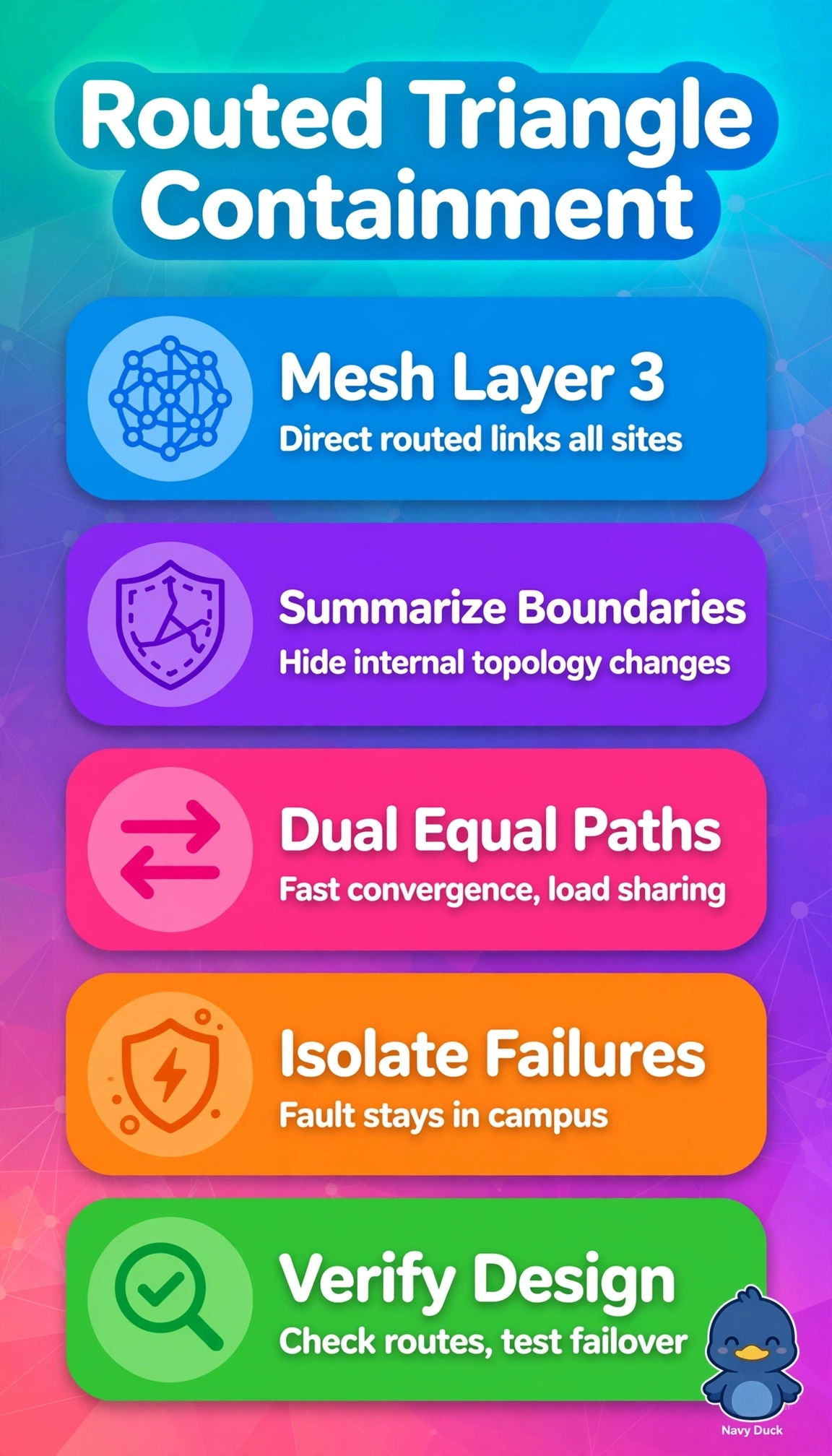
A routed triangle with Layer 3 point-to-point links and route summarization gives each campus an independent failure domain while providing two equal-cost paths to every other campus, which delivers fast OSPF or EIGRP convergence and deterministic traffic flow without dependence on a single transit site. Summarization at campus boundaries hides internal flaps and reduces topology database size, improving stability and scalability across the multicampus design. An extended Layer 2 domain violates containment by flooding STP and broadcast issues across fiber and creates large failure domains with slower convergence. A chained Layer 3 topology through one central campus conserves fiber but adds extra hops, fate-shares remote campuses on the transit campus, and doubles convergence exposure. Backhauling through a data center hub centralizes policy but creates suboptimal trombone routing, congestion risk, and a single point of congestion for campus-to-campus flows. On the exam, prefer routed Layer 3 boundaries with summarization for multicampus designs unless Layer 2 adjacency is explicitly required, and in practice verify summarization and equal-cost paths with routing tables and traceroutes.