
A regional bank branch has primary MPLS and backup Internet VPN with a floating static route. The business needs sub-second failure detection on the primary path and automatic failover only when the remote data-center prefix becomes unreachable. Which backup connectivity and failover trigger design meets both timing and reachability goals?
Select an answer to reveal the explanation.
Short Explanation
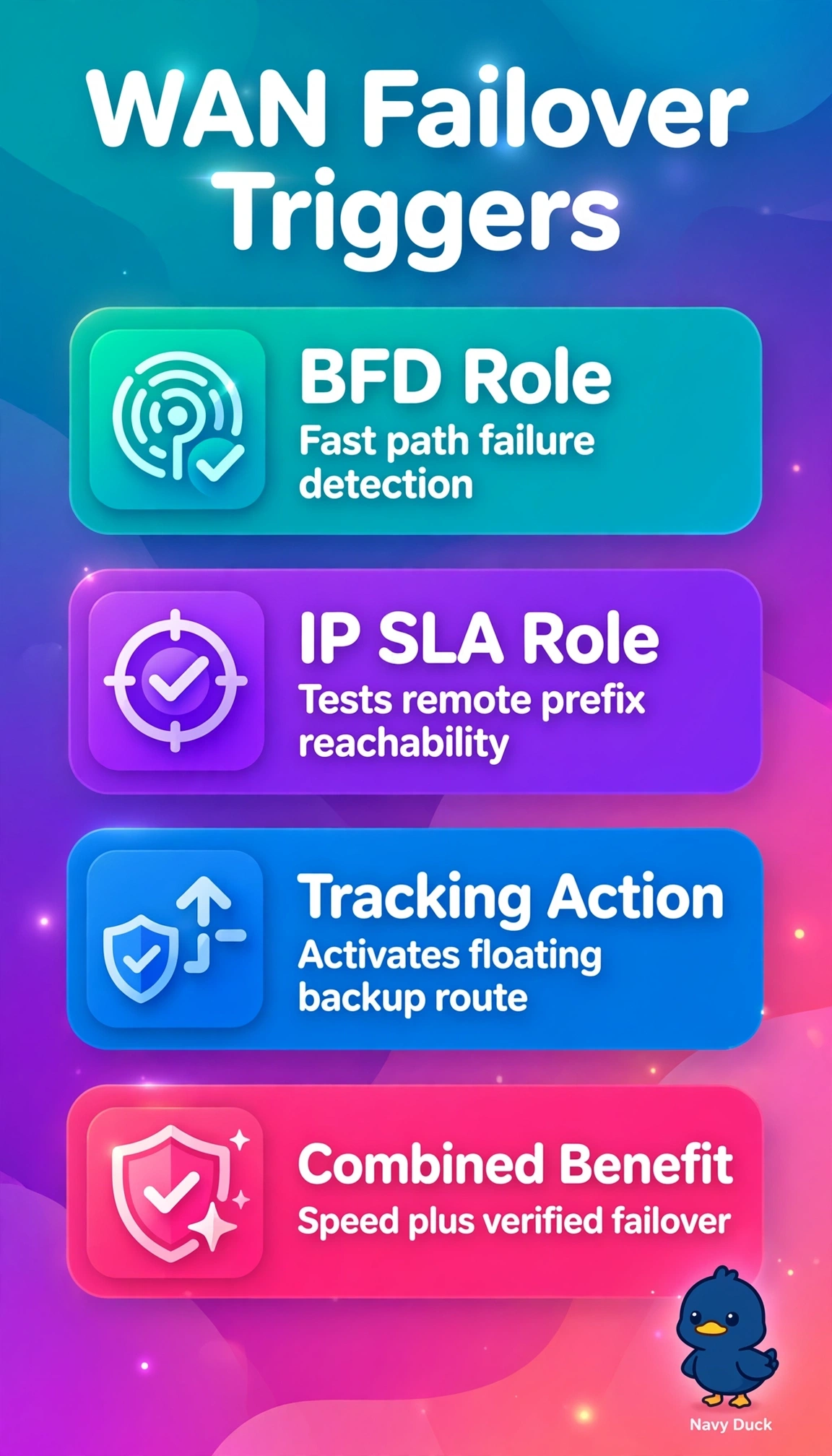
You've got speed plus proof in one design, since BFD spots the outage fast while tracking confirms the far end is gone. That combo is your heartbeat-plus-confirmation for reliable WAN failover.
Full Explanation
The correct approach pairs fast liveness detection with end-to-end reachability validation, because BFD provides millisecond hello-based failure detection on the forwarding path while IP SLA with tracking verifies the remote prefix is actually unreachable before activating the floating backup route. Tracking only the local gateway fails by concept because local up does not prove remote reachability, so failover would miss far-end outages. Relying on interface error counters fails by concept because errors do not equal path loss and would cause unstable flapping between links. Tracking only physical line state fails by concept because the interface can stay up while the upstream MPLS path is broken, leaving the outage undetected. Exam caveat: associate BFD with demand for speed and IP SLA tracking with demand for proof of remote reachability. Practical check: verify BFD neighbor state and IP SLA reachability status before tuning timers in production.