
A university is deploying SD-Access across three buildings with 800 wired users. Endpoints must connect inside virtual networks, external and DC traffic must exit efficiently, and endpoint location must resolve centrally. Which SD-Access fabric role assignment best meets these requirements?
Select an answer to reveal the explanation.
Short Explanation
You nailed the separation of duties here. The edge connects users, the border is the exit door, and the control plane is the directory that knows where everyone lives.
Full Explanation
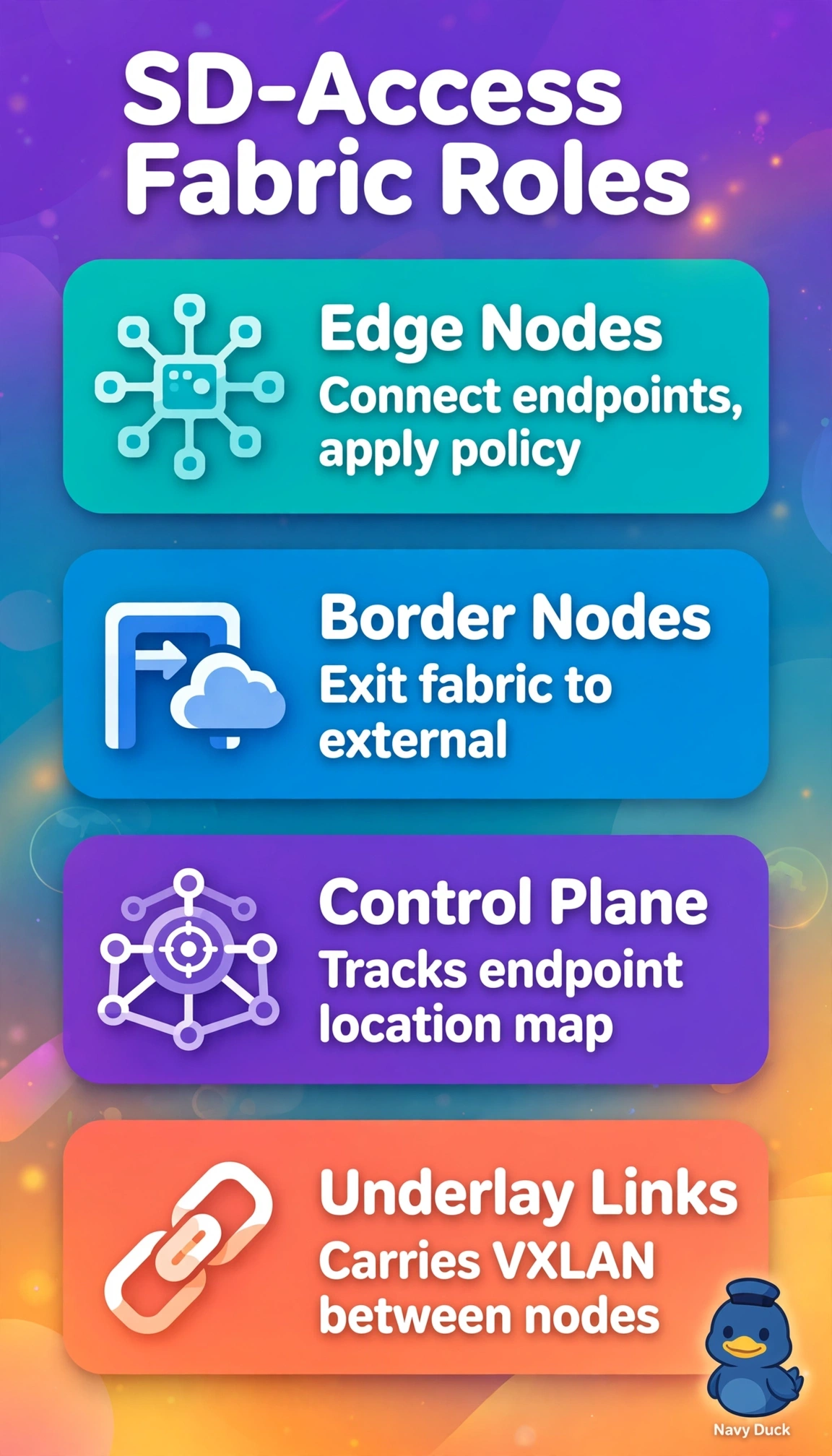
SD-Access fabric separates attachment, exit, and directory functions where edge nodes provide host onboarding and VXLAN encapsulation for endpoints in virtual networks, border nodes connect the fabric to outside networks such as data center, internet, or WAN and handle virtual network to external route leaking, and control plane nodes run the LISP map system to register endpoint IDs to edge locators and answer mapping queries. Placing border nodes at access misplaces the external gateway function and leaves no clean handoff, using control plane nodes for forwarding user traffic confuses signaling with data forwarding since they do not sit in the packet path, and assigning endpoint mapping to border or edge nodes collapses the centralized directory model that allows mobility and consistent policy. Exam caveat is that control plane and border functions can physically co-locate on the same device in small designs but logically remain distinct roles. Practical check is to verify edge to border reachability in the underlay and that endpoints register to the expected control plane node during onboarding tests.