
A service provider plans an on-premises controller cluster for 800 WAN Edge routers with dual transports and a full internet routing table redistributed at data centers, expecting 150,000 OMP routes. Architects must choose server resources and clustering. Which sizing factor for on-premises controllers addresses the scale requirement?
Select an answer to reveal the explanation.
Short Explanation
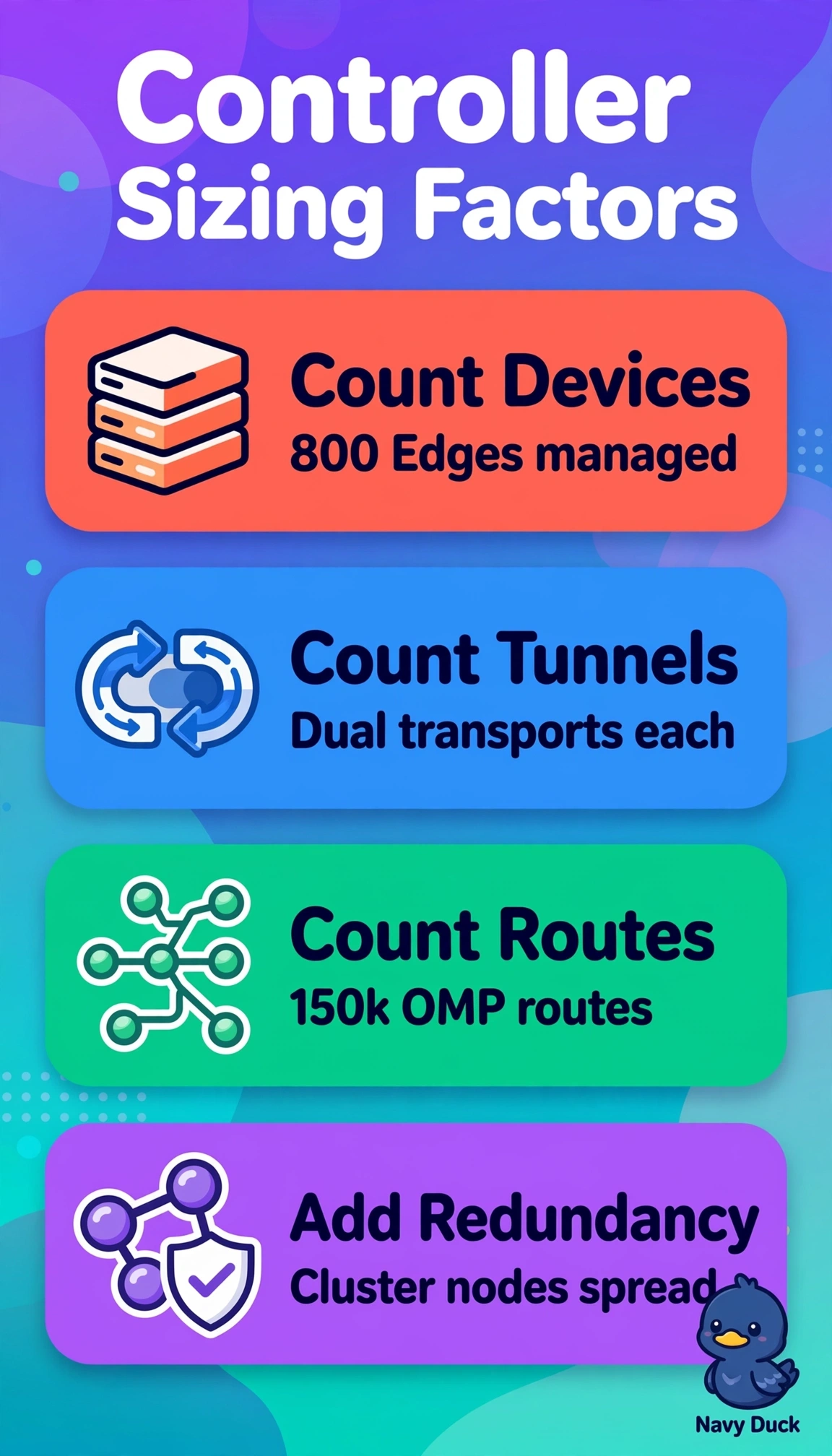
As you plan the cluster, count devices, tunnels, and routes together, and include redundancy. Control-plane scale depends on all of these dimensions, so leaving one out can strain the system under load.
Full Explanation
Sizing on-premises Manager and Controller nodes for device count, tunnel scale, OMP route volume, and redundancy addresses both session and state scale with high availability. Here, 800 WAN Edge routers with dual transports create about 1,600 transport attachments and multiplied DTLS/TLS control connections to Managers and Controllers. The redistributed full Internet table adds 150,000 OMP routes to store, synchronize, and re-originate in the OMP RIB, driving CPU, memory, disk, and bandwidth needs; a redundant cluster across failure domains supports survivability and upgrades. Sizing for 800 devices and dual-transport tunnels with redundancy but omitting OMP volume assumes a default route profile, underestimates RIB memory, synchronization load, and convergence CPU, and risks route churn, delayed updates, and instability when the full table is injected. Sizing for 800 devices and 150,000 routes with redundancy but omitting the dual-transport multiplier undercounts control sessions by nearly half, leaving Controllers undersized for setup, keepalives, and rekey storms during failover. Sizing devices, tunnels, and routes without redundancy omits standby capacity, so a host, site, or upgrade event can cause loss of management and OMP reflection. Exam caveat: Validators broker certificates and connectivity; they do not store OMP routes, so Validator or data-plane capacity cannot replace Manager and Controller scale. Practical check: validate the current Cisco scale matrix and test with the full prefix load, monitoring OMP route counts, control connection counts, CPU, and memory before finalizing server resources.