
A healthcare group needs firewall, IDS and load-balancer functions hosted in two colocation facilities to serve 120 clinics with shared inspection before cloud access. Which Cloud OnRamp for Colocation design should you deploy for service chaining and shared services in a colo cluster?
Select an answer to reveal the explanation.
Short Explanation
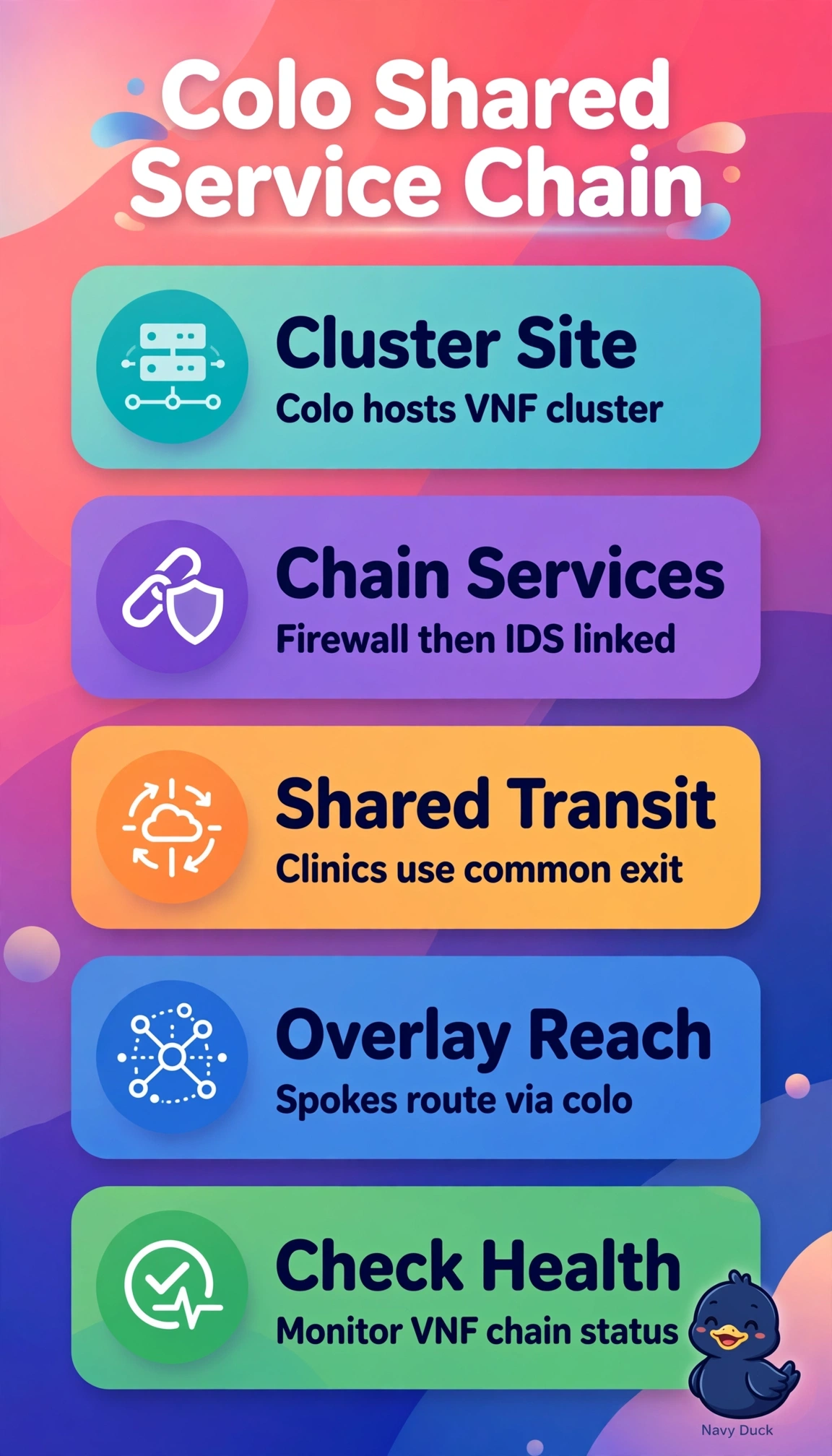
You're building one clean security checkpoint for every clinic to pass through. Colo clustering chains shared virtual services together, like connecting airport security stations in one terminal.
Full Explanation
Cloud OnRamp for Colocation provisions a cluster of compute hosts in a colo with SD-WAN switching, hosting virtual network functions as service chains that branches reach via SD-WAN overlay for shared security and transit. That mechanism makes a colo cluster with chained virtual firewall and IDS services correct because clinics reuse centralized inspection and shared transit instead of per-site appliances. Cloud OnRamp for SaaS with gateways fails by concept because SaaS optimization probes and selects best paths to SaaS applications, not hosting chained virtual functions in a colo. Cloud OnRamp for IaaS with public-cloud routers fails by concept because IaaS integration extends fabric into hyperscalers for workload connectivity, not shared colo service hosting. Branch-local breakout chaining fails by concept because per-site service insertion does not provide shared colo services or centralized scaling. Exam caveat is to link colocation questions to service chaining and VNF clusters managed through SD-WAN Manager. Practical check is to verify service chain attachment, VNF health, and spoke-to-colo OMP routes. Note that Cloud OnRamp for Colocation reached end of sale in October 2023 with release 17.9 as its last supported release, so treat this as legacy design knowledge.