
A retail store has one router with LTE and a second router with wired broadband only 2 meters away, but pulling a second carrier into both routers is too costly. The engineer wants the LTE-less router to use its neighbor for path diversity. Which TLOC extension design correctly shares transport between the collocated routers?
Select an answer to reveal the explanation.
Short Explanation
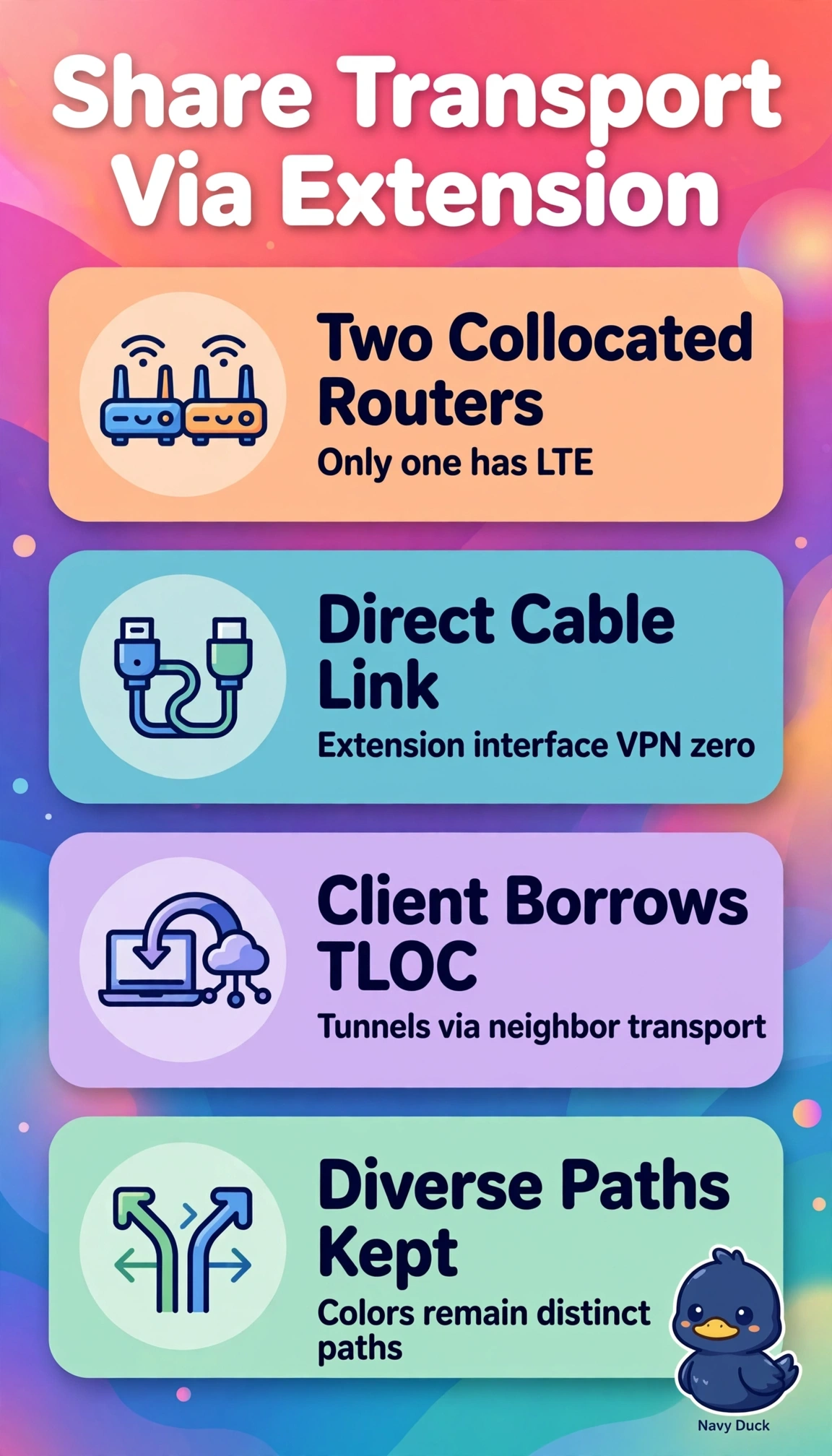
You're letting one router borrow a neighbor's car for the highway on-ramp. TLOC extension shares that transport port over a direct cable.
Full Explanation
TLOC extension uses a dedicated interface on each collocated WAN Edge, typically configured as a TLOC-extension interface in VPN 0 with a private interconnect subnet, allowing one router designated as TLOC-extension client to encapsulate and forward its overlay tunnels out the provider-facing transport of the TLOC-extension server router without needing its own circuit. Using a VPN 512 management link with BGP fails because VPN 512 is out-of-band management and does not carry VPN 0 tunnel encapsulation or TLOC colors, while configuring an on-demand spoke-to-spoke tunnel fails because on-demand tunnels are dynamic overlay IPsec between remote sites, not a last-meter transport-sharing mechanism. Inserting a service-side firewall and advertising a service route fails because that provides L3/L7 service insertion on service VPNs, not extension of a WAN transport TLOC. Exam caveat: both routers still need control connections, but the client builds them via the borrowed TLOC, so do not remove its VPN 0 config. Practical check: verify the extension interface state and show sdwan control connections to confirm the client shows the borrowed color and both transports are up.