
A logistics firm runs OSPF and connected subnets at 60 sites and must advertise only selected branch prefixes into the SD-WAN overlay while preventing core loopback prefixes from entering OMP. OMP is enabled with default behavior on all Edges. Which control for redistribution into OMP satisfies the selective advertisement requirement?
Select an answer to reveal the explanation.
Short Explanation
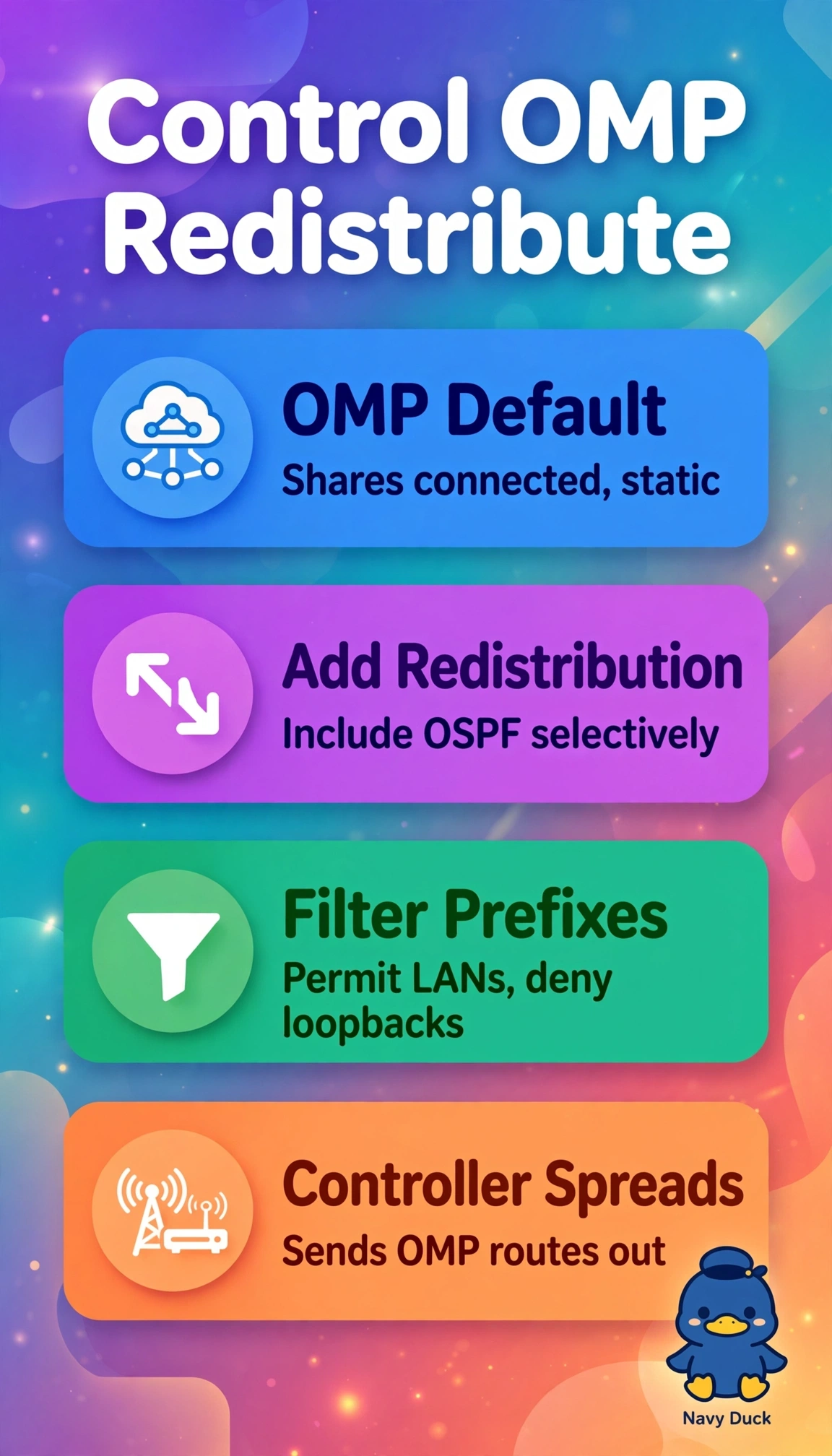
OMP is chatty by default and will share more than you want unless you filter it. Redistribution filtering with prefix lists lets you pick exactly what enters the overlay. It's your guest list for the fabric-wide party.
Full Explanation
The correct control preserves default OMP advertisement and adds explicit redistribution filtering because by default WAN Edges advertise connected, static, and OSPF intra- and inter-area routes into OMP, so applying prefix lists at redistribution provides precise source-side selection of branch prefixes while blocking core loopbacks from ever entering OMP, which scales cleanly across 60 sites without changing OSPF adjacency or overlay peering. The centralized Controller control policy approach fails by enforcement point because it filters OMP routes during overlay propagation after they have already been redistributed into OMP on the Edge, so loopbacks still enter OMP and violate the stated prevention requirement even though downstream reachability looks correct. Filtering only OSPF redistribution while leaving connected redistribution automatic fails by protocol coverage because connected subnets continue to enter OMP without selection, which leaks unintended prefixes and defeats selective advertisement when branch or loopback addresses exist as connected routes. Summarizing core loopbacks into an aggregate fails by advertisement outcome because aggregation still creates and advertises a loopback-derived prefix into OMP for efficiency rather than preventing entry, so the core footprint remains visible contrary to the isolation requirement. For exams, distinguish redistribution into OMP on the Edge from control-policy filtering of OMP on Controller, as wording often tests enforcement location rather than filtering intent. In practice, verify with show omp routes and related routing tables on Edge and Controller to confirm only intended branch prefixes appear in OMP and no loopback or extra connected prefix is present before scaling the template.