
An enterprise runs dual data centers with regional hubs and needs to prevent specific branch TLOCs from being advertised to a partner site, while allowing all other overlay routes. Central changes must apply fabric-wide without touching branch CLIs. Which centralized control policy application achieves this routing control?
Select an answer to reveal the explanation.
Short Explanation
You're shaping who learns which overlay paths, so control the advertisements centrally. Apply TLOC filtering with a centralized control policy on the Controller to govern OMP distribution. It's like a mailroom deciding which forwarding addresses get shared.
Full Explanation
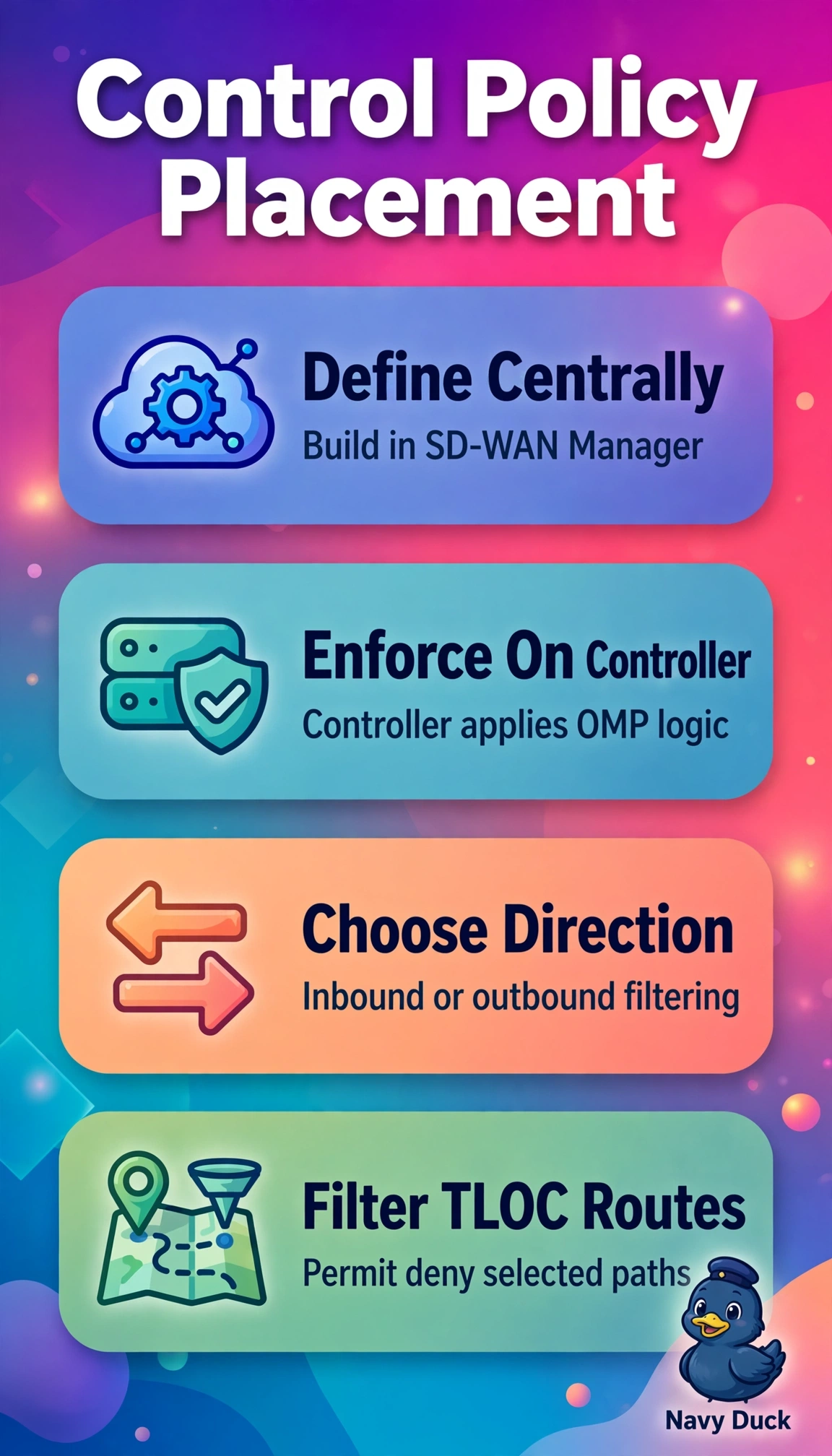
The correct approach works because TLOC routes advertise transport reachability separately from OMP prefixes, and a centralized control policy applied on the Controller in inbound or outbound direction can match specific branch TLOCs to reject toward the partner site while permitting all other overlay routes, with enforcement at the control plane propagating fabric-wide from a single change without branch CLI access. A centralized control policy using OMP route filters fails by route-type concept because OMP filters match prefix NLRI for service VPN advertisements and do not evaluate TLOC NLRI, so prefix filtering cannot suppress transport locator advertisements to the partner. A centralized data policy with TLOC-based matching fails by policy-type concept because data policy programs forwarding behavior and path selection after routing is resolved rather than controlling advertisement of control-plane state, so it can steer traffic but cannot prevent TLOC propagation. A localized control policy with TLOC filters applied at the site fails by scope concept because localization binds enforcement to specific WAN Edge devices requiring device-level provisioning and ongoing maintenance, violating the requirement for single-point central changes without touching branch devices. For exam precision, remember inbound and outbound are evaluated from the Controller perspective and TLOC versus OMP sequence types determine which NLRI a match statement can act upon. As a practical check, stage the policy in centralized policy preview, push to Controllers, then verify omitted TLOCs with show sdwan omp tlocs on the partner device while confirming remaining overlay routes are still received.