
A service provider is building a Cloud OnRamp for Colocation cluster in a downtown colo with two compute hosts, needing firewall plus WAN optimization in a chain and shared DNS for tenants. Which design statement should the architect present to describe Cloud OnRamp for Colocation service chaining and shared services?
Select an answer to reveal the explanation.
Short Explanation
You've got tenants sharing a kitchen while ordering different meals in sequence. Shared DNS is the pantry everyone uses and chains are the recipe order, so orchestration keeps every dish flowing right.
Full Explanation
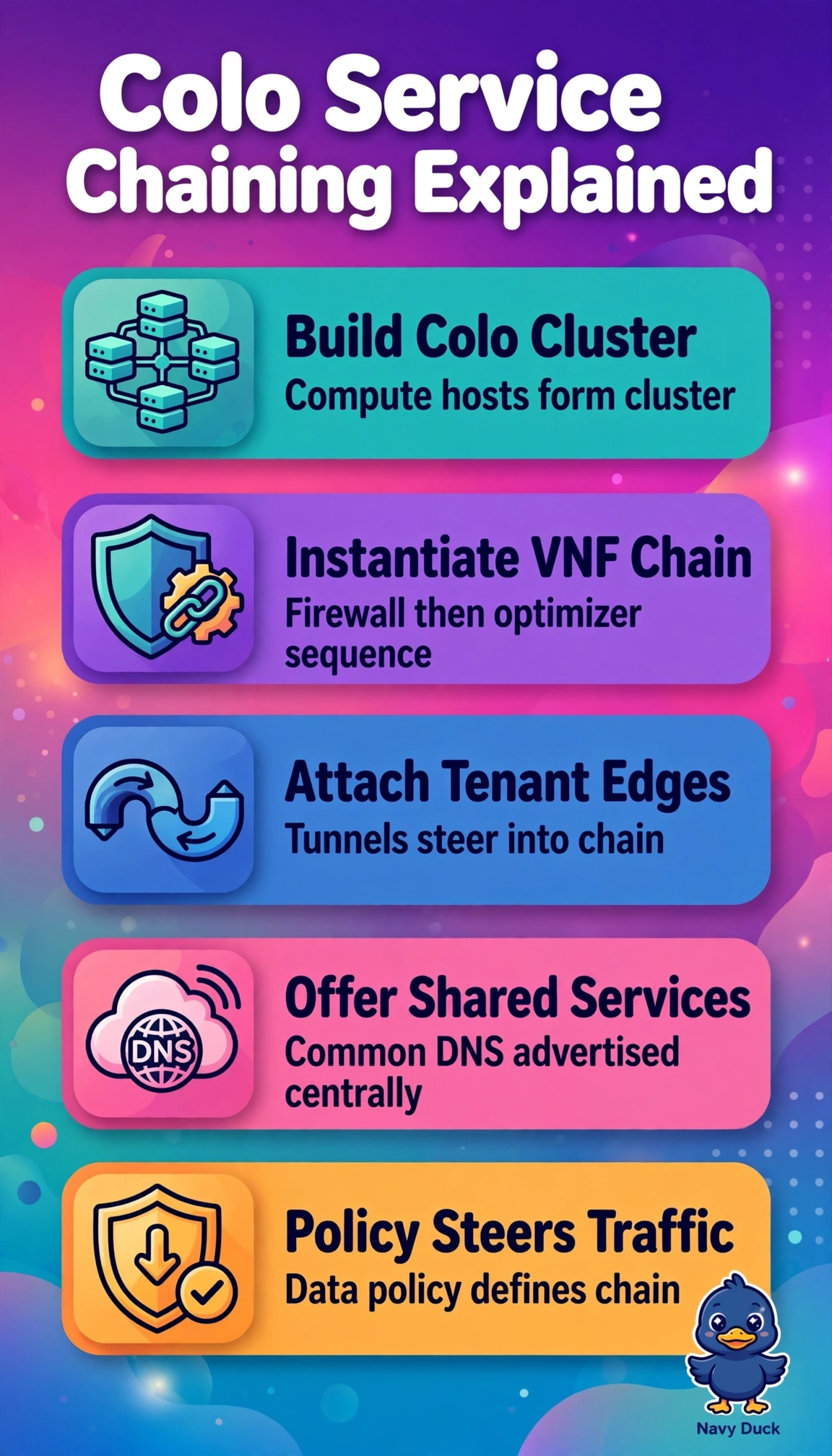
Correct because Cloud OnRamp for Colocation hosts multitenant apps and network services on a colo compute cluster, using data-policy service chaining to steer selected tenant traffic sequentially through stacked firewall and WAN optimization VNFs while shared services are advertised centrally from the colo service VPN, preserving locality, scale and consistency. Backhaul design fails because sending traffic to a distant hub for firewall and WAN processing defeats colocation purpose, adding latency and transport cost instead of chaining locally where users, clouds and apps meet. Public-cloud DNS design fails because using external DNS over DIA replaces the required colo-hosted shared-service model, breaking centralized control, tenant isolation and local resolution. Router-only design fails because two routers alone cannot provide compute, storage and lifecycle management for stacked VNFs, which requires two compute hosts. Exam caveat: distinguish functional similarity from architectural placement, as backhauled security, public DNS and router forwarding can work elsewhere but do not meet colocation chaining and shared-services requirements. Practical check: in SD-WAN Manager verify cluster hosts and VNF placement, inspect chain order and match criteria, and confirm shared DNS advertisement and reachability from each tenant VPN before cutover. Cloud OnRamp for Colocation reached end of sale in October 2023 with 17.9 as last supported release, so treat as legacy.