
A NOC team managing 200 WAN Edges reports voice complaints, needs to isolate whether the issue is device health, specific tunnel performance, or application behavior, and wants a quick triage path. Which SD-WAN Manager monitoring dashboard sequence best delivers device, tunnel and application views?
Select an answer to reveal the explanation.
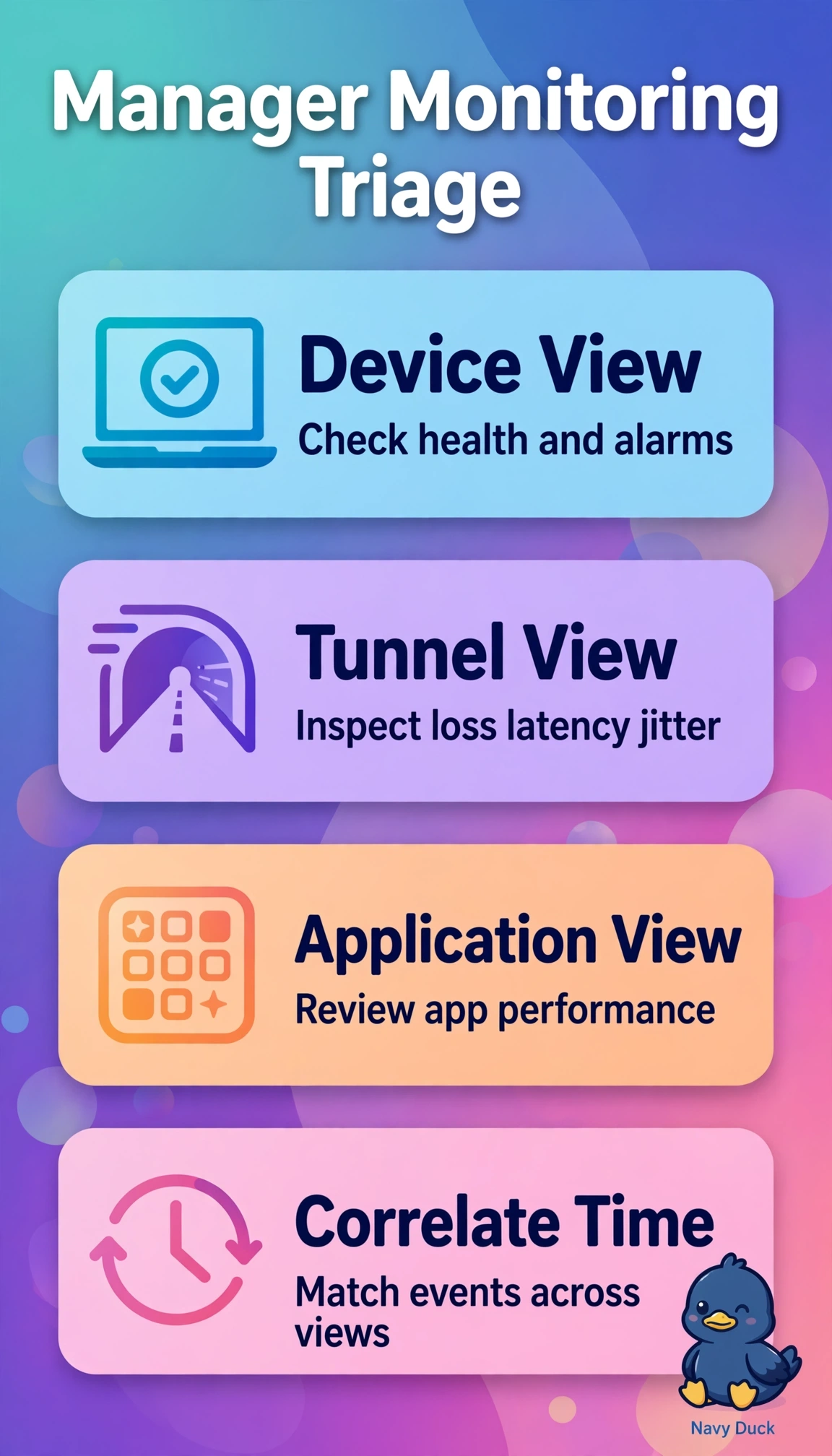
Short Explanation
Great triage thinking for that noisy NOC queue. Start wide at device health, zoom to tunnels, then apps — a classic funnel with visibility at each layer. You'll isolate voice issues fast without guessing.
Full Explanation
The correct sequence succeeds because effective voice triage across 200 WAN Edges must isolate layers in order, beginning with device health to exclude CPU, memory, or connectivity faults that would confound deeper data, continuing to tunnel performance to quantify loss, latency, and jitter on the specific transport, and concluding with application-aware routing visibility to confirm voice classification, path selection, and SLA compliance. The tunnel-first sequence with detailed tunnel metrics and voice application routing is valuable for transport troubleshooting but fails by concept because without device health it cannot separate an overloaded or unreachable Edge from a degraded path. The device-to-application sequence with voice alarms validates endpoint state and policy impact but fails by concept because without specific tunnel drill-down it cannot attribute degradation to underlay performance versus routing decisions. The device-to-tunnel sequence ending with controller connectivity and system status confirms control-plane health but fails by concept because without application visibility it cannot verify how voice is actually experienced or steered. An exam caveat is that best triage questions prioritize coverage of all requested views over deeper detail in one area, so resist efficient-sounding shortcuts that omit a layer. As a practical check, validate the flow in SD-WAN Manager by checking device health, opening an affected Edge for tunnel loss latency jitter, then confirming voice SLA in application-aware routing before escalation.