
A university wants lecture video over MPLS and dorm Netflix over broadband, matching by source subnet, destination prefix, application and DSCP. A centralized data policy is planned in SD-WAN Manager. Which sequence match design selects this traffic correctly for forwarding action?
Select an answer to reveal the explanation.
Short Explanation
You already know the what and when. Four-way match pins lecture versus dorm flows so your action hits cleanly.
Full Explanation
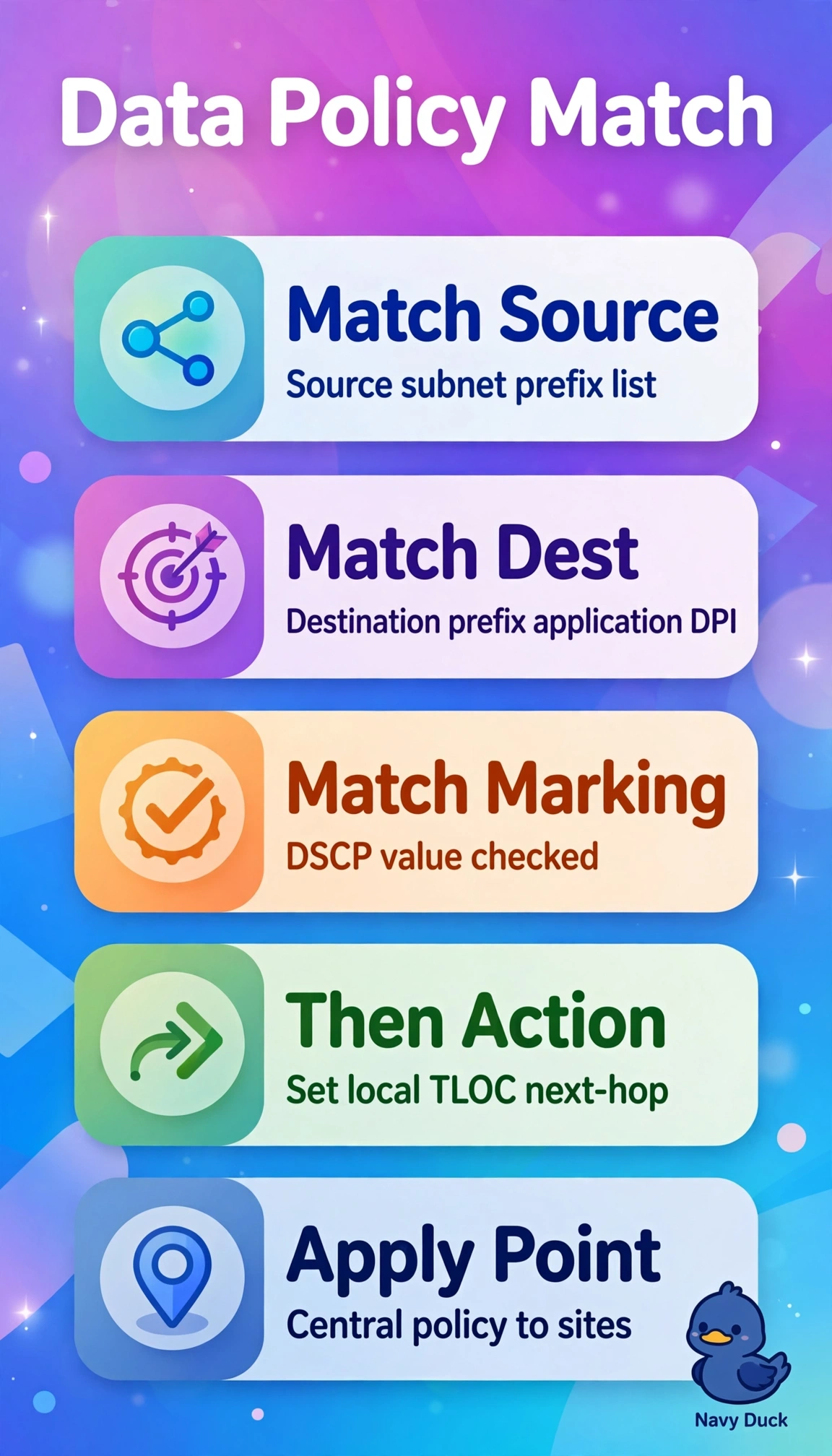
The correct centralized data-policy sequence is right because SD-WAN Manager centralized data policy uses match-action entries applied to site and VPN lists to control forwarding, and matching source IP, destination IP, application through deep packet inspection, and DSCP together precisely implements the required classification for steering lecture video over MPLS and dorm Netflix over broadband with a set local TLOC or next-hop action. The centralized sequence that matches only source, destination and application is a common simplified steering template but fails by omission because without DSCP it cannot satisfy the explicit four-field requirement and cannot distinguish same-application flows with different markings. The sequence that matches all four fields but redistributes OMP routes fails by policy-type concept because route redistribution and advertisement belong to centralized control policy for topology and best-path, not to data-policy forwarding which selects egress TLOC per flow. The WAN Edge localized policy with identical match and forwarding action is widely used for on-box access control but fails the architectural fact because the scenario mandates centralized provisioning from the controller for consistent multi-site enforcement. As an exam caveat, distinguish forwarding actions from SLA-based app-route actions and control-policy route actions, and confirm direction and site scope. As a practical check, preview the policy and use show policy counters to verify each match hit and egress color.