
A hospital edge has a 50 Mbps MPLS circuit where voice needs smooth pacing during bursts and guest internet must be capped at 10 Mbps with excess dropped. CPU is limited and buffer memory is adequate. Which QoS mechanism should the engineer apply to satisfy both traffic types?
Select an answer to reveal the explanation.
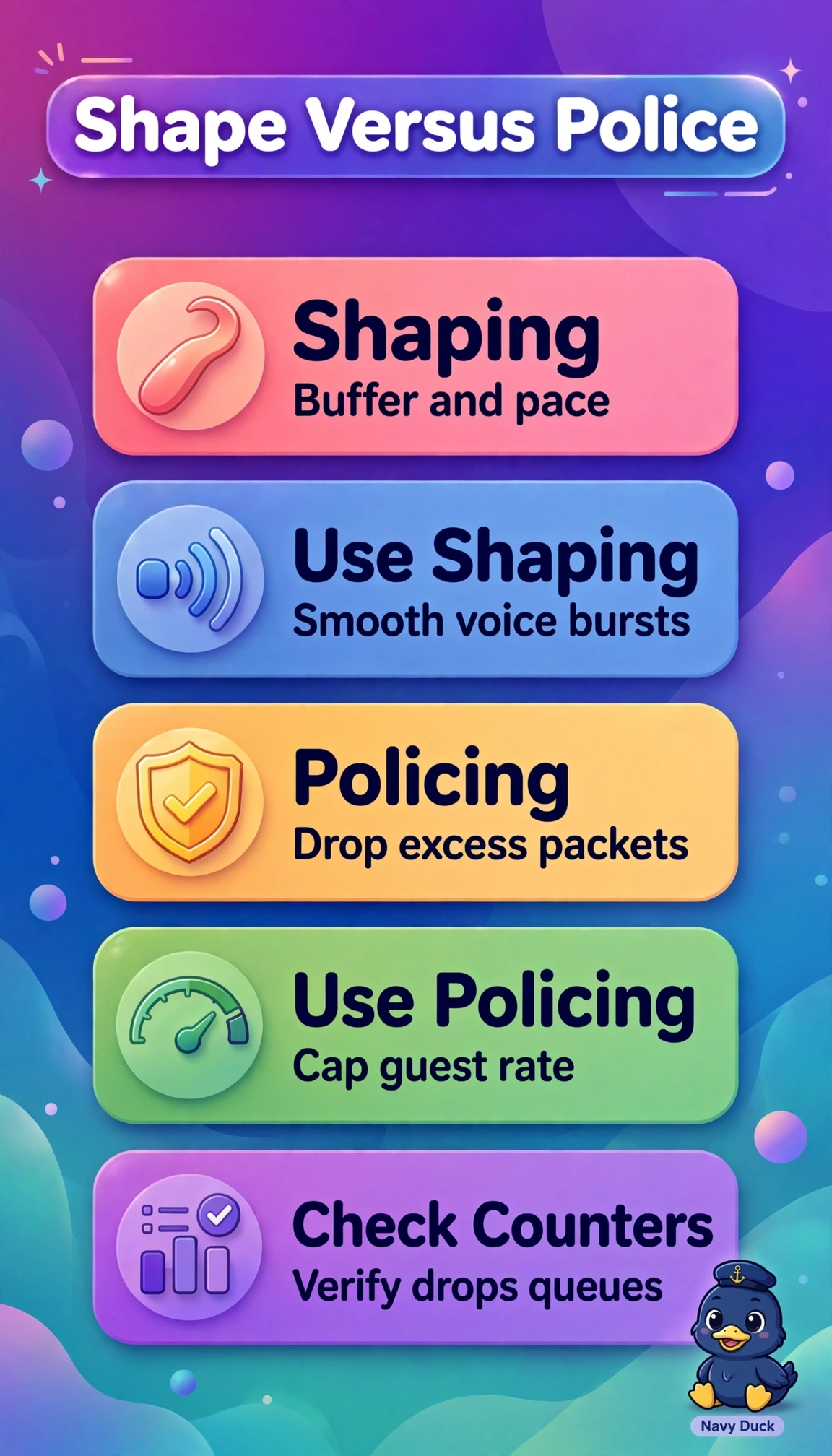
Short Explanation
You're choosing between a faucet and a spillway for traffic. Shaping buffers bursts while policing simply discards what exceeds the limit.
Full Explanation
Quality of service on WAN Edge routers separates buffering from dropping: shaping delays excess packets in queues to smooth output to a configured rate, ideal for priority voice and TCP-friendly flows with available memory, while policing meters ingress or egress against committed rates and drops or remarks excess without queuing, ideal for capping guest or bulk traffic at a hard limit. Applying shaping to voice and policing to guest therefore meets pacing plus cap requirements. Reversing them fails because policing cannot buffer voice bursts and shaping is inefficient for hard enforcement. Marking and classification only set or match DSCP values and do not rate-limit. Queuing and scheduling order packets but without a shaper or policer they do not enforce the 10 Mbps cap. For the exam, associate shaping with output buffering and policing with drop or exceed remark; verify with qos counters and interface statistics in SD-WAN Manager.