
An energy utility has dual-transport routers where internet and MPLS links flap and tunnels form unpredictably. The engineer must explain why a private 10.1.1.1 MPLS link and a public 203.0.113.5 internet link build separate tunnels. Which TLOC description should the engineer use to explain deterministic tunnel formation?
Select an answer to reveal the explanation.
Short Explanation
You're giving every WAN door its own full address. Color and encapsulation tell the overlay exactly which transports can shake hands.
Full Explanation
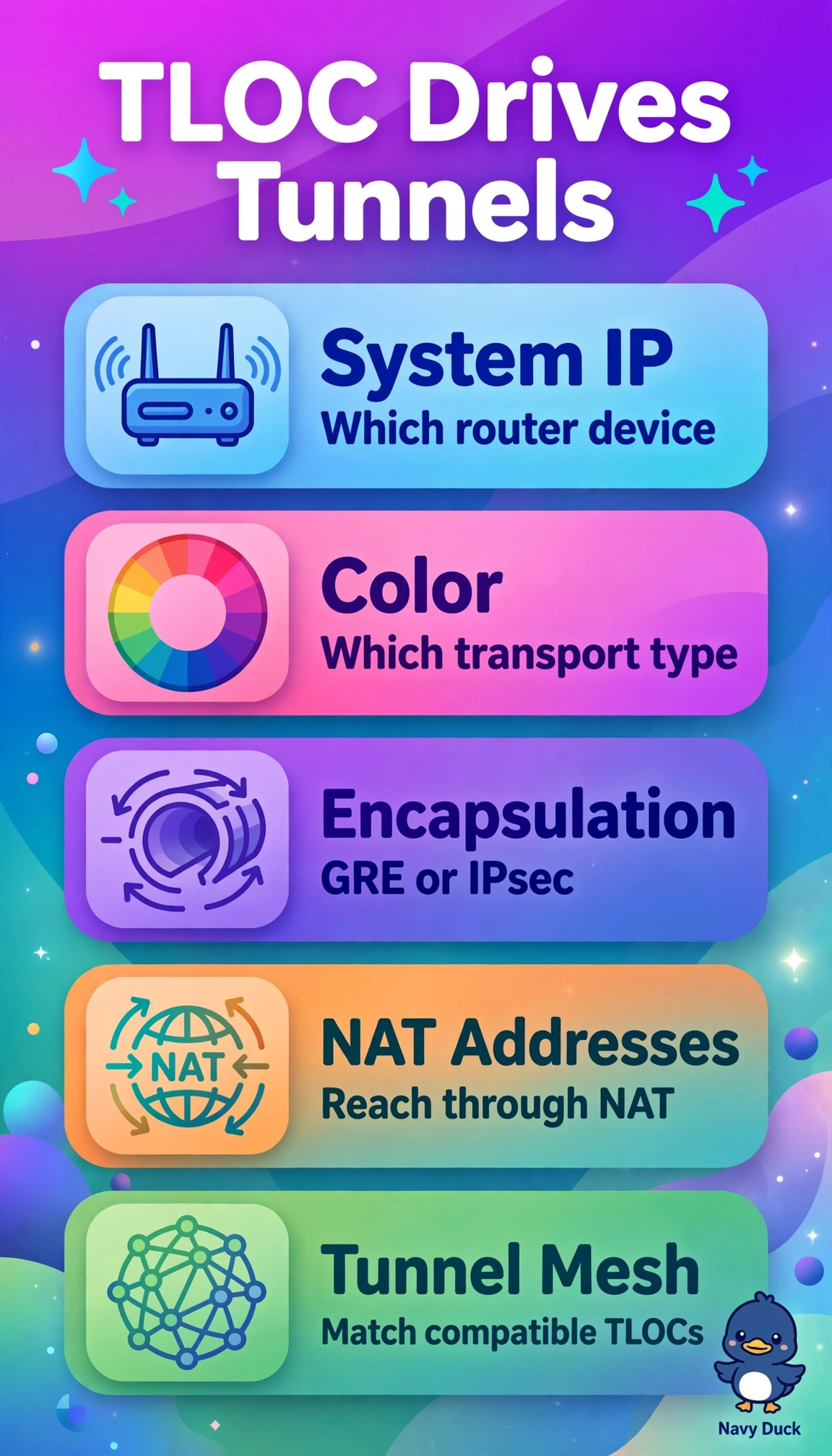
A transport locator, or TLOC, is the overlay attachment point advertised by the SD-WAN Controller (formerly vSmart) via OMP TLOC routes, uniquely keyed by system-IP identifying the device, color identifying the transport type such as mpls or biz-internet, and encapsulation such as GRE or IPsec, plus public and private addresses for NAT traversal. IPsec tunnels form between compatible TLOCs based on color preference, restriction and encapsulation, which explains why MPLS and internet TLOCs create distinct meshes. Site-ID, VPN-ID and OMP preference identify location and route preference for prefixes, not the transport endpoint, so they cannot drive tunnel creation. Organization-name, certificate serial and uptime validate fabric membership and health, not transport identity. Hostname, loopback mask and NAT flag are management or reachability details, not the TLOC tuple used for tunnel binding. For the exam, recall TLOC equals system-IP plus color plus encapsulation; check advertised TLOCs in SD-WAN Manager under OMP TLOCs and use color restrict to control tunnel formation.