
An enterprise call center reports voice clipping on a 50 Mbps MPLS uplink from a WAN Edge while bulk file transfers saturate the same interface during business hours. The design requires voice in a priority queue and remaining traffic fairly shared. Which QoS configuration should the engineer apply on the WAN Edge to enforce egress treatment?
Select an answer to reveal the explanation.
Short Explanation
You hear the real issue — voice needs its own lane. Classification plus queuing works like an express checkout for calls, so lean on queuing.
Full Explanation
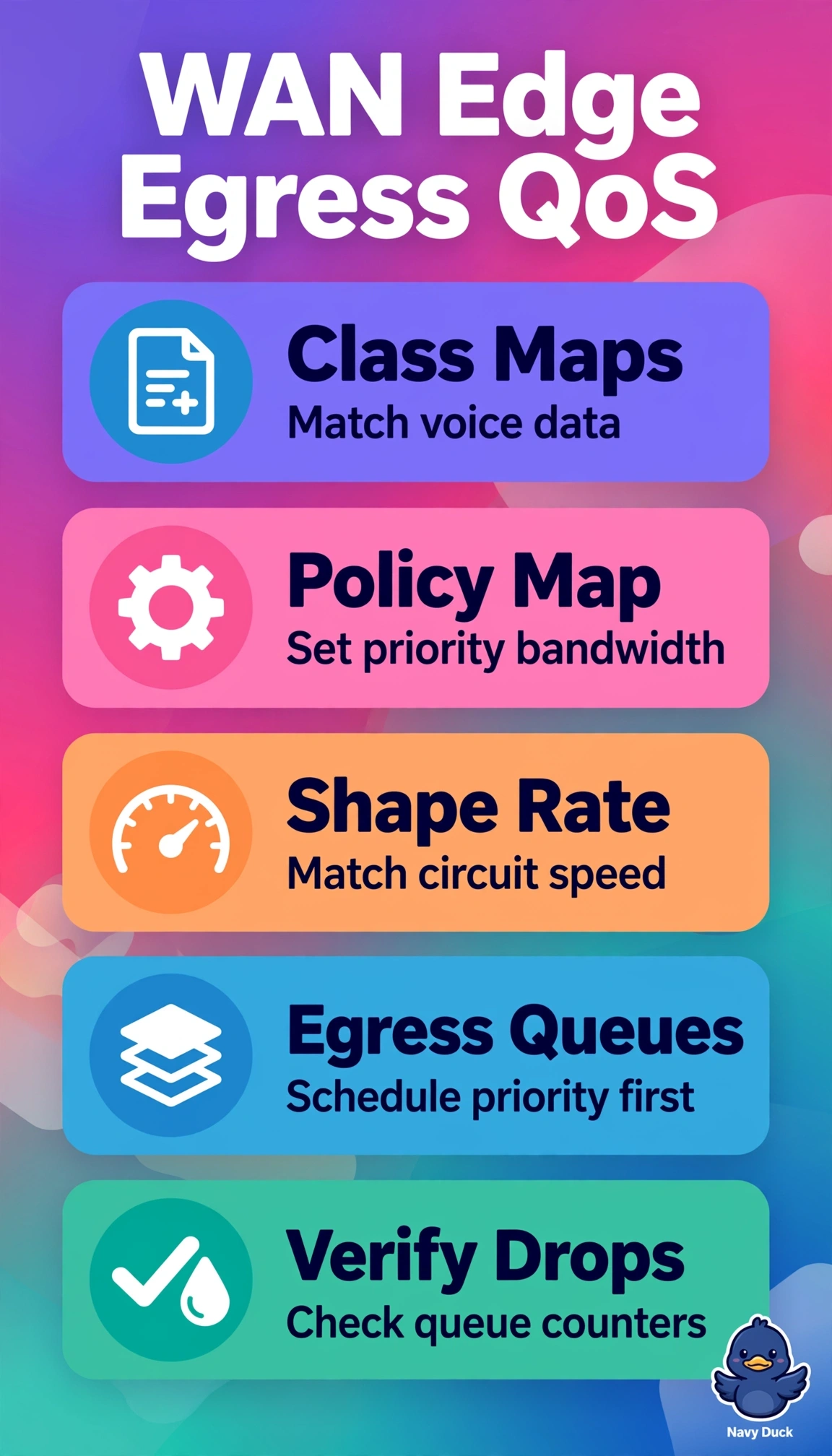
WAN Edge egress QoS uses class maps to match voice, video and data, a policy map to assign low-latency queuing, bandwidth shares and shaping, applied outbound on the transport interface where the scheduler maps classes to hardware egress queues. This protects voice during congestion by dequeuing priority traffic first while shaping the aggregate to the 50 Mbps circuit to prevent ISP tail drop. Access lists with route maps and app-route policy control path selection, not egress scheduling and queue assignment. NAT with security policy and OMP policy handle address translation, filtering and route advertisement, not per-packet queuing. DPI lists with control policy and hub templates influence classification sources or topology, not the outbound scheduler configuration. Exam caveat: distinguish QoS policy maps for forwarding treatment from centralized policies for routing and security intent. Practical check: verify policy-map counters, queue drops and shaped rate on the uplink interface.